J. Michael Bishop, a microbiologist who shared a Nobel Prize in 1989 for research that illuminated the genetic roots of cancer, and who later served as chancellor of the University of California at San Francisco, died March 20 at a hospital in San Francisco. He was 90.
The cause was pneumonia, said his son Eliot Bishop.
Dr. Bishop, the son of a Lutheran pastor, began his education in a two-room schoolhouse in rural Pennsylvania. He became interested in science during high school, when a family doctor took him along on house calls and taught him to read cardiograms and run lab tests.
Dr. Bishop recalled the doctor as a man of “remarkable intellectual vigor and rigor” who sparked his interest “not so much in the life of a physician but in the fundamentals of human biology.”
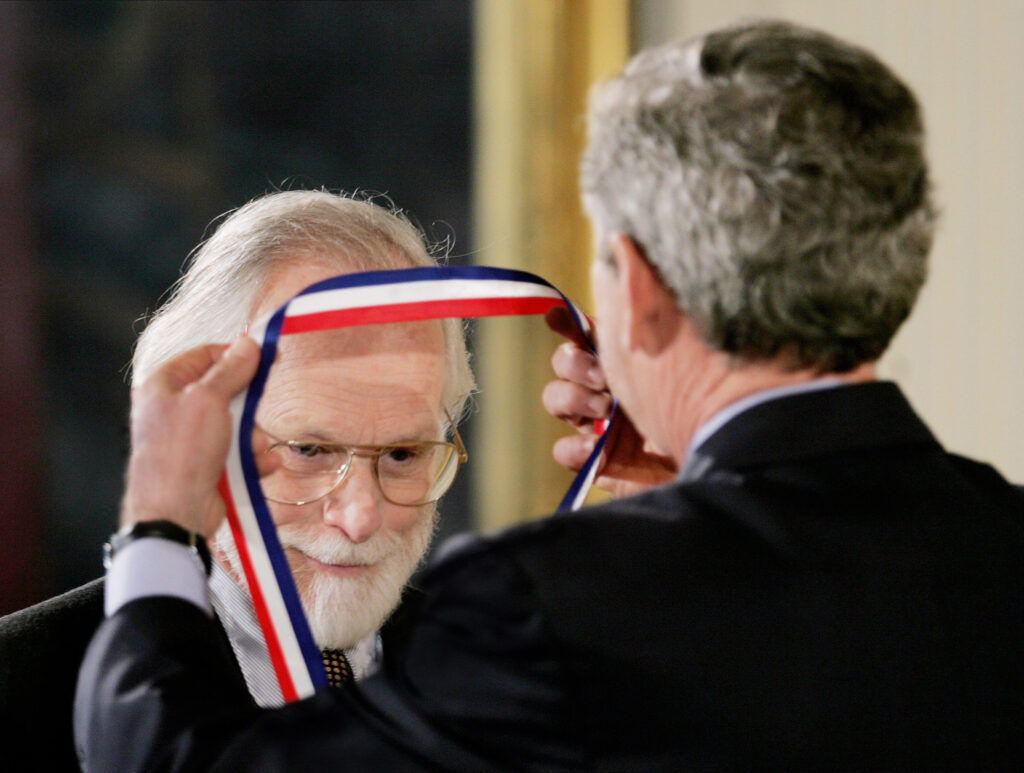
Dr. Bishop brought new insight to those fundamentals during his research career at the University of California at San Francisco. With a longtime colleague, Harold E. Varmus, Dr. Bishop formed one of the most productive partnerships in American science. Together they received the 1989 Nobel Prize in physiology or medicine and shared with other scientists the 1982 Albert Lasker Basic Medical Research Award. They each received the National Medal of Science.
As Dr. Bishop recounted in his playfully titled 2003 memoir, “How to Win the Nobel Prize: An Unexpected Life in Science,” the two men bonded over “a shared infatuation” with science, as well as with words and language. “We are both voracious readers and enjoy writing,” he wrote. “In contrast, we are very different as scientists: Harold revels in detail; I am impatient with it.”
In their breakthrough work, published in 1976, Dr. Bishop and Varmus showed that oncogenes — genes that cause cancer — are not foreign genes introduced into the body by viruses, as was widely believed at the time. Instead, normal versions of oncogenes are present in healthy cells, where they help regulate normal growth and development.
Dr. Bishop and Varmus made their discovery by studying the Rous sarcoma virus, a retrovirus linked to tumors in chickens. Dozens of such proto-oncogenes were soon identified in humans.
The discovery helped refocus cancer research. Attention turned to identifying triggers, such as radiation, that can turn normal genes into oncogenes and to blocking such transformations or blunting their effects.
In the decades since, drugs have been developed to block abnormal growth factors produced by oncogenes. These drugs include Herceptin, used to treat HER2-positive breast cancer, and Gleevec, used to treat certain kinds of leukemia and gastrointestinal tumors.
Robert A. Weinberg, a cancer researcher at the Massachusetts Institute of Technology, described the impact of the Bishop-Varmus discovery in his 1996 book, “Racing to the Beginning of the Road: The Search for the Origin of Cancer.”
“We were wandering around in a fog,” he wrote. “Then, almost without warning, a strong wind swept in, and for the first time a solution appeared in front of us, starkly and clearly. Suddenly the world seemed illumined in strong, brilliant light.”
(When the Nobel Prize was announced, Dominique Stéhelin, a French researcher who had been a postdoctoral fellow in the Bishop-Varmus lab, insisted that he deserved to share the honor. UCSF spokesmen said that Stéhelin had performed difficult experiments but that the ideas and direction of the work came from Dr. Bishop and Varmus.)
Varmus left San Francisco in 1993 to become director of the National Institutes of Health and later served as director of the National Cancer Institute. Dr. Bishop spent the rest of his career at UCSF.
In addition to continuing his research, Dr. Bishop served from 1998 to 2009 as chancellor of UCSF, a unit of the University of California devoted entirely to biomedical sciences. In that role, he presided over a major expansion — the creation and staffing of UCSF’s second campus, Mission Bay — and proved to be a formidable fundraiser.
Dr. Bishop set aside 1 percent of the Mission Bay construction budget to commission site-specific works of public art, the most imposing being two immense metal slabs by the sculptor Richard Serra.
Speaking of public art, he said, “I had very strong feelings about its power to enhance the living environment of people.” The collection has since grown to more than 150 pieces, including prints, photos and new media works, and has been named in Dr. Bishop’s honor.
Dr. Bishop also was active in advocating greater research funding. In 1989, the year he received the Nobel Prize, he helped found the Coalition for Life Sciences, a group of scientists that hired lobbyists to urge Congress to increase funding for the NIH and the National Science Foundation. The group also organized the Congressional Biomedical Research Caucus and provided briefings on scientific developments several times a year.
Passion for music and science
John Michael Bishop, known as Mike, was born in York, Pennsylvania, on Feb. 22, 1936. He was the oldest of three siblings and grew up mostly in nearby Goldsboro, then a town of 400. His mother managed the home, while his father served two small congregations in the area.
In his Nobel biographical sketch, Dr. Bishop cited two lasting legacies of his childhood. One was a passion for music, encouraged by his parents with piano, organ and voice lessons. If he could be reincarnated, he wrote, he would choose to come back as “a performing musician with exceptional talent, preferably, in a string quartet.”
The other legacy from childhood was his love of history, fostered in him from grades five through eight by “a stern but engaging teacher who awakened my intellect with instruction that would seem rigorous today in many colleges.”
Throughout his career, Dr. Bishop was an enthusiastic teacher himself, and a proponent of using the history of science to teach scientific concepts. More than half his memoir, for instance, is devoted to the history of infectious disease, starting in the 14th century, and to the history of cancer research leading up to his own work.
Dr. Bishop majored in chemistry at Gettysburg College, a small liberal arts college that was his father’s alma mater. He graduated in 1957.
In college he met Kathryn Putman, a fellow student whose father also was a Lutheran pastor. They married in 1959 while Dr. Bishop was attending Harvard Medical School. Kathryn Bishop worked as a schoolteacher before the birth of the first of their two sons, Dylan and Eliot. She died in 2016.
In addition to his sons, survivors include a sister and five grandchildren.
As he liked to tell disbelieving listeners, Dr. Bishop had not heard of Harvard until his college adviser suggested that he apply to medical school there. He received his medical degree in 1962, spent two years as a resident physician at Massachusetts General Hospital, then entered a postdoctoral research training program at the NIH.
He was one of 10 Nobel Prize recipients, including Varmus, who got their start in the program. They were sometimes referred to as the Yellow Berets, a nod to the Army’s elite Green Berets, because the program provided an alternative to being drafted during the Vietnam War.
In 1968, Dr. Bishop followed his research mentor, Leon Levintow, to UCSF, turning down an offer, he said, from a more prestigious university on the East Coast. “I would have been a mere embellishment on the East Coast,” he wrote in his Nobel biography. “I was genuinely needed in San Francisco.”
At the NIH, he had focused on animal viruses — a field that was not well developed, he said, and had space for him to make a contribution. When he arrived as an assistant professor in UCSF’s Department of Microbiology and Immunity, he found that a colleague had set up a program to study the Rous sarcoma virus, the chicken cancer retrovirus. In 1970, Varmus joined Dr. Bishop’s lab as a postdoctoral fellow.
Dr. Bishop became a full professor in 1972. He and Varmus shared a lab until 1981, when Dr. Bishop became director of UCSF’s G.W. Hooper Research Foundation.
Despite his achievements, Dr. Bishop harbored abiding regret for a misstep early in his career. In 1969, he recounted in his book, he narrowly missed making a momentous discovery: the enzyme that allows retroviruses to insert their RNA into the DNA of host cells, infecting the host and replicating quickly, often with lethal results.
He did several experiments on the topic, he wrote, but gave up, in part, because more experienced colleagues doubted the highly unorthodox theory that he was pursuing. Scientists who continued this line of research, and laid the foundation for the eventual identification of HIV, received the Nobel Prize a few years later.
When an interviewer suggested that winning a Nobel Prize of his own must have provided some consolation, Dr. Bishop replied, “Two’s better than one.”
From this painful experience, he said, he learned to take risks: “The scientist must trust her or his own imagination, even if, perhaps especially if, it runs counter to received wisdom … There is no substitute for intellectual daring.”
The post J. Michael Bishop, who illuminated genetic roots of cancer, dies at 90 appeared first on Washington Post.