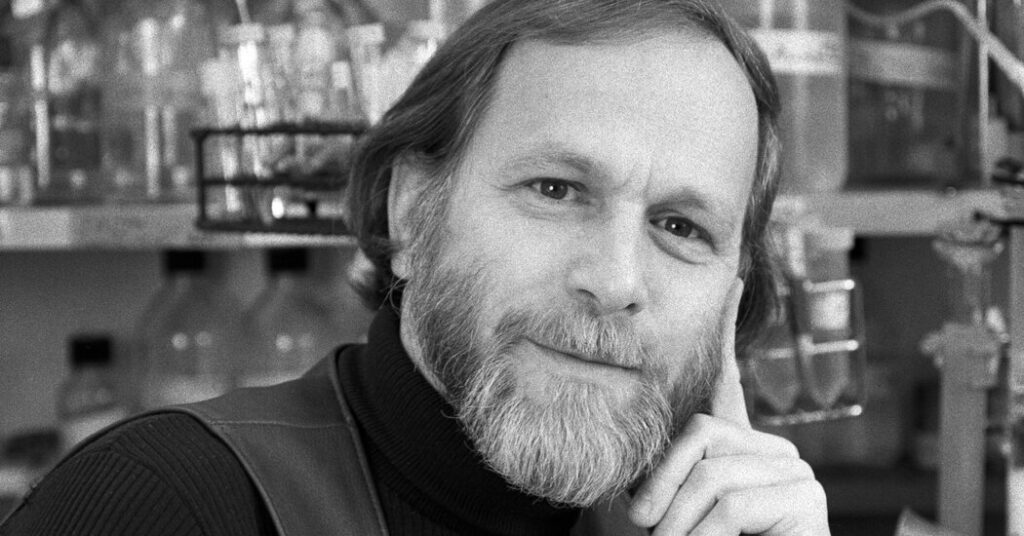
Dr. J. Michael Bishop, who shared a Nobel Prize for the discovery of cancer-causing genes and would go on to become the eighth chancellor of the University of California, San Francisco, where he led a major expansion of the institution, died on Friday in San Francisco. He was 90.
The cause was pneumonia, his family said in a statement.
Dr. Bishop held the titles of professor emeritus and chancellor emeritus at U.C. San Francisco, where he joined the faculty in 1968. He was one of only two Nobel laureates in the history of the 10-campus University of California system to serve as chancellor.
That he would become a world-class scientist and win a Nobel Prize probably wouldn’t have surprised classmates from the two-room schoolhouse in rural Pennsylvania where he received his first eight years of education. He was a top student and, at the end of his college career, was accepted by two Ivy League medical schools.
“I always appreciated Mike’s brilliance and intellect and breadth of knowledge, not only in science but also in literature and art,” Dr. Joseph Goldstein, a friend of Dr. Bishop’s for more than 50 years and a co-recipient of the 1985 Nobel Prize in Physiology or Medicine, said in an interview. “He often laced his talks with quotes from literature and bits of humor.”
Dr. Bishop shared the 1989 Nobel Prize in Physiology or Medicine with Dr. Harold E. Varmus, the Lewis Thomas university professor of medicine at Weill Cornell Medicine in Manhattan.
Together, they identified a large family of genes that control the normal growth and division of cells but, when mutated, transform into cancer-causing genes, or oncogenes. The research, which was done in the 1970s, fundamentally changed the understanding of how tumors emerge. Scientists now know that oncogenes are critical contributors to the development of cancer.
“Mike began his career as a virologist and would become one of the most prominent molecular virologists,” Dr. Goldstein, the chairman of molecular genetics at the University of Texas Southwestern Medical Center in Dallas, said. “With Dr. Varmus, the two of them produced trailblazing research on the origins of cancer at the molecular level.”
The centerpiece of their Nobel Prize-winning research involved the discovery of the first proto-oncogene. The gene was isolated from healthy chickens. A proto-oncogene has the potential to become an oncogene. In experiments involving the Rous sarcoma virus, long associated with a lethal cancer in poultry, the two scientists discovered that the virus was picking up the proto-oncogenes and transforming them into oncogenes.
“Many proto-oncogenes are medically important: They help turn normal cells into cancers, including human cancers, when they undergo mutations,” Dr. Varmus wrote in his 2009 memoir, “The Art and Politics of Science.”
The research partnership between the two scientists began in 1970, when Dr. Bishop hired Dr. Varmus as a postdoctoral fellow in his San Francisco laboratory. Dr. Varmus quickly moved up, joined the faculty and began running his own lab, collaborating with Dr. Bishop’s.
The alliance lasted nearly a quarter-century, until 1993, when Dr. Varmus left the university to lead the National Institutes of Health during President Bill Clinton’s administration.
“We clicked; it was just that simple,” Dr. Bishop said about Dr. Varmus in an article on the Lasker Foundation’s website. In addition to the Nobel Prize, Dr. Bishop and Dr. Varmus shared a 1982 Albert Lasker Basic Medical Research Award. The Laskers are often called the American Nobels.
“We had a long partnership in a system that tends to value independence,” Dr. Varmus said in an interview. “We made discoveries and took a chance. The reason he and I worked well together is because we appreciated each other’s ideas.”
Yet their careers followed different trajectories: “Mike stayed loyal to the institution and became chancellor,” said Dr. Varmus, who moved on to serve as president of Memorial Sloan Kettering Cancer Center in Manhattan, from 2000 to 2010, and then to lead the National Cancer Institute during President Barack Obama’s administration.
Dr. Bishop was appointed chancellor of the University of California, San Francisco, by the system’s Board of Regents in 1998 and remained in that post until 2009. The San Francisco campus is a health science institution devoted solely to graduate and professional education. Dr. Bishop presided over many of the university’s most ambitious projects, including its expansion into the Mission Bay area, where new state-of-the-art research facilities and hospitals were built.
John Michael Bishop was born on Feb. 22, 1936, in York, Pa., the eldest of three children of John and Carrie (Gray) Bishop. His father was a Lutheran minister who served two rural parishes; his mother managed the home.
In his Nobel biography, Dr. Bishop recalled the sounds and scenes of his early years — liturgical music and the bucolic farmlands near the Susquehanna River.
“Those years were pastoral in two regards,” he wrote. “I saw little of metropolitan life until I was past the age of 21, and my youth was permeated with the concerns of my father’s occupation as a Lutheran minister.”
His elementary school was overseen by a teacher he described as “stern but engaging.” History was a large part of the curriculum, which fostered a lifelong interest in the subject, especially the Civil War. “But I heard little of science,” Dr. Bishop wrote, “and what I did hear was exemplified by the collection and pressing of wildflowers.”
In 1954, he enrolled at Gettysburg College, where he majored in chemistry, but was tempted by other areas of study.
“Every new subject that I encountered in college proved a siren song,” he wrote in “How to Win the Nobel Prize” (2003), a memoir and essay collection. “I imagined myself a historian, a philosopher, a novelist, occasionally a physician, but never a scientist.” He graduated in 1958 with a bachelor’s degree in chemistry.
Despite being accepted by two prestigious medical schools, he felt that he wanted to make contributions to medicine beyond direct patient care. “An associate dean at the University of Pennsylvania recommended that I decline my admission to medical school there and, instead, accept an offer from Harvard Medical School,” Dr. Bishop wrote in his Nobel biography.
He told The New York Times in an article in 1989 that while enrolled at Harvard he “discovered biomedical science and just fell in love with it.”
After receiving his medical degree, Dr. Bishop pursued a fellowship at the National Institutes of Health, where he focused on virology and wrote scientific papers about poliovirus replication.
He is survived by two sons, Dylan and Eliot, a sister and five grandchildren. His wife Kathryn (Putnam) Bishop, whom he met at Gettysburg College in the late 1950s, died in 2016.
In 1986, Dr. Bishop received the prestigious Dickson Prize in Medicine, awarded by the University of Pittsburgh School of Medicine and Carnegie Mellon University. In 2003, he was awarded the National Medal of Science and, in 2020, a Clark Kerr Award for Distinguished Leadership in Higher Education. Recipients are chosen by the Academic Senate of the University of California, Berkeley.
Dr. Varmus said his friend and collaborator was an exemplary scientist. “I had the good fortune to form a partnership with a like-minded scientist, J. Michael Bishop,” Dr. Varmus wrote in his memoir, “and to take part in work that uncovered a central element in one of medicine’s greatest challenges: the origins of cancer.”
The post J. Michael Bishop, Nobel Prize Winner for Cancer Research, Dies at 90 appeared first on New York Times.