HIGHTOWN, Virginia — The woodpecker was the first sign of something strange underway.
Ronnie Moyers heard the bird hammering in the woods one morning in late February, several weeks before the species usually shows up in Virginia’s western highlands.
“That means there’s gonna be a thaw,” Moyers’s father told him.
Warm weather would mean bad news for maple syrup production, one of the main sources of income for Moyers’s family farm. Maple trees need freezing nights and brisk days to produce their sweet, flavorful sap. If temperatures rise too much, too soon — something that scientists say will happen more frequently in a warming climate — their sap slows and turns bitter, and the time for syrup-making is cut short.
A few days after the woodpecker’s arrival, a friend of Moyers’s at the local weather service office called to warn that forecasters were predicting a stretch of 60- and 70-degree days in the coming week.
“I guess that’s the end of my season,” Moyers said. He had produced only half his usual quantity of syrup for the year.
Maple syrup has long been the lifeblood of Highland County, a picturesque community of 2,300 people tucked into the Allegheny Mountains. Though hardly a goliath like Vermont and Quebec, Highland boasts that it’s the southernmost commercial maple syrup-producing region in the United States. Its yearly maple festival, held the second and third weekend in March, brings in the bulk of the county’s annual revenue.
Yet climate change increasingly imperils Highland’s centuries-old tradition. Hotter and drier summers are stressing maple trees and damaging their health. Less predictable winter weather patterns are disrupting the conditions needed for sap collection. This year, a brutal January ice storm and unseasonable recent warmth have combined to create one of the worst syrup seasons in recent memory.
Producers across the county fear their problems will deepen as the planet warms. A 2019 study projected that worst-case climate scenarios will shift the zone where maple syrup can be produced as much as 250 miles north — causing taps in southern production areas like Highland County to run dry.
The consequences could be existential for the community. Farmers like Moyers may lose a vital income stream that gets them through the lean days of late winter. Attendance at the maple festival might falter, depleting the county’s coffers.
But residents are determined not to lose this crucial connection to their history — a custom that has always brought sweetness to an isolated place.
“Maple syrup completely shapes our county,” said Highland Chamber of Commerce director Chris Swecker. “If we didn’t have it, I don’t know what our identity would be.”
Like most families in Highland County, the Moyerses have made syrup for generations. It was a form of self-sufficiency, Moyers said, providing people hemmed in by mountains with a sugar source that they didn’t have to purchased from a distant store.
Syrup brought the community together. Neighbors gathered at sugarbushes — the clusters of maple trees where sap is collected — to help one another install taps. Every kid in the county signed up for a volunteer shift during the maple festival, frying maple doughnuts for the Ruritan Club or waiting tables at the high school’s pancake breakfast.
“It’s exciting doing something my elders done 100 years ago,” Moyers said on a recent March morning. He had been at work in his sugar shack since 5 a.m., and now the air was thick with sweet-scented steam.
Every six and a half minutes, an alarm buzzed, prompting Moyers to load more firewood into the old-fashioned evaporator he uses to cook his sap.
“Wood!” he yelled as he tossed a couple of logs on the flames.
The sap that came out of his maple trees contained less than 2 percent sugar — barely enough to taste sweet. But hours of careful cooking caused the clear liquid to boil down into something dark, rich and thick. When the sugar concentration hit roughly 67 percent, the maple syrup would be ready to bottle.
“It’s gold,” he said. “When I make my buckwheat cake in the spring, that maple syrup makes that buckwheat cake taste…”
Moyers trailed off, unable to find the words for the euphoric flavor. “You think, huh, how did that come from a tree?”
It wasn’t until 12 years ago, when Moyers and his daughter decided to start producing syrup commercially, that he began to understand the science behind that mystery.
The true start of syrup production occurs the summer before harvest, Moyers said, when maples spend the long, sultry days turning sunshine into sugar. Come autumn, as the trees get ready to drop their leaves, all that sugar is pulled back into their roots and stored as starch.
Months later, when winter begins to loosen its grip on the forest, the sugar is finally released into the trees’ xylem — the vessels that carry water and nutrients through the tree.
Subzero nights cause the pressure to drop inside the trees, creating suction that pulls up water from their roots. And daytime temperatures of 40 or 50 degrees make the pressure increase again, pushing the sap downward. If the tree has been tapped, that internal pressure is powerful enough to force sap out through the hole.
“This maple syrup thing is 100 percent weather related,” Moyers said. “I can’t do nothing to make it happen if the weather is not right.”
This year, the weather didn’t cooperate at all. And Moyers wasn’t the only Highland producer affected.
The problems began last summer, when abnormally hot and dry conditions weakened some of the region’s sugarbushes. At Eagle’s Sugar Camp, in a lower-elevation part of the county, owner Jay Eagle watched helplessly as some of his youngest maples died before they had ever been tapped.
Then came a late January blizzard that snapped branches from trees and covered the landscape in a thick, persistent layer of ice. The storm buried the six-mile-long plastic tubing system that carries sap from Eagle’s tapped trees to the sugar shack where he makes syrup. And a prolonged deep freeze delayed the beginning of sap flow until the end of February.
But all too soon, the early March warm spell disrupted the freeze-thaw cycle needed for sap to flow. All across the county, the sweet liquid coming out of maple trees slowed to barely a trickle.
“You hear on the news about global warming,” said Doug Puffenbarger, whose family has been selling maple syrup for more than 100 years. “I don’t know. It’s definitely different.”
He pointed to a row of mostly empty shelves in the corner of the sugar shack. This time of year, they should have been piled high with bottles of syrup. But what he had produced so far was barely enough to get him through the first weekend of the festival.
“Just increase your prices, Doug,” advised Sarah Collins-Simmons, a syrup research specialist at West Virginia’s Future Generations University who works closely with Highland producers. “When your season is half of what it normally is, you do what you have to do.”
Puffenbarger grimaced. He didn’t want to raise prices on his patrons, many of whom came back to his farm year after year.
“I’d rather make a little and get along than try to act like a hog,” he said.
But there was no denying that this level of production was not sustainable in the long term.
“The future is weather-dependent,” Puffenbarger said. “The way this warming trend is, there won’t be no syrup made in Highland County.”
Even in the best-case emissions scenarios, Virginia’s average temperatures in the year 2100 could be as much as 8 degrees Fahrenheit (4.4 degrees Celsius) above early 20th-century levels, according to the state’s 2025 climate assessment. Summer heat waves in the mountains are projected to become longer and more frequent. Winters will be milder, with fewer days below freezing.
These changes could imperil sugar maples, which are less adapted to warmer climates than other hardwoods, Collins-Simmons said.
Warmer weather during the syrup season also fuels microbial activity, which can cause sap to sour like milk. Meanwhile, the bacteria growth in the tap hole will cause trees to seal off the wound — much the way a scab forms around a cut.
In a 2023 survey of U.S. syrup producers, 89 percent of respondents said they had experienced negative effects of climate change — even at the industry’s epicenter in New England. This year, maple syrup makers in Vermontand New Yorkhave reported an earlier start and more abrupt end to their seasons.
Producers can try to adapt to these changes by tapping trees earlier — but that leaves them exposed to the possibility of a deep freeze that disrupts sap flow for several weeks. Once a tree has been tapped, Collins-Simmons said, the hole will remain open for only six to eight weeks. And after a tap hole is sealed, the tree should not be opened again until the following year.
“You have to make that really hard judgment call of, when do you open your trees?” she said. “And it’s riskier now.”
As Highland County’s farmers brace for a warmer future, they are also grappling with another fear: Will there be anyone left to make maple syrup when that time comes?
Highland has long been the least populous county in Virginia — it had just 2,232 residents as of the 2020 Census — and its numbers are shrinking. For the first time in decades, there were not enough teenage girls to compete for the title of Highland County Maple Queen at this year’s festival.
Many of the county’s maple syrup producers are well into their 60s and 70s, and it’s not clear who will take over their operations when they retire. Puffenbarger and Eagle both want to pass on their businesses to their children — but they question whether younger generations will be willing to trade good paying jobs outside the county for the strenuous task of running a farm.
The challenges of climate change and population loss are connected, said Swecker, the chamber of commerce director. With no major landmarks to draw visitors and no interstate highways carrying travelers through, the maple festival is Highland’s best chance to appeal to newcomers. Every so often, he said, one of the 20,000 people in attendance is so charmed by the area that they decide to stay.
Swecker sees it as his duty to ensure that visitors have as good a time as possible at the festival. Which is why this year’s meager syrup production makes him worried.
“If I’m being a bit honest … that’s in the back of my mind,” he said. “What if we run out?”
But Highland County residents have a long legacy of making do in tough situations, Collins-Simmons said.
“Even without a PhD in tree physiology, we are figuring things like this out.”
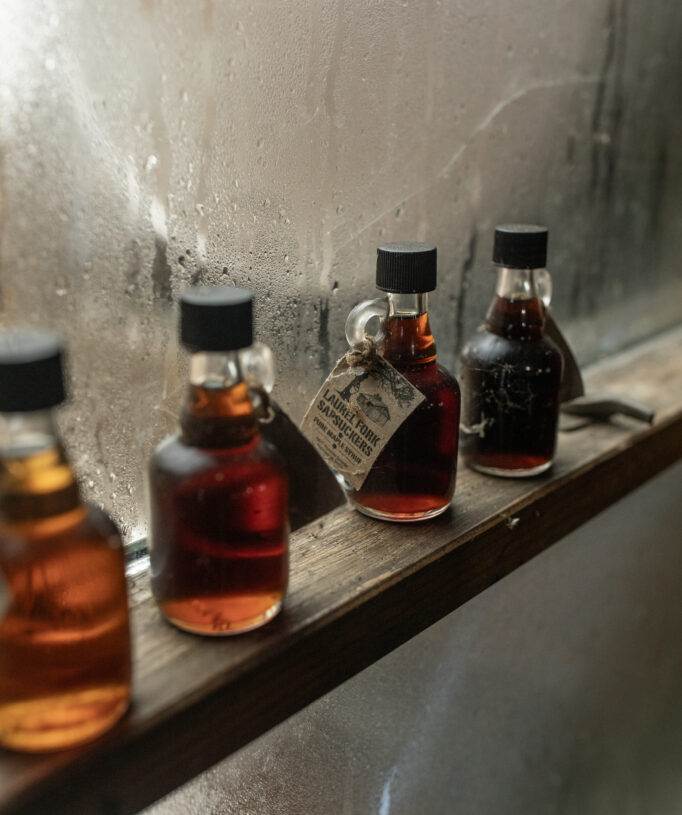
Other farmers are looking to more exotic syrup sources to supplement their incomes. In neighboring West Virginia, producer Gary Mongold is in his fifth year of making black walnut syrup — a rich, caramelly concoction reminiscent of molasses — in partnership with Collins-Simmons and her colleagues at Future Generations.
Black walnut sap has a lower sugar concentration than maple, which makes it more difficult to reduce to the same syrupy consistency. But restaurants and boutique grocers are willing to pay several dollars an ounce for Mongold’s product — making syrup a better business proposition than simply selling his trees for timber.
“Once a tree is cut, it’s gone. But I got money coming in every year,” Mongold said. “I ain’t going to get rich like selling drugs. … But I like it.”
Collins-Simmons is working with Mongold to come up with best practices for black walnut syrup production, identifying the best time to tap and the right equipment to yield maximum sap without harming the trees. She hopes that expanding the industry could help syrup makers offset lower maple yields, since black walnuts can tolerate warmer climates than sugar maple trees.
The chance to make black walnut syrup might also encourage producers to maintain stands that have a mix of trees so they are less vulnerable to disease.
“I think we have more time to adapt than the most aggressive doomsayers,” Collins-Simmons said. “But we have to care for the future health of our trees.”
She pointed to Moyers as an example of a producer who “taps gently” — drilling one hole in a tree even though he could get more sap out of two, setting aside portions of his forest to provide habitat for native species.
Moyers knew that this year’s reduced output would force his family to put a hold on some projects, like finishing an event space that they hoped could bring in additional income for the farm. But his priority was ensuring that his maples could keep producing syrup in the long term.
“Whatever Mother Nature is willing to do to make this happen, I have to work with,” he said.
Then the alarm on his phone buzzed, and Moyers tossed two more logs into his evaporator.
“Wood!”
The post In a haven for maple syrup, a hidden threat endangers a way of life appeared first on Washington Post.