Don Lemon was working through some new material.
“So, uh, a little bit different tonight,” he told a live Manhattan audience of some 300 Lemon Heads (his term, and theirs) in early February, with a bowl of on-the-nose citrus beside him onstage. “I’m just going to sit and talk to you guys. Is that OK?”
A born-again YouTuber who retains his anchorman’s baritone, Lemon had come to City Winery, a lounge-style venue on the Hudson River, as part of a speaking tour with the comedian D.L. Hughley, a friend of his. Typically, the 60-year-old lapsed cable host would begin such evenings by serving up the latest news headlines with a Lemonian spritz: heavy opinion, light yuks, have-you-no-decency monologues about “this administration — well, I should say regime” from a man no longer bound by the standards and practices of what he likes to call “corporate media.”
“But,” he reminded the room, there had been a development: “I am the news.”
Six days earlier, while out West to cover the Grammys, Lemon had been arrested in his Beverly Hills hotel on charges that he had violated the religious freedom of worshipers in St. Paul, Minn., during an anti-ICE protest inside a church in January. Lemon had descended on the state — like many journalists, influencers and political thrill seekers — to film himself covering the violent federal immigration crackdown and the throbbing local opposition for his followers.
In so doing, he walked into a very modern indictment. The defendant, embedded with activists and plainly sympathetic to their cause, had livestreamed and narrated the evidence. Lemon hopes it will show prosecutors dangerously overreaching to menace a constitutionally protected journalist who repeatedly identified himself as such on camera.
Before making things official, President Trump and his acolytes had taunted Lemon for days, with the Justice Department’s lead civil rights official floating a statutory megatroll: charging one of the nation’s most recognizable Black journalists under the so-called Klan Act, a Reconstruction law originally aimed at racist vigilantism. (Another Black journalist at the church, Georgia Fort, was also charged.) “When life gives you lemons …,” the White House posted on X on Jan. 30, beside Lemon’s picture and a chain emoji.
Airing online at 10 a.m. and 5 p.m. each weekday, “The Don Lemon Show” had become a popular destination for the kinds of news consumers who kept their Obama-Biden bumper stickers and really believed in Robert Mueller. The show toggles between guerrilla-style man-on-the-street dispatches and deskbound dissections of Trump’s return to power. A live chat of subscriber comments whirls on the screen beside Lemon’s face through each episode, like a slot machine of resistance-y group texts. His video titles are algorithm-friendly: “LEMON DROP: Donald Trump Has Lost Control And He Knows It!” “HOT TAKES! Donald Trump Is A FAKE Christian!”
As some of the president’s less retributive campaign promises sputtered, Lemon presented a tantalizing offering. “A perfect Big Mac for Trump to eat,” the Rev. Al Sharpton, who has long been friendly with Lemon, told me: Black, gay, outspoken, CNN-bred (through his 2023 ouster).
“Central casting,” Lemon told me of his value to Trump. So why not accept the part?
Cradling the mic at City Winery, Lemon quoted Representative John Lewis on the nobility of “good trouble” and appeared to choke up while repurposing a civil rights spiritual that he said his grandmother taught him. “Ain’t gonna let noooooo jailhouse … turn me around … turn me around …”
Hughley joined the stage and compared himself and Lemon, “on a much lower scale,” to James Baldwin and William F. Buckley, pining for a future “progressive Trump” to take the White House and countergovern with equivalent force.
“So,” Lemon replied, “should I run?”
The Lemon Heads roared. It had struck him in Los Angeles, he continued, while he was detained “in that holding room,” that maybe he had “been playing at too small a level.” Soon enough, Hughley was comparing Lemon to Rosa Parks, too.
By then, as with so many high dramas on Trump’s watch, the Lemon affair was registering already as both wildly consequential and borderline absurdist, sideshow and showpiece, its madcap particulars congealing into a sobering whole whose stakes were only just becoming clear.
Legacy war horses like CBS News and The Washington Post were wheezing through some combination of institutional schizophrenia, financial distress and federal appeasement. The administration was swapping nonpliant Pentagon reporters for newly credentialed far-right bloggers and threatening disfavored late-night comedians. And Don Lemon, the CNN guy who once asked if a missing plane might have been sucked into a black hole, who got wasted on air in New Orleans on New Year’s Eve, who now broadcasts a dozen feet from his kitchen, wearing a “LEMON LIVE” T-shirt beneath a “LEMON LIVE” sweatshirt — that guy was the First Amendment referendum for our times.
“I have spent my entire career covering the news,” Lemon said upon his release, wearing a white suit he later joked about auctioning off. “I will not stop now.”
Much like Trump during his 2024 Republican primary, Lemon appeared likely to experience his legal trouble as a short-term boon. Subscriptions to his show on YouTube have climbed by some 200,000, to more than 1.26 million. His guest bookings are starrier. “When you heard about what happened to me, what did you think?” he asked Representative Alexandria Ocasio-Cortez, who called his arrest an attack on “free speech in America and the entire journalistic press corps.” Jane Fonda showed up at the federal courthouse to declare, “They arrested the wrong Don!” The singer-songwriter Brandi Carlile, wearing an “ICE Out” pin, walked the Grammys red carpet with him. Jimmy Kimmel invited him on his late-night show and razzed him warmly (“Like many recently freed prisoners, you went right to the Grammy Awards events”) in Lemon’s highest-visibility TV interview in nearly two years.
It could feel as if Lemon and Trump had a common goal: to make Don Lemon the face of American journalism — unmistakable proof that today’s press is either hopelessly timid and compromised (except Don Lemon) or stocked with bad-faith lefties cosplaying as proper newspeople (like Don Lemon).
“Best thing that’s happened to Don’s career, certainly post-CNN,” Jeff Zucker, Lemon’s friend and former CNN boss, told me.
“Best thing that could happen to him,” Trump grumbled to reporters aboard Air Force One.
The livestream began in a parking lot on a Sunday morning in the Twin Cities, where Lemon shared that he had learned of a planning meeting for what he called “Operation Pull-Up.”
It was Jan. 18, 11 days after the first resident had been killed by a federal agent (“Justice for Renee Good!” several people chanted outside their vehicles) and six days before the death of a second, Alex Pretti.
“I can’t tell you where they’re going,” Lemon said, before returning to his car. His driver was a college student, Jerome Richardson, who later said, in his own legal-defense GoFundMe, that he had offered to connect Lemon with “local contacts” and “support his work” exposing injustice. A cameraperson focused on Lemon from the back seat.
For months, right-wingers had dominated the political streamer wars, posting about (and sometimes from) the blue-city front lines of immigration clashes. The Minnesota escalation itself was spurred by the work of a 23-year-old influencer, Nick Shirley, whose videos purporting to expose fraud at day care centers run by Somali immigrants quickly gained notice inside the administration.
Lemon, after covering the conflict at a distance, had come to see things for himself. From his passenger seat, he held up a Starbucks cup, handed to him that morning by a barista who recognized him and scrawled: “Thank you for your work. Crush ICE.” The host’s “Lemon Nation” ski hat also might have given him away. As they neared Cities Church in St. Paul, Richardson suggested that he and Lemon trade hats.
By the time Lemon entered the church, without his cameraperson, the activists were inside. They had learned that a pastor there was also an ICE official. (It would later emerge that this pastor was not presiding that day.) Lemon’s followers initially saw only the church’s entrance from outside. The live chat crackled:
“Don off CNN is the best Don.”
“Is this what is called GOOD TROUBLE?”
“Don, please be careful.”
Protesters could be heard shouting down the church’s lead pastor, Jonathan Parnell, and chanting, “Hands up, don’t shoot!” Congregants scattered. Richardson ran inside, with a camera trailing him.
“I’m just here photographing, I’m not part of the group,” Lemon said, still offscreen. “I’m a journalist.” He stood to the side, mostly observing aloud. A young man in the corner, he noticed, was unsettled and crying.
But the protest, Lemon intimated, was a natural consequence of recent events. Minnesotans’ due process had been violated, he said. People were being brutalized. “You have to be willing to go into places and disrupt and make people uncomfortable,” Lemon said, as demonstrators (many also recording) and worshipers circled one another in the confusion. “That is what this country is about.”
Lemon reappeared in the shot to interview an organizer, Nekima Levy Armstrong. Then he found the lead pastor.
“I mean, this is unacceptable,” Parnell said. “It’s shameful.”
“But there are folks who will say,” Lemon told him, as they began speaking over each other, “‘Listen, there’s a Constitution and a First Amendment.’”
“We’re here to worship,” Parnell said. His hand was near Lemon’s midsection, grazing him.
“I’m going to be very respectful,” Lemon said. “Please don’t push me, though.”
Parnell asked Lemon to leave unless he wanted to worship. “I have to take care of my church,” the pastor said.
The church seemed to be pumping in music — “It’s kind of loud, so I can’t hear,” Lemon said after interviewing Parnell — as some parishioners still prayed. Lemon urged viewers to “like and subscribe, become a member, support independent journalism.”
Lemon exited the building about seven minutes after Parnell asked him to, speaking to others outside and briefly re-entering to seek interviews near the exit.
“I’m sorry that you guys are so angry,” one man told Lemon, leaving with his son.
“I’m just chronicling,” Lemon said. “I’m a journalist. They’re activists.”
The man said he loved everyone and wanted them in heaven.
“But don’t you think,” Lemon persisted, “that there should be some sort of peace here on Earth and that people should have agency and we shouldn’t be beating people up off the street and we should be abiding by the Constitution?”
The man stared back at him. “I think that’s just a little bit loaded for me right now,” he said.
When an older congregant suggested that the president was merely trying to right the immigration wrongs of his predecessor, Lemon’s voice dipped into the kind of performative resignation he once reserved for Trump defenders in CNN prime time.
“Do you believe that?” Lemon said flatly, ticking through relative crime rates among immigrants and nonimmigrants. “Honestly.”
“You’re not a journalist,” the congregant said, pushing past him.
Finding himself alone, Lemon delivered a direct-to-camera recap (“They won’t listen to facts”) with the congregant in earshot.
“No, no, no, no,” the man said, re-engaging. “You pose as a journalist, and you ask me questions, and then you start correcting me” — he lifted both hands to scare-quote in heavy winter gloves — “with ‘facts.’”
A short time later, Levy Armstrong gave something like a news conference about the group’s actions as Lemon held out his microphone. Richardson stood beside her, raising his cellphone to the camera to show online evidence of the absent pastor’s ICE connection. He was wearing the “Lemon Nation” hat from the car. It had all taken about 45 minutes.
Lemon wandered toward his parking spot, sloshing through snow, past three local police vehicles. He smiled.
“I might get arrested, people,” he said. “One never knows.”
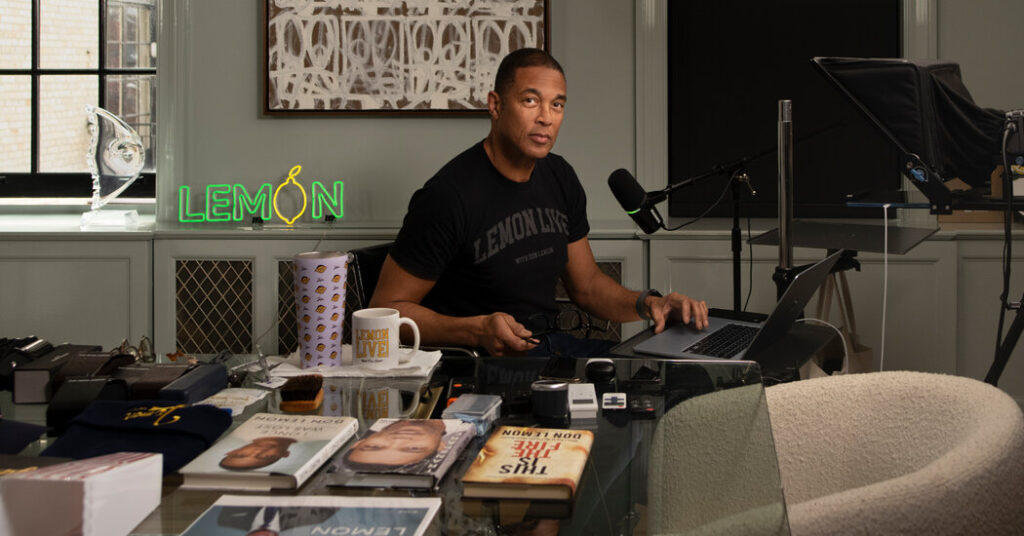
On a Thursday morning a few weeks later, Lemon was gazing into his laptop again, sitting before a glimmering “Lemon” sign and a decorative sheep beloved by his comment section.
“All right!” he said. “Rise and shine, Lemon Heads.”
He was stationed at his control-room-slash-anchor-desk inside the Greenwich Village apartment he shares with his husband, Tim Malone, a 41-year-old real estate agent, operating his own lighting equipment from a cellphone. Three dogs (one wearing a diaper) stirred at Lemon’s shoeless feet despite Malone’s efforts to corral them. Beside the host were two plaques sent by YouTube: one toasting his first 100,000 subscribers, another his first million. “The next one will be our 10 million,” he told me matter-of-factly.
During an ad break, as the dogs fussed, Lemon retrieved a high-frequency whistle and tapped a button.
“Only they can hear this,” he said. “It’s like a little eep.”
“It’s an actual dog whistle?” Allison Gollust, his spokeswoman, asked.
“Not a whistle,” he explained. “We don’t hear it, but they can.”
“That’s what a dog whistle is.”
He protested again.
“That’s what a dog whistle is, Don,” Gollust said firmly.
He turned to me and cackled, feigning humiliation: “Don’t write this!”
At CNN, where Lemon spent 17 years, he had uttered “dog whistle” more than occasionally to describe Trump’s race-baiting. But as with many cable hosts and the president, their relationship had once been friendlier. Invited to Trump Tower in 2015 to interview the new Republican front-runner, Lemon posed for photographs — including one posted on his show’s Instagram page — and chatted up the candidate’s children. “He’s like, ‘I like this guy,’” Lemon remembered. “‘He’s fair.’”
That August, the pair teamed up for one of the race’s most news-making early moments: Speaking to Lemon on air by phone, Trump complained about Megyn Kelly, then of Fox News, who had moderated a Republican primary debate the night before. The candidate seemed to suggest that Kelly must have been menstruating — that she had “blood coming out of her wherever” — prompting the kind of bipartisan scolding that feels quaint in hindsight.
Once Trump was in office, and eager to make CNN his foil, Lemon positioned himself as a truth-to-power crusader. He lobbed slashing asides about Trump to guests during commercials and often went just as far on camera. “This is ‘CNN Tonight.’ I’m Don Lemon. The president of the United States is racist,” he began one evening in 2018.
When Trump lost the presidency in 2020, the news media — and CNN in particular — was facing its own upheaval. The merger in 2022 of Discovery and WarnerMedia, CNN’s parent, hastened the network’s shift away from the MAGA antagonism that Lemon embodied. He was exiled to a doomed morning show, where, in February 2023, Lemon, then 56, suggested that Nikki Haley, a 51-year-old Republican presidential candidate, “isn’t in her prime, sorry,” because a woman’s prime spanned “her 20s and 30s and, maybe, 40s,” to the visible horror of his female co-hosts.
Lemon was fired that April (“WHAT TOOK THEM SO LONG?” Trump posted), on the same day that Fox News axed Tucker Carlson. Carlson told me that he called Lemon in a brief fraternity of the recently terminated. “Just to laugh,” Carlson said in a text message.
Initially, both men planned partnerships with an unlikely collaborator, Elon Musk, to produce long-form videos for X, Musk’s recent purchase. Lemon and Musk christened the arrangement by filming an interview at Tesla’s headquarters in Austin, Texas, where Lemon pressed the executive on his drug habits and the rampant hate speech on X. Musk looked miserable. He killed their deal afterward, calling Lemon’s approach “Jeff Zucker talking through Don.”
Dismissed twice in 11 months, Lemon was hamstrung by a noncompete clause in his CNN exit package — the company is still paying him through the end of his contract this year — which precluded another cable news job. “He found himself looking and saying, What am I good at?” Jay Sures, his agent, told me.
“The Don Lemon Show,” revamped after the Musk debacle, was the answer. Lemon has projected that he will eventually earn more than he did at CNN, where he was paid in the high seven figures, according to a person with knowledge of his former compensation. He is already making well north of $1 million from his YouTube channel alone.
And he is working harder for it, he said, straining his bandwidth even before a federal criminal defense demanded his attention. “Little overwhelmed,” Lemon told me in the back seat of an Uber in February, looking bug-eyed after a Brooklyn festival panel on independent media.
Lemon’s perma-hustle owes partly to the piecemeal nature of new-media revenue: ads during the show, which also airs on Substack and other social platforms; monetized posts on Instagram (2.8 million followers), Facebook (1.7 million) and TikTok (2.2 million); a cut if sponsors use his likeness on their own accounts; merchandise; paid speeches (CNN had stricter ethics rules than “‘The Don Lemon Show’ newsroom,” as he calls it); live events like the Hughley tour; extra dollars from premium subscribers. On YouTube, where the core program is free, Lemon offers three tiers of bonus material for those seeking more of him: “Lemon Nation” ($2.99 a month), “Lemon Heads” ($9.99) and “Lemon Legends” ($49.99). Trolls are considered a net positive. “For them to comment, they have to be at least a subscriber,” Lemon told me. “So they’re trolls who are paying me.”
Market peers include anti-Trump content makers like MeidasTouch and The Bulwark and TV veterans like Jim Acosta and Joy Reid. Chris Cillizza, a fellow CNN expat with a less partisan reputation, told me he had found independent media workable but less lucrative than Lemon. “I always tell people: If you want to start something and you’re solving for money primarily,” Cillizza said, “be as consistently pro-Trump or anti-Trump as possible.”
Lemon’s perspective is recognizable enough from his CNN days that he cannot quite be accused of chasing clicks. But he also does some things that other journalists would not. He recently addressed a Senate Democratic communications summit organized by Cory Booker. He openly supported Kamala Harris in 2024 and has seemed invested in her reciprocal validation. (“Madam Vice President, I hear that you are a Lemon Head,” he said in an interview last October. Harris, perplexed, said she admired his work but was “nobody’s head.”)
Some who think little of Lemon nonetheless regard this chapter as more sincere. “An irony now is that Lemon is more honest,” Christopher Rufo, a conservative activist, told me. “When he was at CNN, he was smuggling left-wing opinion between the perception of the Walter Cronkite straight-news television personality.”
Lemon has felt the most freedom in his bookings — no more election-denier types for nominal balance — saying that today’s CNN has repelled its audience. (The proposed purchase of Warner Bros. Discovery by David Ellison, the son of a centibillionaire Trump ally, has only reinforced Lemon’s concerns that his former workplace might follow the rightward drift of CBS, Ellison’s other recent news acquisition.) When I asked how he identified himself in the journalist-streamer-influencer space, Lemon said he was agnostic so long as “journalist” came first. “I do consider myself an influencer,” he added, “because I do think that I have cultural influence.”
Among fans, Lemon has inspired comparisons to swaggering journalist-entertainers past, the kinds of news slingers who hooked their audiences with more than straight-ahead reporting. “The Geraldo Rivera in this era,” a supporter posted (affectionately) to Lemon’s Facebook page.
But Rivera himself worries about Lemon. “I say to any journalist, or certainly any street reporter, ‘Stay away from churches,’” Rivera, an acquaintance of Lemon’s from their time on cable, told me. “There’s nothing but problems.”
Lemon’s indictment, filed on Jan. 29 after a federal magistrate judge first rejected the case against him, lumps him in with co-defendant “agitators” who prosecutors say conspired to “injure, oppress, threaten and intimidate” those inside the church.
Some of its claims seem fairly incontestable: Lemon helped ensure “operational secrecy” beforehand by reminding others not to disclose the protest location on camera. He acknowledged that a churchgoer was scared and crying, and said, “I imagine it’s uncomfortable and traumatic for the people here.” Other allegations are a bit more dubious. Lemon, the indictment reads, “stood so close to the pastor that Lemon caused the pastor’s right hand to graze Lemon.” The pastor, it says, was “largely surrounded” and “physically obstructed” (he is seen walking away) as Lemon “peppered him with questions to promote the operation’s message.”
“That’s what reporters do!” Lemon later said of such peppering.
Officially, Lemon was charged under the Klan Act and the Freedom of Access to Clinic Entrances Act, a 1994 law intended to plug a legislative gap after the Supreme Court ruled that the Klan Act did not extend to menacing non-Klan demonstrations at abortion clinics. The measure offered similar protections for houses of worship.
“I don’t know if it’s such a dog whistle,” Lemon, who has often discussed his ancestral connection to enslaved Louisianans, said of the case. “This is a regular whistle.”
“Amazing detail,” Rufo said of the Klan wrinkle, admiring the craftsmanship from Trump’s Justice Department. He suggested that Lemon is best compared to those prosecuted after entering the Capitol on Jan. 6, 2021, to document the action in a place they were not supposed to be.
Unsurprisingly, no corner of the media, excepting “The Don Lemon Show,” has devoted more attention to him than his counterparts on the streaming right. In early March, Megyn Kelly (now reincarnated as a new-media MAGA ally) welcomed Parnell, the pastor, who accused Lemon of “trying to incite me,” as Kelly mocked her former cable peer for “cloaking himself in the protection of journalism like he’s Ben Bradlee.”
Before charging Lemon, Harmeet Dhillon, the assistant attorney general for civil rights, telegraphed her plans to Benny Johnson, a pro-Trump commentator. “Quote-unquote ‘committing journalism,’” Dhillon told Johnson, provided no “shield” against being “an embedded part of a criminal conspiracy.”
Because of the latitude historically afforded to reporters at news-making events, the case has few clear precedents. Lemon has largely avoided discussing details that might factor in his defense, citing the ramifications for all journalists “if this goes the wrong way.” But he did volunteer something his therapist had shared recently. “He said, ‘You are Black history,’” Lemon told me. He wept, he said, but he did not disagree.
Lemon’s choice of lead attorney, Abbe Lowell, has placed him in suitably conspicuous company. As the ranking superlawyer for targets of Trump’s retribution, Lowell has represented New York State’s attorney general, Letitia James (who won a fraud judgment against Trump and his business), and Lisa Cook, a member of the Federal Reserve Board of Governors whom Trump has hoped to replace. Lemon has also hired Joseph H. Thompson, a former senior federal prosecutor in Minnesota who resigned in January over the Justice Department’s push to investigate Renee Good’s partner (and not her shooter).
At least one of the Cities Church congregants has sued Lemon civilly, claiming emotional distress. Red-state lawmakers are weighing measures to punish church protests. (“The Don Lemon law,” an Idaho legislator joked.) The Trump administration has pressured mainstream reporters to concede that Lemon is an imperfect standard-bearer. “There’s a lot of things that Mr. Lemon did that you would never do as a journalist,” Todd Blanche, the deputy attorney general, told CNN’s Dana Bash days after the arrest. “Let’s be honest.”
While news organizations, including CNN, have condemned Lemon’s arrest as an affront to press freedom, his turn as an avatar for the profession remains disorienting for some who knew him. Asked if it was healthy for journalism to see Lemon elevated to ambassador status, S.E. Cupp, a longtime CNN contributor, laughed. “You can quote me: ‘No comment.’”
Yet if Lemon is not the most statesmanlike figure committing journalism in 2026, or the most evenhanded, or the most likely to be held up as a model at journalism schools, he has achieved a more relevant distinction, whatever the outcome in court: Here is our most 2026 journalist, unaffiliated and unbound, self-immolating and self-regarding, deeply trusted by a fragmented audience in an age of fragmentation and collapsing audience trust, telling his followers a story about the country and its leader with such total commitment that he became that story’s central character.
“I’m not afraid to do this,” he had said inside the church. The danger is the credibility. He is the news.
As if narrating a segment about someone else’s life, Lemon can seem detached from the notion that he is the accused criminal in the headlines. The morning before his arraignment in St. Paul, Lemon and his three producers had been mapping out marathon coverage for his plea, planning a guest roster of influencers, legal minds, elected Democrats. Lemon had his flight to Minnesota in a few hours. He politely showed me the door, past the sheep.
“Do you think I’m crazy?” he asked.
Moments later, he was consumed with a different question. His arrest had been an international spectacle. His name, as he noticed with satisfaction during a supervised trip to the bathroom while detained, was back on CNN. Helicopters followed the car that ferried him from the courthouse.
But what would his news value be tomorrow?
“Do you think,” Lemon wondered, “there’s going to be crazy media?”
The post ‘I Am the News’: The Absurd Drama (and High Stakes) of the Don Lemon Affair appeared first on New York Times.