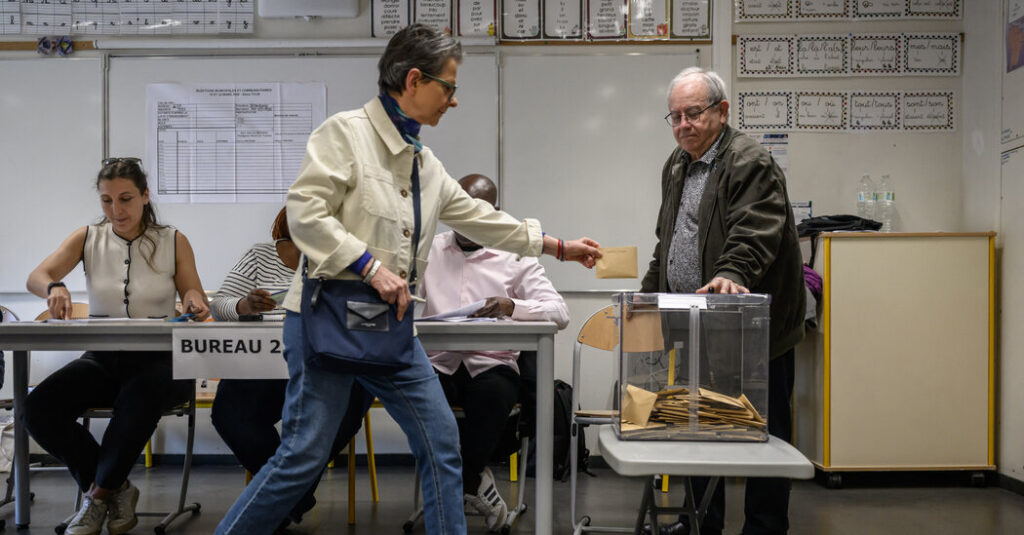
For months, the far right in France has been viewed almost as a national government-in-waiting, its leaders holding wide polling advantages against all rivals a year before presidential elections. Yet on Sunday, in mayoral elections, French voters seemed to deliver a more mixed verdict, according to early results.
Though final results in every race were not expected for hours, far-right candidates lost in two major southern cities, Toulon and Nîmes. Another was on track to lose in Marseille, France’s second-largest city, which the far-right National Rally had identified as a ripe target to showcase its ascent.
As the results trickled on Sunday evening from a second round of voting, it was a far-left party, France Unbowed, that claimed early momentum. It scored a victory in the industrial town of Roubaix, though the party’s gains were limited elsewhere, notably in Toulouse, where it had allied with a center-left candidate who was projected to lose.
One far-right candidate was projected to win in Nice, and another appeared on track to capture Carcassonne.
While the outcome of the mayoral elections may have lacked the sort of victories that would have electrified the far right and alarmed its opponents, they still left the National Rally as a force to be reckoned with 13 months before the presidential election.
Marine Le Pen, a fixture of far-right politics in France, and her protégé, Jordan Bardella, the party’s 30-year-old president, have topped most polls for the presidency for nearly a year. If Ms. Le Pen is barred from running by her conviction on financial charges, which she is appealing, Mr. Bardella is likely to run in her stead.
At one level, the election of more than 34,000 mayors was a quintessentially local exercise. Parochial issues, like trash collection, figure high on the list of voter concerns. Yet the elections are also a bellwether for the political winds in France, which continue to blow fiercely against more centrist parties.
Centrist candidates struggled to win mayoral races, and in cities where they did, they frequently had to ally with rivals, both on the left and the right, to prevail in the runoffs. That reflected deep-seated disenchantment with mainstream politics, which has both splintered and polarized French voters.
A conspicuous exception was Paris, where Emmanuel Grégoire, the candidate of the center-left Socialist Party, was projected to win his runoff against a conservative, Rachida Dati. Ms. Dati had amassed support from a far-right candidate who dropped out after the first round. Mr. Grégoire is a former deputy to the outgoing mayor, Anne Hidalgo, and his victory kept Paris, which has elected Socialist mayors for 25 years, in the hands of the left.
Analysts caution against over-interpreting what the mayoral results reveal about the likely outcome of the presidential election. Yet they are a useful as a gauge of the relative strength of the parties, and as an indicator of the terrain that politicians plan to stake out as the national campaign gathers momentum.
Ana Castelain and Daphné Anglès contributed reporting
Mark Landler is the Paris bureau chief of The Times, covering France, as well as American foreign policy in Europe and the Middle East. He has been a journalist for more than three decades.
The post French Local Elections Are Yardstick for Far Right. Initial Results Are Mixed. appeared first on New York Times.