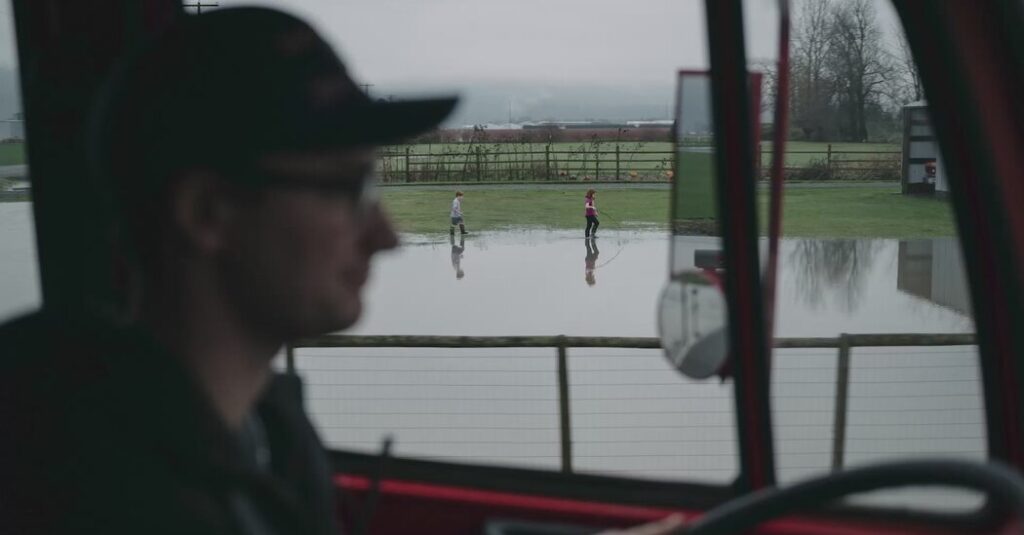
Just over a week after Saul Magallon’s wife gave birth to their first child late last year, a flood rushed into their home in Western Washington, carrying in 30 inches of mud, manure and sewage that forced the young family to move into a trailer in their backyard.
Like many of the displaced in Sumas, Wash., Mr. Magallon, 26, has an answer for floods that have grown more frequent and more devastating: Dredge the Nooksack River.
“All these people, including myself, want to see a difference, and they believe dredging is the right thing to do,” he said.
It is not that simple. Climate change has brought more extreme weather to the Pacific Northwest, including an “atmospheric river” in early December that caused record flooding, killed one man and forced the evacuation of 100,000 residents in Western Washington. The deluge put a spotlight on some of the longstanding issues in the northern border region that may be exacerbating the flooding, such as overdevelopment in the floodplain and environmental protections for endangered salmon runs that Native tribes depend on.
It was the second time in four years that floodwaters jumped the banks of the Nooksack and traveled dozens of miles through farms and cities on both sides of the U.S.-Canada border. At this rate, the next surge may arrive before officials can agree how to respond to the last one.
And looming over the search for that response is dredging, which many see as a silver bullet, and some fear would be a disaster. The word represents the perennial conflicts in Washington between Indigenous tribes and the newer arrivals that have developed in the region. Gravel harvesting in the past may have increased flow and provided some flood protection.
But tribal officials say dredging harmed wildlife habitat — and the tribes, by law, get a say. Treaties signed in the 1850s reserved the rights of the Nooksack Indian Tribe and the Lummi Nation to hunt and fish — and after much persecution by the state — established the legal basis for them to protect salmon.
Three forks of the Nooksack rush down from the mountains of the North Cascades and converge near Deming, Wash., into a single stem that winds for 36 miles through farms, cities and towns, and then into the Puget Sound.
When the river swells after heavy rain, the overflow rolls from that main stem into the cities of Nooksack; Sumas; and Abbotsford, in British Columbia. Damages from the 2021 surge surpassed $1 billion on both sides of the border. In Whatcom County, dirty water inundated hundreds of homes and soiled churches, city halls and a vital cattle feeding plant.
The final tally from the 2025 flood may be higher. In Sumas, a city of around 1,500 people more than a dozen miles from the Nooksack River, three out of five households reported damages.
“I may be the last mayor of Sumas,” said Bruce Bosch, the city’s leader.
Some residents said they had qualified for federal assistance to raise their houses or simply abandon them after the 2021 overflow, but never received the money. Then their homes were swamped again. The funds had been allocated but the grants awaited approval from the homeland security secretary, a position now in transition.
“It’s basically blue state retribution,” said Elliot Swaney, 62, whose Sumas home flooded in December as he waited for assistance.
The Federal Emergency Management Agency said it approved more than $5 billion for recovery projects last month, with more than $3.7 million earmarked for hazard mitigation projects in Whatcom County.
t.
Mr. Swaney is relieved. “It has taken a while, obviously longer than it should have, but hopefully by this summertime will we get the house up a few feet so we won’t have to go through another winter or another flood,” he said.
In the meantime, the push for gravel removal is gaining steam. A petition to dredge the Nooksack has nearly 4,000 signatures, around 60 percent of the people living in the most impacted area.
The Nooksack River conveys more than one million tons of sediment a year, the most per square mile of all the rivers draining into the Puget Sound.
“You’re not going to be able to dredge our way out of this,” said Ned Currence, a recently retired natural resource director for the Nooksack tribe.
Natural sediment buildup has been exacerbated by development. In Whatcom — the county with the highest blueberry yield across the country, according to the Washington Blueberry Commission — farmers have confined the river with levees and other controls that have narrowed the Nooksack and disrupted the river’s ability to flush sediment downstream.
When people “built bridges and levees,” said the mayor of Everson, Wash., John Perry, they killed the river’s “ability to retain its natural state.”
If nothing is done, flood levels will rise by two to five feet in the coming decades, according to a recent report. The county had considered sediment management plans, but the permitting required discouraged it from moving forward. Gravel companies suffered a similar fate. By the late 1990s, environmental regulations to improve river conditions and protect depleting salmon populations rendered harvesting cost prohibitive.
Those regulations, which remain in place today, have embittered some residents.
“People’s lives are being destroyed,” said Stacey Dailey, of Sumas, “and people want to talk about fish.”
Human development, industrial fishing, logging, farming and climate change have all had a hand in reducing salmon runs. More than a dozen salmon and steelhead species in Washington are listed under the Endangered Species Act, three of them in the Nooksack.
For the Lummi and Nooksack tribes, salmon is a cornerstone of their identity.
“If we have healthy salmon, then we ourselves will be healthy,” said Rosemary LaClair, the chairwoman of the Nooksack Tribal Council.
The Treaty of Point Elliott, signed in 1855, guaranteed tribal access to hunting, gathering and fishing grounds. But negotiated in three languages, the agreement set off more than a century of clashes over its implications. It took a 1974 federal court ruling to affirm the tribes’ rights to hunt and fish in their “usual and accustomed places.” They also retained the rights to half of all current and future fish catches.
The court later conferred on the tribes the right to protect wildlife, recognizing them as co-managers of watersheds throughout Washington.
Empowered by the decisions, Indigenous groups have helped bring down a dam that disrupted fish passage and successfully lobbied against a coal shipping terminal.
In 2024, after input from the Nooksack and Lummi tribes, the state filed a water-rights lawsuit, establishing an adjudication process to determine who has a legal right to use water, how much water can they use and who has the most priority.
“We want to be able to have what we need as a people,” said Anthony Hillaire, the chairman of the Lummi Nation, who believes the tribes have the most senior water rights. “‘First-in-time, first-in-right.’ And we were here since time immemorial,” he added, quoting a central principle of Washington water rights laws.
Under the process, around 30,000 county residents have to file a water rights claim by May 1.
“It would boggle your mind in one year’s time, how much agriculture, whether it be dairy or potatoes or berries, has been spent just on lawyer fees and professional consultant fees,” said Jeff De Jong, a diary farmer from Lynden, Wash., all to get “a little bit of water in an area that has more water than we ever know what to do with.”
After a recent meeting on flood reduction, another dairy farmer, Jerry De Bruin, said, “I felt it was kind of ironic that we are actively being sued by the very people in that room.”
Mr. De Bruin, 64, who lives in Sumas, has been named in the adjudication lawsuit. He tries to ignore that during flood response meetings, he said, because “we need to be working together.”
Last summer, Andrew Nelson, a geomorphologist at Northwest Hydraulic Consultants, presented a plan to pull back the levees and allow the river to restore its natural processes, which would reduce flooding and improve salmon habitat. Property owners would have to give land back to the river, but sediment would be removed, as many landowners want, temporarily, to kick-start the restoration process. The tribes supported the compromise, so long as habitat isn’t harmed.
The plan wouldn’t stop flooding completely, but it would bring relief to the cities of Everson, Nooksack and Sumas. While the concept is generally backed by most parties, it will take years and is freighted with challenges.
Creating more channel capacity will also send more water downstream — potentially exposing other communities, including the Lummi reservation, to more risk. Before county officials can remove gravel, they’ll have to study and mitigate those downstream effects, delaying construction.
Many worry that momentum will stall.
“We want to see some action,” Mayor Bosch said. “Then we will believe that we are moving in a good direction.”
To push back the levee, the county will also have to persuade owners to sell the land the levee is on. Dusty Williams, an organic farmer who rents out some of that land, did not seem interested. His answer would send the county back to square one.
“I don’t think we need to widen the channel,” he said. “We just need to dig it deeper.”
Bernard Mokam covers breaking news.
The post As Northwest Flooding Worsens, Conflicting Interests Stymie Solutions appeared first on New York Times.