After 12 years ministering to the needs of veterans with post-traumatic stress disorder, Tammy Alexander retired from full-time work in 2022.
She and her husband, both former Department of Veterans Affairs employees, were able to keep their federal health insurance. More recently, they needed to switch their coverage so that each spouse had an individual policy.
Ms. Alexander, who lives in Beebe, Ark., spent over a year trying to ensure the change would happen correctly. But one day last month, she checked online and found out that she no longer had any health insurance. There had been no warning in the mail, via text, from a phone call or through email.
By the time I talked to her early this week, she was dropping prescriptions and getting ready to ration other medications.
There does not seem to be any data on how often something like this happens. It is likely that many insurance companies and Medicare issue at least some warnings most of the time.
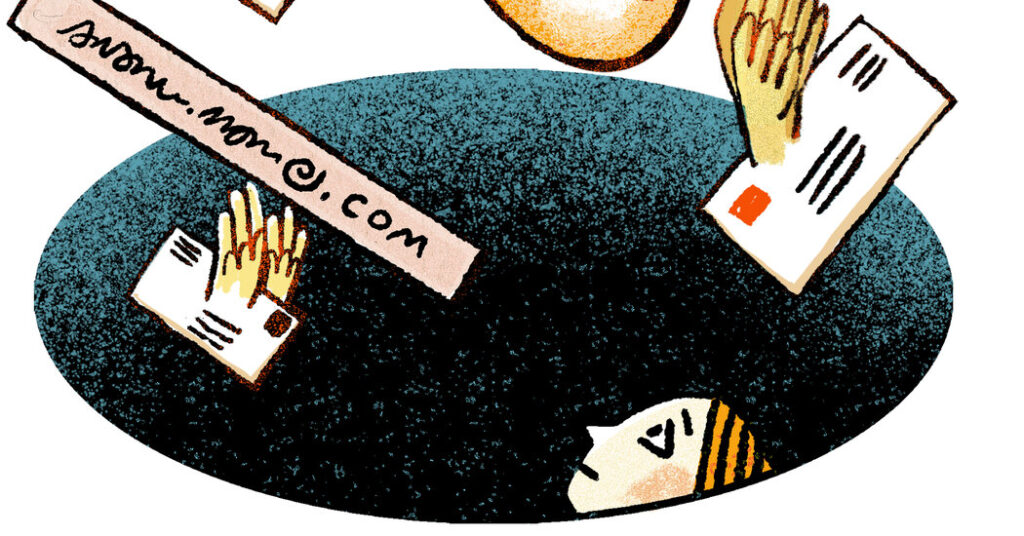
Here’s the problem: The warnings may come via only one method. Often, that’s U.S. mail, which can be delayed, stolen or lost en route.
And here’s what should happen that doesn’t: If you’re going to lose your coverage, insurers should put you on full blast. If they have your postal address, email and mobile phone number, they should deploy urgent letters, electronic messages, calls and texts — and do so weeks before they’re about to yank your coverage.
So why doesn’t it happen?
One big challenge here is the Health Insurance Portability and Accountability Act, or HIPAA. It passed in 1996, when there was concern about the privacy and security of electronic health records but before email and mobile phones were ubiquitous.
While there have been HIPAA updates, they don’t seem to have been pointed enough to reduce health insurers’ fears about certain consumer notifications. Paper mail remains a kind of default for security and privacy, which is laughable given how easy it is to steal mail and how often it never arrives.
The problems don’t end there. Different health insurance plans may face varying federal laws and regulations, and state laws can play a role too.
And Medicare is its own thing, as Dan Doucette discovered last year when his wife, Elizabeth, 75, lost her coverage with no warning and couldn’t get it back for close to a year.
As I wrote last week, the federal government (in the name of the Post Service) often doesn’t forward federal government mail (in the name of the Centers for Medicare and Medicaid Services). This seems to have tripped up the Doucettes, who spent years away from their Sanibel, Fla., home after a hurricane destroyed it.
As best as they could tell, something about the mail forwarding, or lack thereof — and a returned letter somewhere along the way — caused the federal government to think that Elizabeth was dead. And so, no more Medicare for her.
The couple said they had never seen a single notice. They found out only when she went to the doctor and didn’t have coverage anymore.
Mr. Doucette, who used to run a group of property and casualty insurance companies, knows his way around the industry. He still serves as an expert witness in insurance litigation.
“If a private insurance company had done what Medicare did, they’d be sued so fast that their license would be jeopardized,” he said.
A spokesman for the Medicare agency did not respond to a request for comment. Last week, he said that as of last year, the agency had started calling some people in the Doucettes’ situation in addition to mailing paper letters.
To legally engage in such “multimodal” warnings — sending emails, making phone calls and texting about pending coverage cancellation — insurers face a “how” challenge and a “what” challenge.
According to HIPAA experts, the how challenge — using those multiple modes to send a red alert — can be surmountable. Insurance companies generally need your permission to use the different modes in certain contexts, though they may vary in how aggressively they ask for it. (Many individuals ignore their prompts, not realizing how important it is for the insurers to be able to reach them in multiple ways. Don’t do that.)
A default to multimodal cancellation notifications would be ideal, and if it requires an adjustment to the law, so be it.
Then there is the what challenge — what you can say in any given communication. Again, the law may flunk the logic test here.
“‘Hi, Ron’ is not a problem,” said Thomas G. Goddard, who has spent decades helping health care providers with accreditation and interpreting standards. “But ‘Hi, Ron, your health insurance has been canceled’ depends on what rises to the level of individually identifiable health information or protected health information.”
If it does rise, it shouldn’t. After all, the message need not say why you’re about to lose coverage — say, if you’ve failed to pay your premiums. And this type of message does not disclose health conditions. It’s merely a warning that you’re about to lose something that could actually keep you alive.
If nothing else, insurers should — and should be able to — at least send messages to people who are in danger of losing coverage, using every mode at once, saying, “Please call us or check our app for an urgent message.”
The companies claim they do, though it isn’t clear how hard they go on the imperativeness. “If there are clear delays in response or action from members related to any part of their coverage — or if they are at risk of disenrollment — plans do regularly attempt to contact or reach the member via phone, email and any other means presentable,” according to a spokeswoman for America’s Health Insurance Plans, a trade group.
Would people dismiss aggressive outreach as a phishing attempt? Probably not, if it’s phrased correctly and hits their phone, inbox and voice mail all at once.
As soon as Ms. Alexander, 65, a survivor of both breast cancer and a near-fatal car crash, realized that she no longer had health insurance, she asked her congressman for help. She also began leaving daily messages with the U.S. Office of Personnel Management.
“I think I was crying at least one time,” she said.
None of it worked, though her congressman’s office sent word that it might take 60 days to hear back after it made its own inquiry. So she sent me an email after reading our Your Money newsletter.
The entities that took her coverage away should have put her on full blast to warn her, so I put them on blast and let them know that I was writing about the situation. By the end of the week, they seemed poised to fix the problem.
Ms. Alexander was thrilled. “But what of those who don’t have your leverage?” she asked.
I don’t know, but nobody should have to find out. Alas, there are probably about to be more of them, as Anthony Wright, the executive director of Families USA and a veteran health care consumer advocate, told me. The recent loss of enhanced federal subsidies for Affordable Care Act plans and changes to Medicaid rules are probably going to cause more people than usual to lose their coverage this year.
If that’s in danger of happening, they should hear about the problem well in advance, repeatedly, and not just through the Postal Service.
“Cost is the top line,” Mr. Wright said. “But right underneath, things are not just complex and confusing but Kafkaesque, where one errant notice means you lose coverage.”
Ron Lieber has been the Your Money columnist since 2008 and has written five books, most recently “The Price You Pay for College.”
The post You’ve Lost Your Health Insurance. It Shouldn’t Have Been a Surprise. appeared first on New York Times.