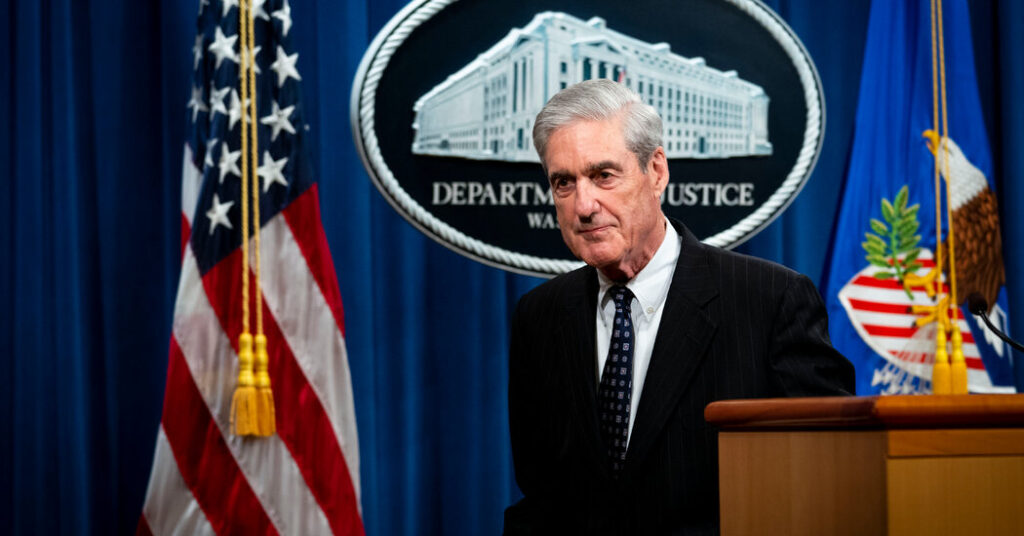
In the years shortly after President Trump was elected to his first term, Robert S. Mueller III cut an impressive figure as an impassive and tight-lipped former F.B.I. director who, as special counsel, would get to the bottom of claims that Russia interfered in the 2016 election.
But after the investigation turned him into a political target of Mr. Trump and his allies, Mr. Mueller came back to the public with an ambivalent finding in his famed 2019 report: He would neither absolve nor accuse Mr. Trump of a crime.
A liberal Republican, Mr. Mueller was known for his no-nonsense approach, and his tenure at the F.B.I. marked some of the most significant structural and cultural changes in the bureau’s history. All that would fade to the background in May 2017, when the Justice Department appointed him as special counsel in the Russia investigation — a role that would supersede Mr. Mueller’s legacy in American political history.
The contentious investigation of a sitting president shook Washington, and its findings fed an acrimonious debate between Republicans who seized the president’s language, calling the findings a vindication, and Democratic lawmakers who stressed that the report did not exonerate him.
As news of his death spreads, here’s a look back at some key moments of his notable role and investigation.
The Trump-Russia investigation
In May 2017, the Justice Department appointed Mr. Mueller, then a former F.B.I. director, as special counsel for the investigation into Russian interference in the 2016 presidential election. His job was to examine any links or coordination between the Russian government and associates of the president.
Mr. Mueller, also a former federal prosecutor, was appointed because of his unblemished reputation, after pressure from Democrats, and even some Republicans, for the Justice Department to conduct an independent investigation following the abrupt dismissal of the F.B.I. director, James B. Comey.
Over nearly two years, the investigation examined a broad campaign by Russia to influence the election, including the hacking and release of Democratic emails connected to his opponent, Hillary Clinton, and a social media operation aimed at American voters. It also scrutinized contacts between Russian individuals and Mr. Trump’s campaign advisers, as well as actions taken by the president after he took office.
The inquiry resulted in charges against more than 30 people and three companies on more than 100 criminal counts.
Several of Mr. Trump’s associates and others in their circles were charged and eventually pleaded guilty or were convicted, including the president’s former campaign chairman, Paul Manafort. Twenty-five others were Russians accused of interfering in the presidential election.
Mr. Mueller submitted his report in March 2019. It concluded that Russia had carried out a sweeping and systematic effort to interfere in the election, and that the Trump campaign expected it would benefit electorally from those efforts. The investigation did not establish that members of the campaign had conspired or coordinated with the Russian government in its election interference activities, the Justice Department concluded.
On the question of obstruction of justice, the report examined several episodes involving the president but did not make a traditional prosecutorial judgment, according to William P. Barr, then the attorney general. The report cited Justice Department policy against indicting a sitting president and stated that while the investigation did not conclude that Mr. Trump had committed a crime, it also did not exonerate him.
Released in redacted form in April 2019, the report became a central document of Mr. Mueller’s tenure and a focal point of political and legal debate in Washington.
Mueller’s final report: inconclusive
When the final report was released, it left some significant questions open and did not establish a conspiracy had been afoot.
While the report listed several instances in which Mr. Trump tried to influence or limit Mr. Mueller’s own investigation, it did not make a final legal judgment on whether those actions were criminal. Instead, the report presented the evidence, but did not clear the president of wrongdoing.
“If we had confidence after a thorough investigation of the facts that the president clearly did not commit obstruction of justice, we would so state,” Mr. Mueller’s report said. “Based on the facts and the applicable legal standards, however, we are unable to reach that judgment.”
Mark Walker is a Times reporter who covers breaking news and culture.
The post What Was the Mueller Investigation? And What Did It Find? appeared first on New York Times.