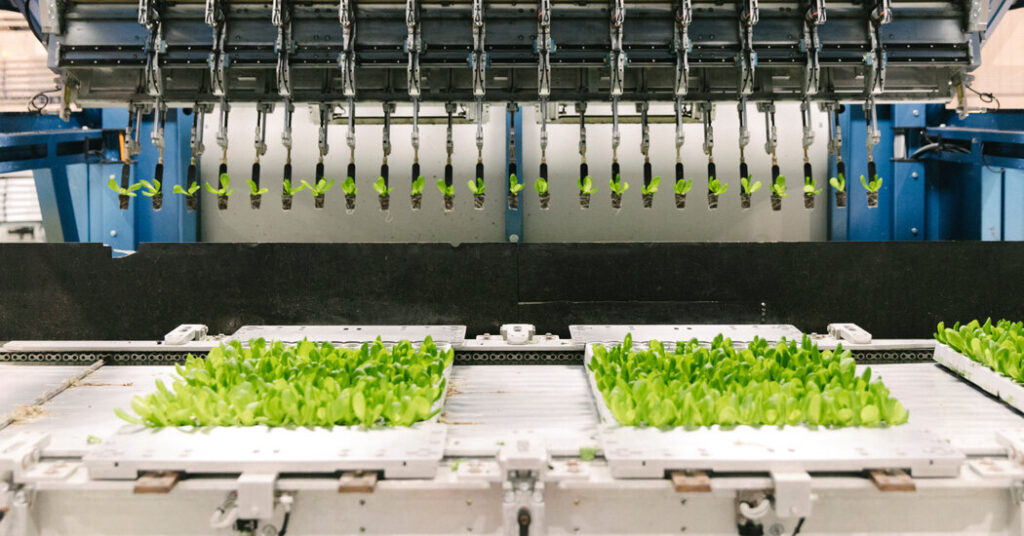
Vertical farming businesses blossomed a decade ago, promising an abundant, cleaner source of fruits and vegetables. Today, most of those start-ups have withered.
Constructed in opaque buildings, like warehouses, vertical farms resemble sterile manufacturing facilities more than farms. Crops are grown in trays stacked to the ceiling, fed with hydroponic or aeroponic systems. Plants are bathed in white and purple LED lights to maximize photosynthesis.
Owners of vertical farms once talked about their industry in almost messianic terms, as a climate-friendly solution to the ills they said plagued modern farming: pesticide use, water overconsumption, long-distance trucking and labor exploitation. By the late 2010s, Silicon Valley was on board, investing billions of dollars in companies promising to remake agriculture.
Now, that venture capital funding has gone up in flames, most prominently the $938 million raised by Bowery Farming and $792 million by AppHarvest, which are out of business.
Just three years ago, 23 companies signed on to a Vertical Farming Manifesto and committed to goals like transforming “food systems for the benefit of people and the planet.” Today, fewer than 10 are in business.
The farms and their investors were not fully prepared for what they would encounter in the agriculture industry, where margins are already thin. New, high-tech vertical farms had to elbow their way into produce markets dominated by extremely efficient traditional farms. Any perceived edge that vertical farms may have had eroded when energy costs rose. Higher interest rates tightened the purse strings of venture capital firms, and made it tougher for farms to get access to cash.
“The industry went through a very difficult time,” said Omar Asali, whose investment firm One Madison Group invested in Plenty, a vertical farm. “The industry was very ambitious.”
Vertical farms belong to a broad category of technologies called controlled environment agriculture. Besides vertical farms, the category includes simple wood and plastic structures, standard greenhouses and high-tech greenhouses.
The infrastructure costs for vertical farms are enormous — especially compared with how cheap it is to plant a few acres. Many of these business spent large sums on warehouses and lights without fully fledged business models. Some had to build their own software and hardware.
But they heralded several benefits: requiring 95 percent less water than traditional farms, using no pesticides and producing tastier crops in less time. Vertical farms could be built in cities, near millions of potential customers, increasing shelf life and eliminating most transportation costs.
“I would argue vertical farming has done a lot in 10 years, and yet it has also completely failed,” said Mike Zelkind, a co-founder of 80 Acre Farms, one of the biggest remaining vertical farm companies.
“There was an early notion by V.C.s and tech bros — this idea that you had to immediately take this cheap or free money and you could out-cost traditional farmers,” Mr. Zelkind said. “But this is advanced manufacturing,” he added. “This is not software.”
Nona Yehia readily admits that her company, Vertical Harvest, which she helped start in 2010, made plenty of mistakes, like how to manage airflow and humidity. But the reason Vertical Harvest is still around is the scale of those mistakes.
“My colleagues and competitors made big mistakes with big money and big farms,” she said. “We made small mistakes with small money and small farms.”
She said the first wave of vertical farms had approached business as if they were huge, established food companies, and not start-ups. Their business plan was “large-scale, commodity lettuce sold into retail at thin margins,” she wrote in an email, a difficult proposition against established competition.
Last year, Vertical Harvest opened a 50,000-square-foot vertical farm outside Portland, Maine, funded with nearly $50 million in loans guaranteed by the Agriculture Department.
Few consumers seek out vertically farmed produce, Ms. Yehia said, so for now, she is targeting a slice of the market — not the mass market. She grows a wide variety of greens, selling to schools and hospitals in addition to local grocers.
Plenty, which raised nearly $1 billion, was one of those companies that made big mistakes with big money. In addition to One Madison, its investors included SoftBank, Walmart and Jeff Bezos. Plenty filed for Chapter 11 bankruptcy protection in 2025, with more than $100 million in liabilities, but emerged from it with a new business model.
“Part of what you saw with the industry evolution was a little bit of a shakeout in whose technology could actually produce a crop that the market needed and wanted,” said Dan Malech, Plenty’s chief executive.
Plenty, like many others, began with lettuce because it was easy to grow and commanded a high price relative to its weight. But Plenty soon learned that the market was well supplied with lettuce.
“How much of a premium lettuce product the market is actually interested in” is an open question, Mr. Malech said.
Plenty closed farms and has pivoted its sole remaining farm, in Virginia, to strawberries. It has a partnership with the berry giant Driscoll’s, which distributes its strawberries to restaurants and in higher-end stores. Rather than attack conventional farms head-on, as it did a decade ago, Plenty is starting with customers willing to pay more for a tastier strawberry.
While vertical farming businesses have not fared as well as expected, high-tech greenhouses are flourishing. Using many of the same technologies as vertical farms, greenhouses grow food in a single layer and rely on the sun for photosynthesis. More than half the tomatoes consumed in the United States are grown in greenhouses, for instance, according to data on grocery stores from Nielsen.
“What Gotham Greens can grow in about one acre of our greenhouse we believe would require about 30 acres out in the field,” said Viraj Puri, a co-founder of Gotham Greens. His high-tech greenhouse company started on a rooftop in Brooklyn and now grows romaine lettuce, arugula and other leafy greens.
In the United States, most leafy greens are grown in the California region of Salinas Valley, which has abundant water and sun light, good soil and access to low-paid migrant farmworkers. But Mr. Puri thought there was a path for greenhouses to challenge conventional agriculture because of cost pressures and environmental degradation.
Whether such a path still exists for vertical farms is an open question.
Mr. Zelkind of 80 Acre Farms, one of the industry’s few mainstream players that has farms in several states and distributes its greens and salad kits across the country, said that his farms were profitable, but that his company was not once you take into account administrative and other centralized costs.
He said that vertical farming would not replace conventional farming, but that it would develop to produce the highest-value and most perishable produce. He added that he thought placing vertical farms next to, or inside, regional grocery distribution centers made sense, and that companies would pay a premium for the supply chain and off-season flexibility vertical farms provided in an increasingly fragmented world.
But the industry is reminded of its fragility daily. AeroFarms, which raised more than $300 million, said in December that its largest investor had withdrawn funding and that it would close. It obtained temporary financing, and has since told city officials in Danville, Va., where it is based, that it has a nonbinding letter of intent to sell the company, but still could shut down this month. AeroFarms did not respond to requests for comment.
Even vertical farm evangelists, then, may need to fall back on a big-picture argument for its utility to the American food system, rather than on any individual company’s succeeding.
“Whether there will be any current survivors, or the industry will be built on the boneyard of the pioneers, there is value there,” Mr. Zelkind said.
Kevin Draper is a business correspondent covering the agriculture industry. He can be reached at [email protected] or [email protected].
The post Vertical Farms Tried to Compete With Open Field Farming. It Isn’t Going Well. appeared first on New York Times.