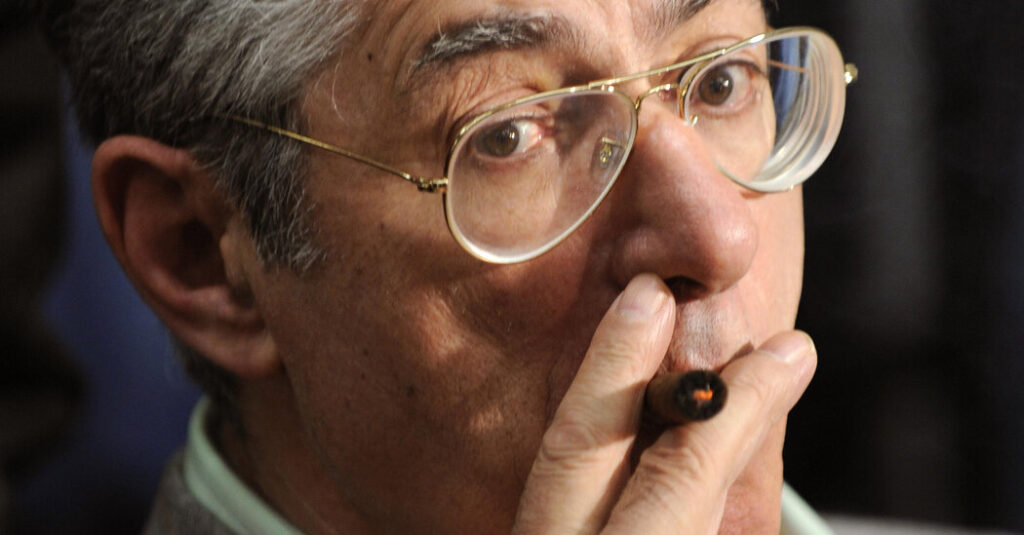
Umberto Bossi, a polarizing firebrand who upended Italian politics in the 1980s and ’90s as the founder of the populist, anti-immigrant, separatist party Northern League, died on Thursday in the northern town of Varese. He was 84.
Nicoletta Maggi, his longtime press officer, confirmed the death, in a hospital, but did not provide the cause. Mr. Bossi was admitted to the hospital earlier this week, she said.
Famous for his cigars, white tank tops and “man of the people” bravado, Mr. Bossi used incendiary oratory — one observer called it his most potent weapon — to channel the anger and frustrations of disaffected northerners who saw Italy’s Rome-centered, “colonialist” national government as only south-looking, believing it had robbed them of their hard-earned money and their cultural identity.
As the governing class that had ruled Italy since the end of the Second World War collapsed amid a vast bribery and corruption scandal, Mr. Bossi and Silvio Berlusconi, the media tycoon who had started his own party, Forza Italia, found favor with much of the electorate by bringing a new, confrontational populist style to the country’s politics.
Mr. Bossi gained traction by railing against migrants, another Northern League bugaboo, in the years that they began crossing the Mediterranean to Italy’s shores in growing numbers. A tough 2002 immigration law, colloquially known as the Bossi-Fini law, bears his name.
On Friday, political commentators and lawmakers of various political stripes acknowledged the impact Mr. Bossi had in Italy’s political arena. Front page newspaper articles commemorated him as “the last revolutionary” and the “Lion of the North.”
President Sergio Mattarella described him as a “passionate politician and sincere democrat” who was the “protagonist of a long political season.”
Mr. Bossi founded what was originally known as the Lombard League in 1984, campaigning on an anti-South, anti-immigrant platform that called for much of the North to secede from Italy. In 1987, when the party first ran in national elections, it received only half a percent of the national vote and one seat in the Senate, enough to anoint Mr. Bossi with his lifelong nickname: Il senatùr — senator in the Lombard dialect.
Riding a wave of anti-establishment discontent, the charismatic Mr. Bossi propelled his small regional party into a national force, with a speed matched only in recent Italian history by Mussolini’s Fascists in the 1920s.
After corruption scandals brought down the traditional parties, the Northern League, as the party became known, and Forza Italia joined forces to win the election in 1994. It was a short-lived alliance. Mr. Bossi pulled his support after seven months, and the Berlusconi government collapsed.
Realpolitiks eventually won out over hard feelings, and the Northern League went on to be part of two other Berlusconi governments, bagging significant ministries even when poll numbers were down.
Mr. Bossi was sidelined by a stroke in 2004 but recovered, slowly. He was elected to the European Parliament three times and to the Italian Parliament 10 times in all, most recently to the lower house in 2022.
At first, he had a dream: sovereignty for Padania, the name he chose for an undefined area north of the Po River, stretching across northern Italy from Piedmont to the Veneto.
In September 1996, Mr. Bossi embarked on a 400-mile “March to the Sea” along the river, meeting, at various stops, small bands of enthusiastic supporters dressed in the green shirts and neckwear of his movement.
But the long-awaited independence day fell far short of expectations, as only about 10,000 supporters gathered in Venice for the final rally. The “mood was more of a small town party than the beginnings of a separatist rebellion,” The New York Times wrote.
At one point, in 1996, Mr. Bossi suggested that Italy’s north and south should get a divorce, Czech-Slovak style, harking back to the peaceful breakup of Czechoslovakia into the independent Czech Republic and Slovakia three years earlier. But to appeal to moderates who felt queasy about a breakup, he sometimes tailored his message, arguing for a federal system, like that of the United States.
The secessionist theme eventually took a back seat, especially under the Northern League’s current leader, Matteo Salvini, who took over after Mr. Bossi resigned from the party in 2012 amid a corruption scandal. Seeing little room for national growth with a secessionist message, Mr. Salvini dropped “Northern” from the party’s name, making clear that he no longer blamed southern Italians for Italy’s problems. His supporters shifted the blame to migrants instead.
Umberto Bossi was born on Sept. 19, 1941, in Cassano Magnago, a small town in Lombardy. His father, Ambrogio Bossi, was a textile industry worker, and his mother, Ida Valentina Mauri, was a building caretaker.
Mr. Bossi studied medicine for a time at the University of Pavia, but dropped out and took odd jobs until his political career took off. Early on, he wrote poetry, in the Lombard dialect, that reflected what would become his political concerns, Ms. Maggi, his press officer, said.
His marriage to Gigliola Guidali ended in divorce. He is survived by his second wife, Manuela Marrone, a founding member of the Northern League; a son, Riccardo, from his first marriage; and three sons from his second marriage, Renzo, Roberto Libertà and Eridano Sirio.
Prime Minister Giorgia Meloni was planning to attend Mr. Bossi’s funeral, which will be held on Sunday in the small town of Pontida, where the Northern League has held annual rallies since 1990.
At the first rally, after Mr. Bossi denounced “the centralist Roman underworld, on our backs for the last 40 years,” the crowd roared back, “Rome, you thief, the league will not forgive you!”
Elisabetta Povoledo is a Times reporter based in Rome, covering Italy, the Vatican and the culture of the region. She has been a journalist for 35 years.
The post Umberto Bossi, Fiery Founder of Italian Separatist Party, Dies at 84 appeared first on New York Times.