BUDAPEST — In the run-up to Hungary’s pivotal election in April, a unit of Russia’s foreign intelligence service last month began sounding the alarm over plummeting public support for Prime Minister Viktor Orban, whose friendly ties to Moscow have long given the Kremlin a strategic foothold inside NATO and the European Union.
Officers from the intelligence service, or SVR, suggested that drastic action might be necessary — a strategy they called “the Gamechanger.” In an internal report for the SVR obtained and authenticated by a European intelligence service and reviewed by The Washington Post, the operatives proposed a way to “fundamentally alter the entire paradigm of the election campaign” — “the staging of an assassination attempt on Viktor Orban.”
“Such an incident will shift the perception of the campaign out of the rational realm of socioeconomic questions into an emotional one, where the key themes will become state security and the stability and defense of the political system,” the operatives wrote in a report prepared for the SVR’s main unit for political influence operations, Directorate MS, or Active Measures Department.
There have been no physical attacks on Orban, whose popularity has eroded because of a worsening economy. But the mere suggestion of staging an attempt on Orban’s life underscores how high the stakes are for Moscow in the Hungarian race.
The July 2024 campaign-trail attack in which Donald Trump was grazed by a would-be assassin’s bullet resulted in iconic photos of him, praise for his resilience, and a quick bump in his poll numbers, especially among core supporters.
Polls show Orban trailing Peter Magyar, who is also conservative and a former member of Orban’s party, Fidesz, but campaigning as an anti-corruption reformer. “The majority (52.3%) are dissatisfied with the state of affairs in the country,” the Russian officers wrote. “The dissatisfaction prevails not only in cities but also in the rural areas (50.8%) where traditionally the ruling Fidesz party’s position is strong.”
Russia is not the only outside power potentially looking to prop up Orban in one of the toughest campaigns of his career. Secretary of State Marco Rubio visited Budapest last month, telling Orban that “your success is our success,”and Orban has made no secret that he hopes Trump will do the same. But with Trump consumed by the war in Iran and Orban behind in the polls, Hungarian Foreign Minister Peter Szijjarto said Vice President JD Vance will visit instead.
While the Trump administration has offered joint appearances and subtle endorsements, Russia’s intervention could be more direct. Some Western officials say the Kremlin is intent on preserving Orban, who has assisted Moscow in hampering key E.U. policies and acted as a bridge for the Kremlin to U.S. conservatives in hopes of forging a new post-liberal world order.
Orban’s spokesperson Zoltan Kovacs did not respond to a request for comment on the SVR report, Russia’s alleged interference in the election or the prime minister’s relationship with Moscow.
It is unclear how high up in the Russian government the SVR proposal was read. Kremlin spokesman Dmitry Peskov dismissed questions from The Post about the SVR strategy document. “This is another example of disinformation,” he said. The SVR declined to comment.
In recent weeks, Orban and Fidesz have increasingly sought to redirect Hungarians’ focus away from economic problems and toward alleged external security threats.
Amid a deepening standoff over Hungary blocking a 90 billion euro E.U. loan for Ukraine, Orban’s government has accused Ukraine of halting cheap Russian oil supplies to Hungary via the Druzhba pipeline that snakes through Ukrainian territory — despite the shutdown initially being caused by a Russian attack that hit the pipeline’s infrastructure.
Tempers have frayed. Orban last week accused Ukrainians of plotting physical attacks on his family, while Ukrainian President Volodymyr Zelensky earlier this month, speaking about Orban, threatened to give “this person’s address to our armed forces.” On Thursday, the Hungarian government said it was banning three Ukrainian citizens from entering its territory, alleging they made threats against Hungary, Orban and his family.
After Orban said he was moving troops to protect Hungary’s critical energy infrastructure against a potential attack by Ukraine, jitters have grown in Budapest. “Anything could happen,” said one Western official, who like others spoke on the condition of anonymity to discuss sensitive politics. “I’ve never seen Fidesz so nervous,” another said of Orban’s ruling party.
“There is growing panic in the ruling party, and I think they may take some not well-considered steps to hold onto power,” said Andras Telkes, a Hungarian former deputy foreign intelligence chief. “The Russians will do everything to keep Orban in power. … They consider Hungary as part of their sphere of influence.”
The Russian measures to support Orban have included a Kremlin-backed social media campaign to amplify messaging that Orban is the only candidate who can protect Hungary’s sovereignty, according to European security officials familiar with the activities who spoke on the condition of anonymity to discuss intelligence findings.
Some of the Kremlin-backed narratives have been conveyed through Tigran Garibian, a Russian counselor-envoy at Moscow’s embassy in Budapest who, according to one of the European security officials, regularly holds meetings with pro-government Hungarian journalists to give them tasks and instructions.
The Russian Embassy said: “We have repeatedly stated that Russia does not interfere in elections in other countries. We would like to emphasize once again that interference in the Hungarian election campaign is by no means coming from the Russian side.” The embassy declined to comment further.
Russia has been accused repeatedly of meddling in elections, including in 2016 in the United States. Yevgeniy Prigozhin, the late commander of the Wagner mercenary group and Putin ally, was put under sanction by the U.S. and had admittedthat troll farms under his control sought to influence American voters.
In their report, the Russian operatives proposed that Orban equate his rule with peace and as a “space for stability, predictability and long-term development” and that he focus the campaign on portraying Magyar as a “puppet” of Brussels and his Tisza Party as “the party of war” supporting Ukraine.
One of the European security officials said his service had been informed about the arrival of three people operating on behalf of Russian military intelligence in Hungary, confirming a report by Hungary’s independent investigative outlet VSquare about the trio and raising further questions about potential Russian interference.
While Fidesz has a skilled propaganda machine of its own, the Russian operatives could be involved in contingency planning for Moscow to cast doubt on the integrity of the vote, one of the Western officials said.
With each side accusing the other of manipulation and smear campaigns, and polls tightening, the election is on a knife’s edge. Concerns are growing in Budapest that the outcome could be disputed.
“Orban has been one of Russia’s best assets,” one of the Western officials said. “It is hard to imagine that the Russians would not be standing ready to assist if things go sideways.”
For years, the Orban government has provided Moscow with a vital window into sensitive discussions in the E.U. both through the physical access of its allies in the Hungarian government and through Russian hackers’ penetration of the computer networks of Hungary’s Foreign Ministry, said several current and former European security officials, including Ferenc Fresz, the former head of Hungary’s Cyber Defense Service who spoke about the Russian hacks.
Szijjarto, the foreign minister, made regular phone calls during breaks at E.U. meetings to provide his Russian counterpart, Sergei Lavrov, with “live reports on what’s been discussed” and possible solutions, one of the European security officials said.
Through such calls, “every single E.U. meeting for years has basically had Moscow behind the table,” the official said.
Szijjarto has made 16 official visits to Moscow since Russia’s full-scale invasion of Ukraine in 2022, most recently on March 4 when he met with President Vladimir Putin. Szijjarto did not respond to a request for comment.
When Orban first emerged as a political player in Hungary soon after the collapse of the Soviet Union, he made his name as a firebrand opponent of Communist rule. During his first stint as prime minister, from July 1998 to May 2002, Hungary joined NATO — over Moscow’s objections.
After he was elected for the second time, in 2010, Orban gravitated into Moscow’s orbit, promoting ties with Russia over Hungary’s Western partners and espousing populist traditional values at the same time that Putin sought to portray himself as a protector of Christian values against decadent Western liberal democracy.
“I think the first thing for Orban was about money,” said Telkes, the former deputy foreign intelligence chief. “They made a deal about Russian energy imports for Hungary. Russian energy has been supplied not directly but through different intermediaries.”
For years, a central node in this relationship has been MOL, the Hungarian oil and gas conglomerate that is one of the country’s biggest and most profitable companies benefiting from the supply of cheap Russian energy. Just before Orban became prime minister, MOL sold a 50 percent stake in its gas trader MOL Energy Trade, later renamed MET, to a Cyprus-registered company, Normeston Trading.
Once Orban was in power, Normeston transferred its stake in MET in 2011 to two of Orban’s closest allies, allowing them to earn hundreds of millions of dollars in dividends through the purchase of cheaper gas on the European spot market, according to researchby Daniel Hegedus, now deputy director at the Institute for European Politics in Berlin. MET’s management bought out the shareholders in 2018. “The system helped a lot of them to fill their pockets,” Telkes said.
Another key way for Orban and his allies to benefit came through Orban’s decision to award a contract to Russia’s state nuclear monopoly Rosatom to build the Paks II nuclear reactor in 2014, according to Andras Racz, a senior fellow at the German Council on Foreign Relations’ Center for Security and Defense, with Russian state bank VEB providing a 10 billion euro loan for the project, of which 40 percent was to go to Hungarian subcontractors.
Orban’s childhood friend Lorinc Meszaros was a key beneficiary. He received tens of millions of dollars’ worth of construction deals, according to E.U. procurement contracts, helping him become Hungary’s richest man and earn the moniker “Orban’s wallet.” Meszaros publicly has attributed his soaring fortune since Orban’s 2010 election as “thanks to three factors: God, luck and Viktor Orban.” Meszaros did not respond to a request for comment.
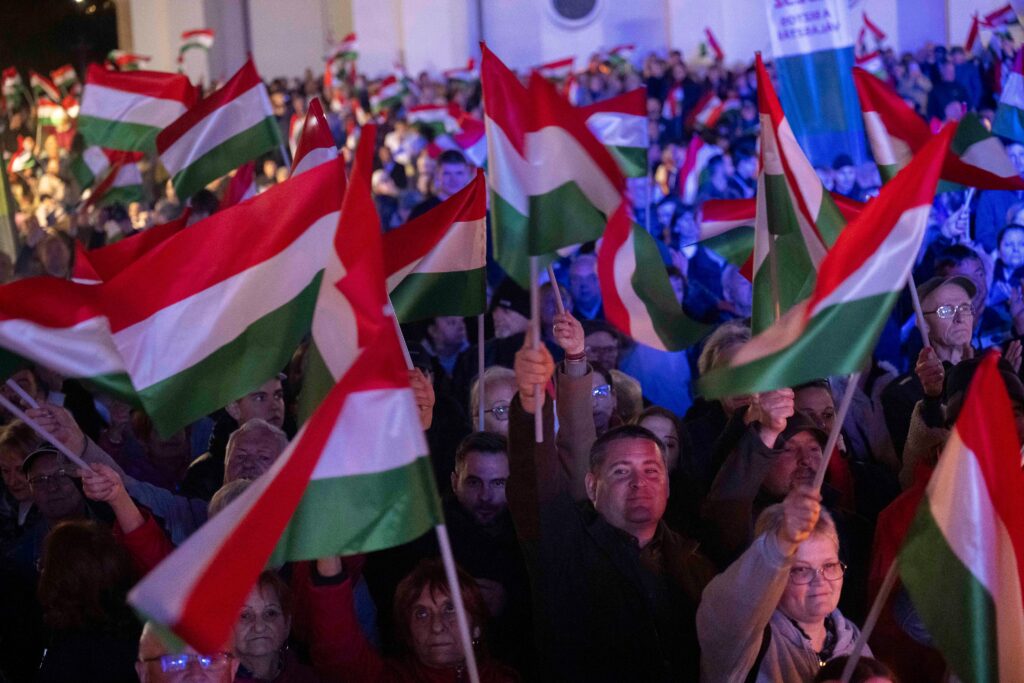
In the current campaign, Orban has sought to promote himself as the candidate for peace, while presenting Magyar as a stooge of Brussels who would drag Hungary into war on Ukraine’s side. The two candidates held rival rallies on Sunday, which drew hundreds of thousands, with both sides claiming their gatherings were the “largest ever.”
Magyar’s campaign against the alleged corruption of Orban’s rule has gained resonance — in particular since concerns about rule of law and Orban’s repeated blocking of key E.U. initiatives caused the E.U. to withhold subsidies, further affecting Hungary’s economy.
Amid the tense politicking, Russia’s foreign intelligence operatives have been stepping up efforts to support Orban’s campaign. Aside from the note mapping potential strategies, Russia has directed operatives to engage in concrete measures to tarnish opposition candidates, additional documents show.
The operations included efforts to create artificial intelligence videos to damage one Tisza candidate, Mariya Gurzo, and to smear another, Ervin Nagy, by fabricating allegations that he beat up a local woman, forging documents and photos and then spreading the disinformation through national and social media, according to the additional documents. Nagy and Gurzo did not immediately respond to a request for comment.
Serhiy Morgunov and Natalie Allison contributed to this report.
The post To tilt Hungarian election, Russians proposed staging assassination attempt appeared first on Washington Post.