Mami Kataoka has been thinking a lot about curatorial vision — and whether it’s possible to have a genuine curated exhibition in the specific environment of an art fair, which is essentially a giant marketplace.
“The challenge with an art fair is that the works are not communicating with each other — it’s a display case,” Kataoka said in a video call from Tokyo, where she is the director of the venerable Mori Art Museum. “That’s a different purpose than curating.”
Kataoka’s job as the head of a contemporary art museum, of course, is to have imagination and vision when presenting art, and to place it in a contextual narrative that gives it meaning that is larger than itself.
For the 2026 edition of Art Basel Hong Kong’s Encounters, a part that focuses on large-scale sculpture, installation and performance, she leads a four-person curatorial team that includes Isabella Tam of M+ Museum in Hong Kong; Hirokazu Tokuyama of the Mori; and Alia Swastika, an independent curator based in Jakarta. The team’s goal: inject energy and dialogue in the fair’s most visible and ambitious art experience.
Encounters presents 12 big artworks in a conceptual framework inspired by Asian philosophy, with four aisles on the fair floor organized around the elements of water, fire, earth and ether.
The programming also goes outside the convention and exhibition center to include a site-specific digital installation by Christine Sun Kim, “A String of Echo Traps,” at Hong Kong’s Pacific Place; a version of it was shown at her solo exhibition at the Whitney last year.
Kim is known for exploring the complexity of communication and the dynamic, spatial nature of American Sign Language, using graphic representations of sound in relation to bodies and physical space. In the context of ether, the power of spatial communication gains new resonance.
The elemental theme provides a scaffolding for the sizable works — selected from artists and galleries presenting at the fair — while encouraging audiences to think about the invisible energy flowing between different places and cultures, Tam explained.
“This is one of the most important cultural months in Hong Kong and in the region,” Tam said. “We are very aware that in the context of the fair, people can easily get lost — and we don’t just want the audience to consume the artwork. We want them to think about the relationships between them.
“The three installations in the water aisle, for instance, are all fabric-based and very fluid, but they also work as a kind of cultural archive for community memory and water ecology in the places they are rooted” — in India, Indonesia and Malaysia. The pieces are in dialogue with each other; the friction between them stimulates new and interesting ideas.
Kataoka emphasized that the four elements had a horizontal relationship, not a hierarchal one. That idea of shared give-and-take, she said, is “so much needed for contemporary society — that was my basic value for the structure of the world.” Given Kataoka’s original question about whether genuine curation is possible at an art fair — well, is it?
“I’m still waiting to find out,” she said with a laugh. “The curator has an imagination of what it is, but we have to see it in an actual space. I’m still always impressed at the moment when the dialogue emerges from the actual works being together. It all has to come together.” She paused, thinking. “It’s a beautiful moment.”
Below are interviews with each of the four curators about standout works from the show, and how they are situated within the collective curatorial vision.
Anthems of Archipelago: We are King of Ocean
Art by Parag Tandel (India). Element: Water. Interview with Isabella Tam, curator of visual art at M+, Hong Kong
Tandel creates sculptures that are protective talismans. India has a lot of islands and a strong traditional fishing community. In this installation, there are seven quite large sculptures, representing the seven major islands forming the Koli community in India. The people there create a lot of these talismans, reflecting the ancestral bond with the sea, and how the community’s spirituality is inseparable from the ocean. He puts that cultural richness and community into this installation.
You’ll see lobster shapes, jellyfish, that kind of icon. Each sculpture acknowledges the ritual honoring of that sea creature — in this series, he’s primarily using thread and steel to form the basis of the structure. Tandel is thinking about the original culture of the Bombay Islands, but also about the bounding of this archipelago. (Merged by land reclamation projects, the islands now make up modern-day Mumbai). The ocean ecology, community livelihood — how human beings were dependent on it but also endangered it.
It’s a really interesting way to think about water. All the works in the water aisle nod to the community to anchor the roots, but they also address concerns with ecology. It’s a very special conversation between the works that deals with tradition, community and reimagining new ways to work with materials.
Melting Vessel
Art by Masaomi Yasunaga (Japan). Element: Fire. Interview with Hirokazu Tokuyama, senior curator at the Mori Art Museum, Tokyo
Fire has so many meanings and metaphors — that was the point for us. Some work in the aisle is more visually obvious with fire; other is more hidden. For Masaomi Yasunaga, he is a ceramic artist — all his work means fire. It has to be fired. His work is the outcome of fire. It also has the strong prospect of craft — a functional object, but I don’t like to see craft as secondary to fine art.
With craft, the object we use on an everyday basis is also of fire, but its existence is embedded. The fire is everywhere, even if you don’t see it. He makes ceramic pieces with no clay — only glaze. I’ve never seen ceramic work before that’s only glaze. The way he does it, it’s very original.
For the installation, he will showcase eight huge pieces on the floor, and put pebbles underneath to connect all of them. In this way it is all one piece. To walk among them is to become part of the work itself — the audience transformed into performers, their movement and presence woven into the piece as a living, breathing element. At Art Basel Hong Kong, the audience will be able to interact and be part of it. That’s really unusual for ceramics and people — usually you’re not allowed to be included. But, here, the audience’s physical presence is not incidental — it is integral to the work’s meaning.
City Lantern
Art by Suzann Victor (Singapore). Element: Earth. Interview with Alia Swastika, independent curator and writer, Jakarta
Suzann is a big figure. Her work has been seen in many public projects, including a big installation in Singapore Changi Airport. Presenting “City Lantern” in Hong Kong feels right — it’s connected to the context of Hong Kong itself, the development of a city in the landscape of islands.
It’s coming from the reflection of how Suzann sees growth in different parts of the world, as a result of the colonial to postcolonial condition, complicated by capitalism and gentrification and the very fast development of cities. It’s based on photography — there are 60 cities included in the photographs.
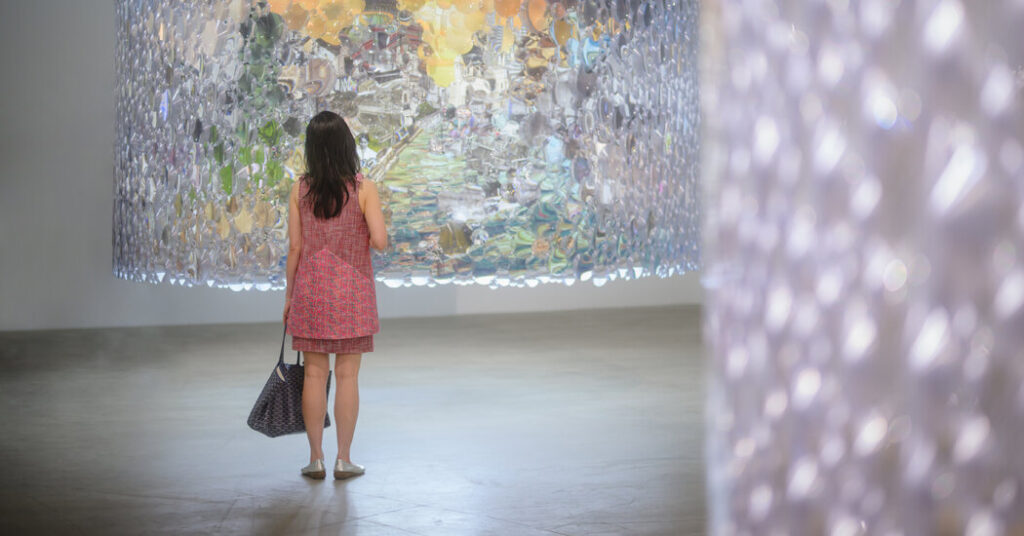
She made a round lantern of Fresnel lenses; the lantern is of course very connected to Chinese culture, and for the Hong Kong audience it’s very much part of their everyday life. The size is very big. It is giving a sense of surprise to the audience. She invites the audience to come closer to see how the colors of the landscape and the city panorama can talk to their own memories.
Usually with an art fair, it’s very divided; you walk from one booth to another, one gallery to another. But then you encounter these large-scale, big experiences with your body — you understand the context of the work. We’re inviting people to experience the work by moving them around the pieces.
Art Basel Hong Kong is very international; Suzann includes iconic images from different parts of the world as part of this global composition. It’s also a kinetic installation. Slowly moving, turning, so people can see the movement, the idea of mobility and migration, moving from one place to another. The slow motion plays with your memories, and nostalgia. I’ve been amazed for a long time by how Suzann transforms ideas with old technology meeting new, and it feels very fresh.
And also there are lots of contradictions — not only the glory, but also the slum areas in many cities, building the conversation between dream and reality. The collective experience of an art fair also creates a different and very vivid memory in your body on the ground, of all of that.
Grafting
Art by Steph Huang (Taiwan). Element: Ether. Interview with Mami Kataoka, director of the Mori Art Museum, Tokyo
Ether is probably the most difficult element to explain visually. It’s talking about the invisible energy in the space. In Asian culture we’ve always been feeling invisible power in the empty space.
With Steph, she’s really looking at void space, from the family gathering space on tatami mat, wooden doors, and the ideas of space and materials in Taiwan. It’s more than the individual works — it’s the natural dialogue raised by placing them together in a way that is most interesting. I saw her solo exhibition last year; it was quite new and fresh to me how she used ordinary, everyday materials, and the way she was given a big gallery space, and she wasn’t trying to fill it. She was creating narrative in the space — I could feel that the void space, the breathing room, and the relationship between objects was really important to her. To give the flow of energy between all the elements. I thought it would be perfect for her to join this aisle devoted to ether.
Bonnie Tsui is the author of “On Muscle” and “Why We Swim.”
The post These Curators Inject Energy and Dialogue Into the Art Fair Experience appeared first on New York Times.