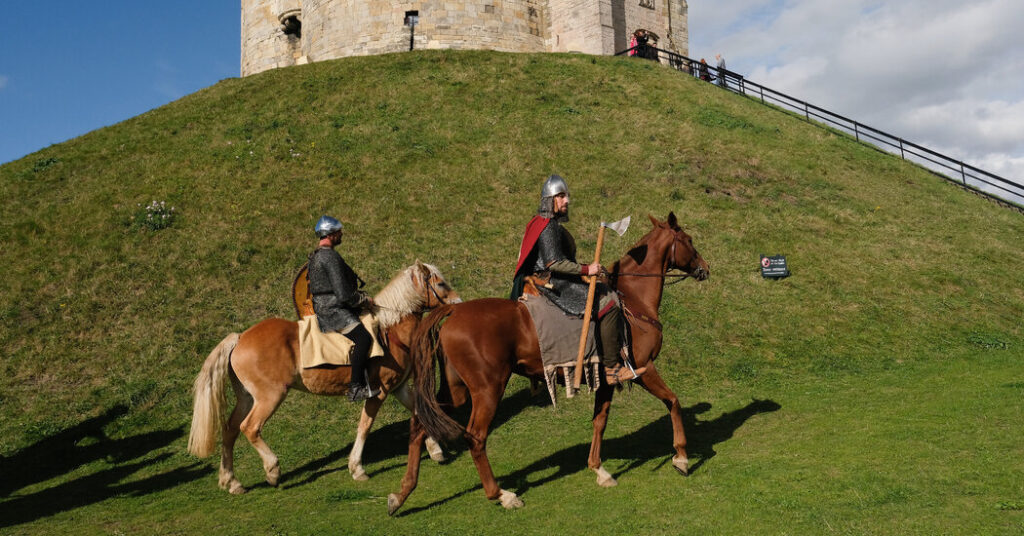
The year was 1066, and after battling marauding Vikings, Harold Godwinson, the last Anglo-Saxon king of England, marched his bedraggled troops more than 200 miles south to the Battle of Hastings where the exhausted men fell to defeat by William the Conqueror.
That is, at least, what generations of Britons were taught about the prelude to the Norman Conquest — the last successful invasion of their island.
But new research suggests that rather than marching for days at breakneck speed, King Harold II’s army may have made a more restful journey — by ship.
That could change the way Britons see Harold and his defeat in one of the nation’s most decisive battles, according to Tom Licence, a professor of medieval history and literature at the University of East Anglia, whose research it is.
The mythology of the forced march — which some Britons re-enacted a decade ago in medieval costume — has shaped the image of Harold as one of the most headstrong losers of English military history.
“It is very much part of Harold’s story in our national psyche,” said Prof. Licence. He argues that if Harold traveled by sea, that would show him to be “a better commander, a more sophisticated character, and more versatile general,” rather than someone “rushing up and down the country desperately trying to get from one battle to another.”
Prof. Licence came to his conclusion after re-examining medieval texts that were used by scholars from the Victorian era to infer that, earlier in 1066, Harold had been forced to disband his flotilla.
Instead, Prof. Licence argues, a reference in the Anglo-Saxon Chronicle, a crucial text, to sending the fleet “home” in fact meant that they were dispatched to London, their base.
That would have made them available to Harold when he learned in September 1066 that the Viking king, Harald Hardrada, had invaded the north of England. It would have allowed Harold to ferry troops north to Yorkshire where they scored an emphatic victory at the Battle of Stamford Bridge.
Ships would have been on hand days later, Prof. Licence suggests, when news arrived that William, then the duke of Normandy, had invaded the south. Harold could have used the fleet (augmented, possibly, by captured Viking boats) to move forces to London.
From there, Harold’s progress to the Battle of Hastings would have been a manageable 60 miles — not a crippling forced march.
“Only a mad general would have sent all his men on foot in this way if ship transports were available,” Prof. Licence said. He points to the use of an Old English term normally translated as “fleet” to describe the force that was assembled by Harold close to Stamford Bridge, and to the lack of any mention of a forced march in contemporaneous accounts.
Other academics agree with that but not with all of his conclusions.
Erin Goeres, an associate professor of Old Norse at University College London and the author of a forthcoming book on the Battle of Hastings, acknowledged that the legend of a forced march is “probably overblown.” But she added: “It is likely that Harold Godwinson moved troops by both land and sea, and most likely, many of the troops that moved by land would have been mounted.”
Evidence is tantalizingly sparse and, while the famous Bayeux Tapestry depicts the Battle of Hastings, it is silent on how Harold’s forces got there.
Dr. Goeres added that the new research is “a useful reminder of what we don’t know,” but questioned whether “we have all the evidence to back any interpretation with any great confidence.”
What does this mean for those who have devoted weeks, dressed in medieval costume, to re-enacting a march that Prof. Licence believes is probably a myth?
That includes Nigel Amos, a performer of historical displays, who was part of a 2016 re-enactment of the march — on horseback and foot — organized by English Heritage, a charity, to mark the 950th anniversary of the Battle of Hastings.
Mr. Amos’s team of six riders and two on foot encountered some annoyances that Harold could hardly have imagined.
To limit contact with cars, they avoided traveling in rush hour, and Mr. Amos recalled stopping for a break at the “worst pub in the world, with the most surly landlord I’ve ever met.”
However, the most miserable day, Mr. Amos said, was trekking through the Fens, a famously flat region of eastern England. “We walked down this long straight road all day thinking ‘God, will this never end?’ It became quite surreal.”
Mr. Amos concluded that, rather than dragging a battle-weary, exhausted army south on foot, Harold more likely took only his best fighting men, on horseback. Riding along Roman roads, he argued, they could have covered 30 miles a day and gathered fresh troops in southern England.
As to the theory of ships ferrying many soldiers south, Mr. Amos pointed to logistical challenges, including feeding them on the way. “I’m not currently convinced,” he said, “but I’d love to see some evidence.”
Stephen Castle is a London correspondent of The Times, writing widely about Britain, its politics and the country’s relationship with Europe.
The post The Road to the Battle of Hastings in 1066? Maybe Not a Road After All. appeared first on New York Times.