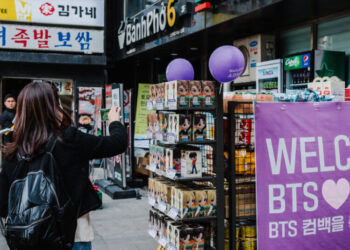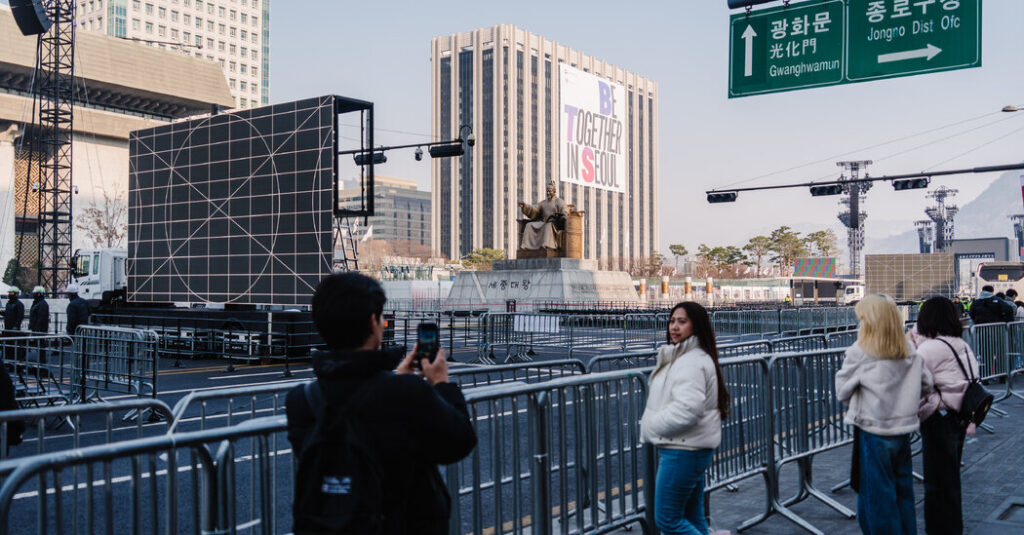
The president of South Korea has personally issued instructions on concert safety and ticket scalping. At the venue, police have rolled out security measures normally only seen at high-level government events, while several nearby museums are closing for the day.
Such is the gravitational pull that BTS exerts in its home country, where the group — a symbol of South Korea’s cultural export power — is ending its nearly four-year hiatus with a highly anticipated concert at Gwanghwamun Square in Seoul on Saturday.
But it has disrupted the rhythms of life in the immediate neighborhood. Public transportation in the area has been suspended and access to major buildings near the venue is being blocked. Some weddings in the area are scrambling to find alternative methods of transportation for their guests. At least one couple is in talks with the Seoul police to shuttle their guests with police buses, the receptionist for the venue said.
“I can’t help but question the fairness of an arrangement in which the inconvenience is borne by the public while private companies take the profits,” Kwon Yeong-guk, the head of the progressive Justice Party, said in a social media post on Thursday.
The concert is expected to generate $177 million in economic impact for the city, according to an analysis by Bloomberg. To ensure the event goes off without a hitch, the authorities in Seoul have assigned around 10,000 safety personnel to the event, including more than 6,000 police officers, and another 4,800 sent by Hybe, the company that manages BTS.
Officials say such extensive precautions are necessary for the safety of the 260,000 people expected to show up for the concert. But some are questioning whether the government has gone too far for what is ultimately a private production by Hybe and Netflix, which is livestreaming the concert.
Baram, a human rights organization based in Seoul, said in a statement on Thursday that Seoul authorities had restricted political gatherings throughout the week in the concert area — a move it called “an abuse of governmental power.”
Gwanghwamun Square has long been a cradle of political protest in Seoul, featuring regular gatherings of both far-right groups and labor unions. Protests there have drawn millions of citizens and helped depose two presidents, most recently in 2024.
The Seoul chapter of a civil servants’ labor union criticized the decision to mobilize so many civil servants for the concert.
“The responsibility for security at large-scale events lies primarily with the organizers,” the union said in a statement, adding that “the role of government bodies should be limited to supervision and a bare minimum of public assistance.” Mobilizing the public work force beyond that, it said, is “a misuse of administrative power.”
Kim Ji-hoo, a senior official with the Seoul Metropolitan Police Agency’s crisis management division, rejected the criticism that the government was catering too much to private interests.
“There are so many variables with this event in terms of security. It’s such a wide-open space and there is no knowing what might happen,” he said. “Our priority is making sure that this is a safe experience for both Seoul residents and international guests.”
The post The BTS Show Is a Headache for the Neighbors appeared first on New York Times.