Alright, we all know that Nvidia’s new AI feature that yassifies your favorite video games sucks.
But wait: if you actually look at it extra carefully, you’ll discover that — yeah, it still sucks.
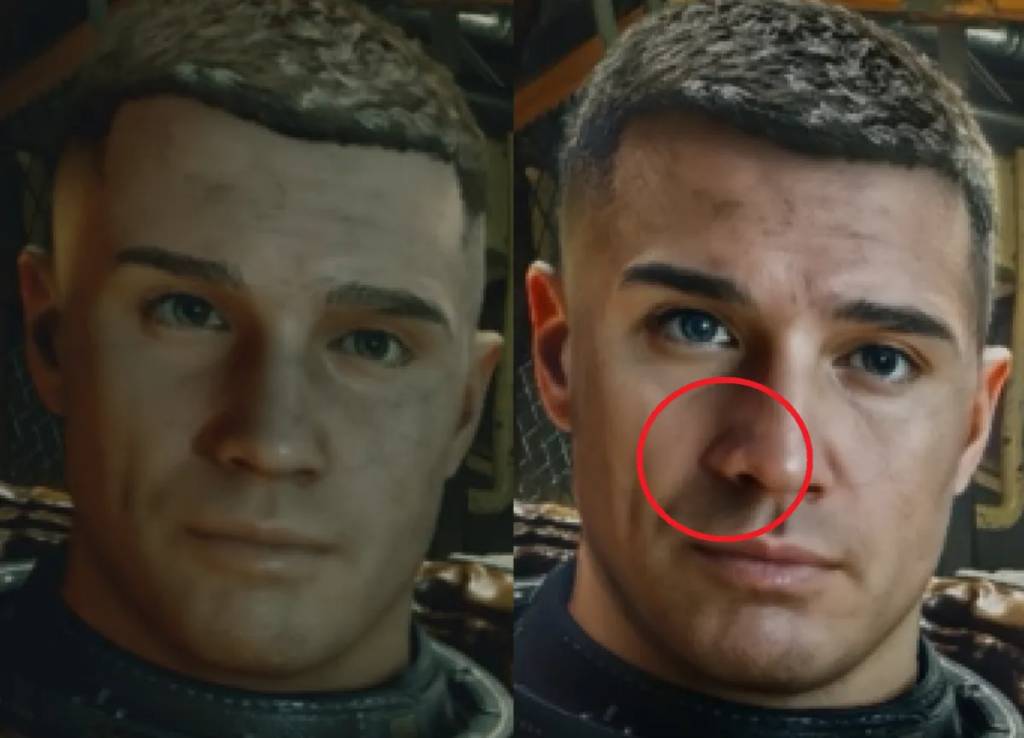
Outraged gamers unwilling to let the controversy die down have latched onto a hilarious visual screw-up in Nvidia’s presentation of its DLSS 5 feature that looks like an AI nose job gone wrong. In a screenshot of Nvidia’s tool being applied to a character from the game “Starfield,” the AI seemingly turns a facial shadow into a monstrous “giga-nostril.”
Is this uncharitable cherry picking? Ask Nvidia, since it decided to display this exact same screenshot in its official announcement.
“That’s a nostril big enough to inhale the required amount of copium to believe that DLSS 5 will be useful,” jeered one gamer in response to a Reddit highlighting the visual carnage.
“The artist couldn’t express how huge this nostril is, DLSS helped,” joked another, while many observed that the eye colors appeared to be slightly mismatched as well.
DLSS 5 turns a shadow into a giga-nostril byu/Freddy_Pringles inpcmasterrace
Nvidia announced DLSS 5 on Monday and immediately caused a volcanic eruption of outrage. Whereas previous iterations of DLSS tech focused on upscaling lower resolution graphics to boost framerates without sacrificing as much image quality, the new version uses a generative AI model to plaster often uncanny and hyperreal details onto the original imagery. Character faces look like they were Facetuned to conform to bland beauty standards. Resident Evil’s Grace Ashcroft received an AI makeover in the form of hollower cheeks and poutier lips.
The thrust of most of the criticism, beyond the feature looking like AI slop, was that it undermined artistic intent and effaced a game’s original aesthetic. Nvidia CEO Jensen Huang struck back against this framing, calling gamers “completely wrong” — the customer isn’t always right, it seems — and insisting that “direct control” was still in developers’ hands.
Huang unloaded a bunch of jargon about how DLSS 5 “fuses controllability of the geometry and textures and everything about the game with generative AI.” It’s “not post-processing at the frame level,” but “generative control at the geometry level.” He even insisted it’s not generative AI, but “content-control generative AI.”
The long and short of it is that Huang is trying to make it seem like DLSS 5 doesn’t act like a glorified AI filter. And in its announcement, Nvidia describes DLSS 5 as taking a “game’s color and motion vectors for each frame as input, and uses an AI model to infuse the scene with photoreal lighting and materials that are anchored to source 3D content.”
But PC gaming YouTube Daniel Owen released a video about an email exchange he had with Nvidia’s Jacob Freeman in which Freeman admits that it essentially acts as a filter.
“DLSS 5 takes a 2D frame plus motion vectors as input,” Freeman says during the exchange. In other words, the feature isn’t seeing 3D lighting and geometry from the game itself, and instead is working on what amounts to real-time, flat screenshots.
More on AI: Novel Pulled From Shelves After Author Is Accused of Using AI
The post Nvidia’s AI Yassification Feature Gives “Starfield” Character Grotesque “Giga-Nostril” appeared first on Futurism.