The war in the Middle East has left Hamas, the Palestinian militant group, balancing two key allies, Iran and Qatar, that are on different sides of the regional conflagration.
The United States and Israel have been waging a huge air assault against Iran, which has responded by firing missiles and drones at Israel and at Persian Gulf nations, including Qatar.
The crossfire presents a problem for Hamas: While it has repeatedly expressed its solidarity with Iran in its battle with Israel and the United States, it has subtly tried to convey to Qatar that it cares about its interests, too.
“Hamas is walking on the knife’s edge,” said Iyad al-Qarra, a Palestinian analyst sympathetic to the militant group. “Between Iran and Qatar, it’s in a very difficult position.”
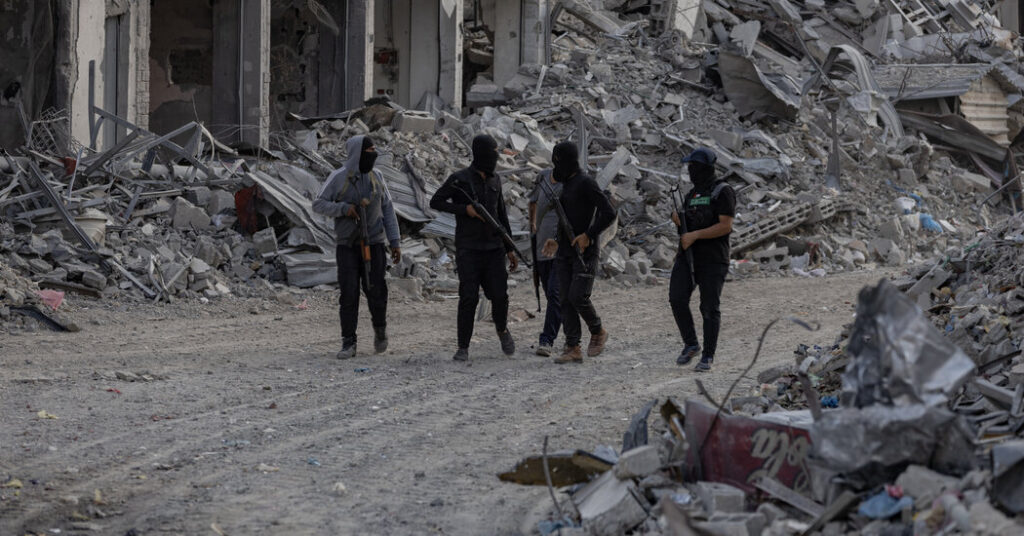
Hamas is part of Iran’s so-called axis of resistance, the network of militias that the Iranian government has cultivated in the Middle East. Hamas officials have described Iran as the biggest foreign backer of its military wing, a source of vast funding, equipment and training.
Hamas also has strong ties with Qatar, which has hosted its senior officials for years and provided hundreds of millions of dollars to Gaza — with Israeli approval — for poor families, infrastructure projects and public-sector employees’ salaries. Israeli officials have more recently said they regret the decision to allow Qatari money into Gaza, since it enabled Hamas to divert funds to military operations.
At the start of the war, Hamas condemned the Israeli-American attack on Iran, calling it “a direct assault on the entire region,” and issued a statement mourning the death of Ayatollah Ali Khamenei, the Iranian supreme leader.
“The departed martyr offered political, diplomatic, popular, and military support to our people, its cause, and its resistance, despite the pressure, the siege, and the conspiracies against the Islamic Republic,” Hamas said in its statement about Ayatollah Khamenei, who was killed in an Israeli strike on Feb. 28.
In a letter dated March 13, Mohammed Darwish, a top Hamas official, wrote to Ayatollah Mojtaba Khamenei, the son of the slain leader, congratulating him on his appointment as successor and encouraging him to continue Iran’s support of Hamas.
But for two weeks, Hamas was silent on Iran’s attacks on Qatar, even as its officials in the capital, Doha, were receiving alerts of incoming Iranian missiles and drones.
A week ago, on the 15th day of the war, Hamas issued its first and, to date, only statement on Iran’s attacks on countries in the region, calling on Iran not to target them. It did not mention Qatar by name.
Hamas’s statements, one expert said, reflect divisions within the group.
“There are two currents in Hamas: one close to Iran, which is stronger, and another close to Arab states, which is weaker,” said Esmat Mansour, a Palestinian political analyst who spent years in Israeli prisons with senior Hamas leaders. “We can see both of these currents manifesting in Hamas’s statements since the beginning of the war.”
Adam Rasgon is a reporter for The Times in Jerusalem, covering Israeli and Palestinian affairs.
The post Middle East War Leaves Hamas Balancing Allies on Opposite Sides appeared first on New York Times.