Elsa Schiaparelli, a trickster couturier who put shoes on heads and lobsters on skirts, made a certain amount of sense in Paris. Eccentrics will always have a home in the French capital, where the avant-garde can seem almost de rigueur. But what did she think of London?
“The most masculine city in the world,” she proclaimed in her 1954 autobiography. And what of the English themselves? “Profoundly honest,” but “mad, mad, mad.”
In 1933, as Europe was still steadying itself from the aftershocks of the U.S. stock market crash of 1929, Schiaparelli opened a London satellite of her thriving couture business.
The venture was less risky than it might have seemed: She was able to take over a townhouse in the Mayfair district that belonged to her lover’s brother, promptly filling the residence with some 80 workers who could translate her Parisian designs into made-to-measure ensembles for wealthy British women.
“Schiaparelli: Fashion Becomes Art,” a new exhibition opening next weekend at the Victoria and Albert Museum in London, will explore the entire arc of the designer’s namesake fashion house, all the way up to the tenure of its current creative director, Daniel Roseberry. But a section focusing on Schiaparelli’s short-lived London operation — it closed abruptly in 1939 — may be a particular highlight, making the case that what Paris’s most provocative designer offered to her British clients was hardly Schiap Lite.
“They bought clothes that were as colorful, as vibrant, as unusual, as some of the Paris clients,” said Sonnet Stanfill, the museum’s senior curator of fashion. A series of mini-profiles in a publication accompanying the exhibition suggest that the women who wore Schiaparelli designs — Peggy Guggenheim and Marlene Dietrich, aristocrats and an aviatrix — were an international sisterhood of eccentrics and capital-P personalities.
(For his part, Mr. Roseberry sees the distinction between the two cities in terms of their “different energies.” “Paris is noble, proud and dignified, a place that celebrates spectacle and stateliness,” he said in an email. “London, on the other hand, is energetic, warm, witty and spontaneous. If Paris is the week, London is the weekend.”)
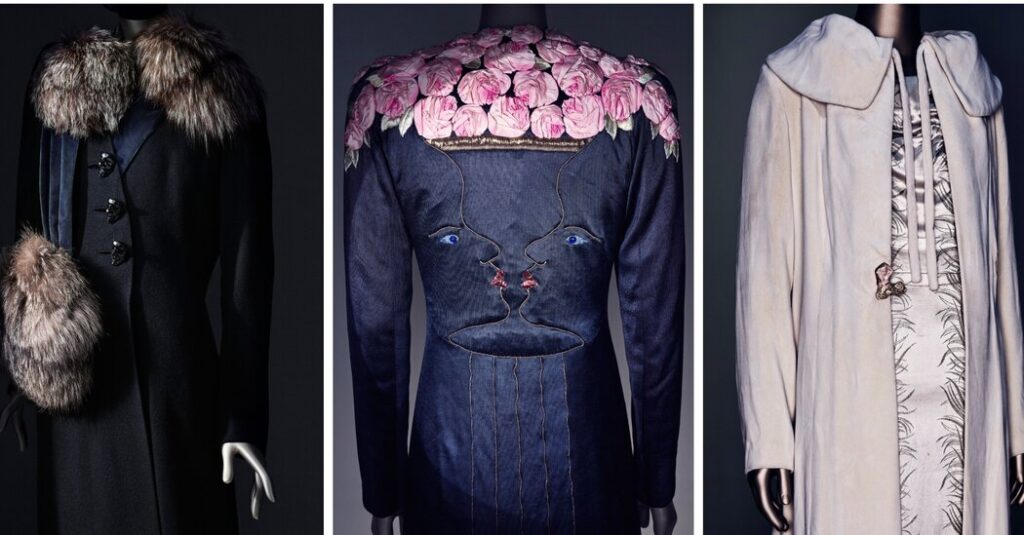
In a recent interview, Ms. Stanfill and her colleague Lydia Caston, the project curator on the exhibition, guided The New York Times through six garments made in the brand’s storied Mayfair workroom — all featuring the rarely seen “Schiaparelli London” label — that should make clear that Britons were getting nothing less than signature Schiaparelli.
Autumn 1937
Lady Alexandra Haig’s ‘Dinner Suit’
1934
Rosalinde Gilbert’s Wedding Dress
Circa 1937
Maud Russell’s Evening Dress
Summer 1937
Lady Jane Clark’s Coronation Coat
Fall 1938
Pamela Carme’s Fur Coat
Spring 1937
Jean Cocteau Evening Coat
The post How Elsa Schiaparelli Dressed ‘the Most Masculine City in the World’ appeared first on New York Times.