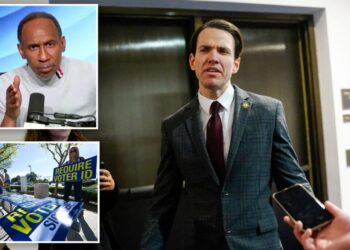
Utility bills are not typically the stuff of brass-knuckle politics in D.C. mayoral races.
But the soaring expense of gas and electricity bills, universally squeezing the wallets of D.C. residents and businesses alike, has lit a fuse in the campaign between Democratic front-runners Janeese Lewis George and Kenyan R. McDuffie, driving brittle political attacks this week and prompting more scrutiny of their records.
The loudest shots rang out last Saturday at a raucous Free DC mayoral candidate forum, where McDuffie, a former D.C. Council member, repeatedly urged the audience to “check the receipts,” insisting he had a more robust record.
“You’ve got a candidate who talks about lowering utility costs and wants to point the finger. She hasn’t introduced a single piece of stand-alone legislation to deal with the problem,” McDuffie said. As Lewis George yelled back, he walked off the stage.
“A receipt I want you all to check is your utility bills these last several months,” Lewis George, who represents Ward 4 on the council, told the audience earlier, blaming McDuffie. “He has stood with Pepco and Washington Gas and not the people of this city.”
The issue is potentially more of a vulnerability for McDuffie, who for nine years chaired the council’s business committee and had oversight of the government body that regulates Pepco and Washington Gas. During that time, the Public Service Commission approved multiple gas and electric rate increases. Still, the D.C. Council as a whole, Lewis George included, took limited action to directly address rising costs.
Neighborhood listservs are clogged with complaints about utility bills, and dozens of D.C. residents flooded a recent council hearing to air their concerns and demand relief. Both candidates promise they would deliver it.
Why bills have gone up
D.C. residents’ average gas and electric bills have each increased about 36 percent between 2024 and 2026, according to data gathered by the D.C. Office of the People’s Counsel, which advocates for consumers and successfully sued the Public Service Commission over the most recent Pepco rate increase.
Bills have gone up for a variety of reasons, not all of which are within the Public Service Commission’s control. The rise of data centers — many in Northern Virginia — to serve AI chatbots and algorithms have sent demand for electricity through the roof. Simultaneously, Washington Gas and Pepco have been undertaking long-term infrastructure projects to upgrade the grid and replace old gas pipes that each cost tens of millions of dollars every year.
The utility commission modified and approved rate hikes for the companies to recover the project costs — passing the bill to consumers.
“My feeling is that the reason why utility rates in D.C. are increasing at such an exponential rate is that the commission has really failed in its regulatory obligation to ensure that the rates are just and reasonable,” said People’s Counsel Sandra Mattavous-Frye.
Emile Thompson, chairman of the utility commission, defended its oversight in an interview, noting that its members shaved off tens of millions of dollars from infrastructure project requests before approving rate hikes. The commission also recently approved a more targeted approach to replace only the riskiest pipes.
“These huge infrastructure projects we agree are needed for reliability,” Thompson said. “We take a tough look at every rate case. We comb the lines. We figure out where we can cut money.”
The D.C. Court of Appeals recently threw out a two-year, $123 million rate increase for Pepco approved by the commission in 2024, finding that it failed to hold a proper hearing allowing experts to scrutinize the plan. The Office of the People’s Counsel and the Apartment and Office Building Association of Metropolitan Washington, which also sued, are pushing the commission to restore electric rates to earlier levels and refund customers the difference. Thompson said he could not comment on the request, citing pending litigation.
Environmental advocates saw the court’s decision as a major, and rare, victory against utility interests. But some have questioned why the D.C. Council — namely McDuffie — did not push back more forcefully against the hikes, especially given the flaws the court found.
“He provided zero oversight,” said Mark Rodeffer, policy director at the D.C. chapter of the Sierra Club, which has endorsed Lewis George. Its political arm is pouring thousands of dollars into attacking McDuffie on the issue, including pointing to donations his campaign has accepted from Pepco and utility lobbyists.
McDuffie campaign spokesman Derrick Robinson defended the candidate’s oversight as vigorous and said no lobbyist would dictate policy.
What have the candidates done about it?
Robinson said McDuffie’s track record supports that. He pointed to pandemic-era protections that McDuffie successfully pushed the commission to enact for customers who fell behind on bills, such as deferred payment agreements and longer shutoff notices — which he pledged to make permanent if elected mayor. He also noted McDuffie’s support for major legislation expanding renewable energy production such as wind and solar.
Former council member Mary M. Cheh, who led that legislation, endorsed him, and Robinson said McDuffie received an award from the D.C. Environmental Network in 2015 for pushing other renewable energy legislation.
But Mike Tidwell, executive director of the Chesapeake Climate Action Network, which jointly signed the award with the D.C. Environmental Network, said he would not give McDuffie any award today. “From 2015 on, there’s nothing we can see that would warrant anything other than concern from climate change and energy groups like ours,” he said, citing in part McDuffie’s oversight of the Public Service Commission.
D.C. Council member Charles Allen (D-Ward 6), who chairs the transportation and environment committee, took on oversight of the commission after McDuffie resigned to run for mayor in January and said he believes its leaders “need to be asked tough questions.”
“I don’t think there was very vigorous oversight of the PSC,” Allen said when asked about McDuffie. “That’s pretty clear.” He added that he hasn’t made an endorsement “yet.”
Allen led a majority of council members — including Lewis George — in sending two letters to the commission in 2024 and 2025. They questioned how Washington Gas could justify increasing rates to pay for the wholesale replacement of aging gas pipes that may have a short lifetime, given the city was moving toward electrification and carbon-neutrality goals.
McDuffie did not sign either letter. He asked Thompson to respond to his colleagues’ concerns during a 2024 hearing.
Robinson said McDuffie preferred to more formally engage with the commission through hearings. “Kenyan did not sign those letters, but that should not be confused with support for unchecked rate increases or for asking customers to pay for investments that do not align with the District’s long-term affordability and climate goals,” he said.
Aside from the strongly worded letters, the council as a whole did not approve direct legislative action to address high utility costs, though its authority over utilities is also limited. Lewis George and McDuffie co-introduced a bill led by Allen to expand automatic enrollment in discount programs for lower-income residents. Lewis George also co-introduced legislation requiring D.C. Water to establish an amnesty program for debt.
Robinson criticized Lewis George for being the lone vote against a solar expansion bill in 2022. She pointed to concerns shared by the Sierra Club that electricity ratepayers, especially in low-income households, could face higher bills.
What would they do about it if elected?
The mayor’s power in the utilities space is limited, but primarily, he or she nominates members of the Public Service Commission and sends them to the D.C. Council. Lewis George and McDuffie backed the current commissioners as part of a unanimous council vote. The mayor can also send legislation to the council impacting the commission’s regulations or use the office’s bully pit to push for changes.
Both candidates pledge to put affordability at the center of their approach, including expanding utility discount programs and bolstering programs for households to install energy-efficient upgrades.
Lewis George’s plan broadly seeks to expand solar power and battery storage, including on D.C. government property and vacant lots, and to expand solar incentive programs for renters. She would also push for a greater range of utility rates that residents could opt in to at certain times of the day depending on how they use electricity.
“My plan is about making D.C. more resilient and about making our utility bills more affordable. I do that by fighting for the best deal for DC residents,” Lewis George said in a statement.
Robinson described McDuffie’s approach as an “all of the above” strategy to strengthen consumer protections and expand renewable energy. Some of McDuffie’s other ideas include offering free energy audits and establishing a one-stop shop for residents seeking help on their bills. He would also invest in community solar initiatives, Robinson said.
Some proposals from the candidates would seem to require negotiation with the utilities. Lewis George wants Pepco to allow customers to finance the purchase of home energy upgrades by paying off the appliances or insulation as part of their monthly bills. McDuffie would call for more leniency in bills, such as establishing limits on fixed monthly charges and allowing for longer-term, zero-down payment plans to help customers get out of debt.
Still, whether D.C. voters will ultimately be captured by the political attacks over utilities is another question. Many residents have directed their ire at the private utility companies that send them bills.
Alison Cave, a 68-year-old retiree who has lived in Glover Park for three decades, said her electric bill was over $1,000 in January and about $700 last month, an increase so unbelievable that she called Pepco to ask if there was something wrong with the meter.
If mayoral candidates had ideas to do something about it, Cave said she was all ears — but not necessarily expecting it. “I’m not sure what they can do, really,” she said, given the companies are still private. “I would just like to know, why has the bill gone up?”
Paul Schwartzman contributed to this report.
The post D.C.’s mayoral race turned negative. Soaring utility bills lit the fuse. appeared first on Washington Post.