When I left with Prime Minister Mark Carney on what is expected to be the last of his overseas tours for a while, the Royal Canadian Air Force Airbus carrying the traveling party took a very indirect route from Ottawa to Norway. We first dropped in at an airplane hangar in Yellowknife, in the Northwest Territories.
There was a connection. Unlike most of Mr. Carney’s recent globe-trotting, this trip was more about military alliances than diversifying trade in the turmoil of the Trump administration.
Ahead of his visit to a NATO training exercise in Norway, Mr. Carney said that the government would spend 32 billion Canadian dollars to build three military bases in the northern territories and to make improvements at an existing base in Labrador.
[Read: Canada to Expand Military Presence in Arctic, Following Trump Threats]
Mr. Carney has been prime minister for just over a year. And from the beginning, rebuilding and expanding the Canadian military has been one of his priorities.
The government’s focus on expanding the armed forces follows a long shift in Canadians’ thinking about what they want from their military.
In 2010, as Canada was preparing to pull its troops out of deadly combat in Afghanistan, 52 percent of respondents in a Nanos poll said that U.N. peacekeeping was an important role for the armed forces. But only 21 percent of them said they valued overseas combat missions.
Last year, in a survey by Nanos and the University of Calgary, 30 percent of respondents said they saw Canada’s role in the world as that of a peacekeeper. But 65 percent said that a strong military was necessary for Canada to be an effective player internationally.
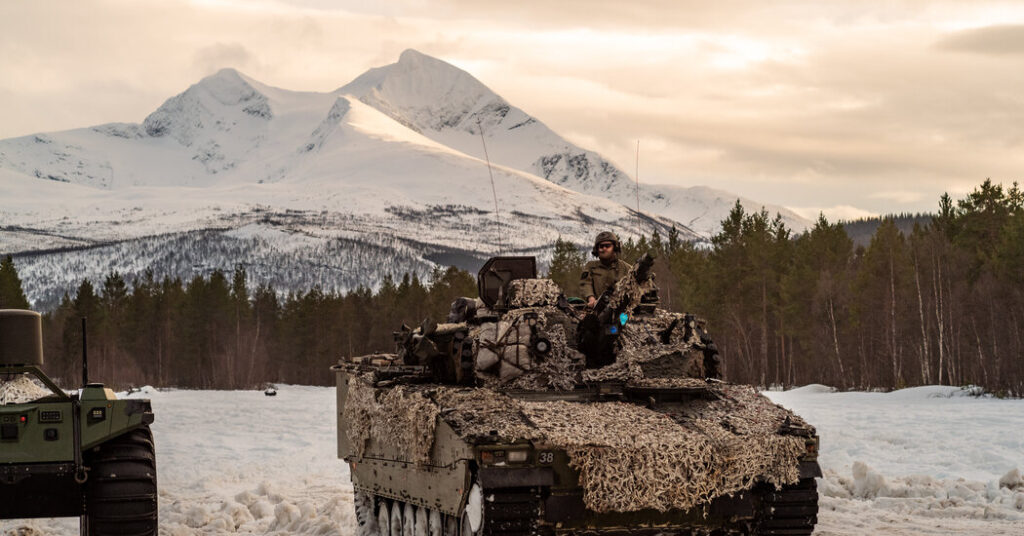
When the Airbus landed in Oslo, everyone was soon shuffled over to a Hercules aircraft for a noisy, two-hour flight to Bardufoss to look at NATO’s “Cold Response” exercise above the Arctic Circle.
The weather was disappointingly not arctic as we waited for Mr. Carney, Prime Minister Jonas Gahr Store of Norway and Chancellor Friedrich Merz of Germany to arrive in an armored vehicle. The temperature was about freezing, and it was lightly raining.
Drones buzzed overhead, tanks roared and fired ammunition, an autonomous vehicle drove itself around, and best of all, strings of Norwegian ski troops were pulled behind large snow machines with ropes making them vaguely resemble children being walked from a day care.
The military met the trade side of Mr. Carney’s roadshow when the three leaders held their news conference in the drizzle. Germany and Norway are pushing to sell Canada their jointly developed new submarine made by ThyssenKrupp Marine Systems.
They’re up against a similarly aggressive bid from Hanwha Ocean of South Korea.
The review of the two pitches is just beginning. Citing the independence of that procurement process, Mr. Carney avoided answering a question about which way the government was leaning.
Mr. Store, however, characterized a potential submarine with Norway and Germany as a way to boost collective security in an uncertain world.
“Investing together in these kind of very comprehensive capacities is about more than the capacity,” Mr. Store said after mentioning Norway’s cooperation with Germany on tanks as well as submarines. “It means also a very strong political integration between mature and trusted allies.”
On Sunday at Mr. Store’s official residence in Oslo, Mr. Carney met another military ally looking to close a major military sale: Prime Minister Ulf Kristersson of Sweden.
He was among the leaders of the five Nordic nations who had gathered to meet Mr. Carney.
The topic of Sweden’s suggestion that Canada buy fighter jets from Saab rather than U.S.-made F-35s didn’t come up — at least publicly. But there was effusive praise for Mr. Carney and his call in January at the World Economic Forum in Davos, Switzerland, for middle powers to band together on specific issues.
[Read: Nordic Leaders Praise Carney as They Discuss Arctic Security]
[Read: As Carney Travels the Globe for New Alliances, He Looks Away From Human Rights]
Speaking with a pronounced, if idiosyncratic, American accent she picked up while studying and working in the United States, Prime Minister Kristrun Frostadottir of Iceland said that political leaders and citizens of countries around the world “are very thankful for the leadership Canada has shown over the past few months.”
From Norway, Mr. Carney went to London to meet with his British counterpart, Keir Starmer, for the seventh time in the past year. Neither leader spoke to reporters afterward. But on Thursday, Canada joined Britain, France, Germany, Italy, the Netherlands, Japan and other countries in a joint statement expressing their “readiness to contribute to appropriate efforts to ensure safe passage” of ships through the Strait of Hormuz, which Iran has largely blocked since the start of its war with Israel and the United States. What the statement will mean in practical terms was not spelled out.
Finally, Mr. Carney visited King Charles III, before starting a week’s vacation in Britain.
When Mr. Carney took office, Canada was largely isolated as it grappled with President Trump’s attacks on its economy and sovereignty. Mr. Carney’s global travel before and after Davos appears to have succeeded in winning new friends for Canada and reinvigorating old alliances.
Trans Canada
This section was compiled by Shawna Richer, an editor on the International desk at The Times.
-
My colleague, the food reporter Brett Anderson, traveled to Montreal in search of rotisserie chicken heaven.
-
Norimitsu Onishi wrote about Pierre Poilievre’s appearance on “The Joe Rogan Experience,” when the Conservative leader talked about jujitsu, kickboxing and martial arts as well as Canada’s energy policies and Trump’s threats to annex Canada.
-
In less than three years as Wired’s top editor, Katie Drummond, who was born in Calgary and graduated from Queen’s University, has transformed the publication from a fading magazine and website into a buzzy brand that has become a bright spot for Condé Nast.
-
The blockbuster weight-loss drug sold as Ozempic and Wegovy will soon go generic in Canada and several other countries, significantly lowering the price and making the medicine more accessible. See how drug prices compare around the world.
-
Lululemon, the Canadian-founded athleisure company, is embroiled in a corporate power struggle that has destabilized its yoga pants empire.
-
A hydropower line from Quebec to Queens, N.Y., could power a million homes in New York City. Hilary Howard, a Times climate reporter, explores the Champlain Hudson Power Express.
-
The Canadian authorities charged two people with murder in the death of an activist who spoke out against the Iranian regime.
-
Two Toronto-area synagogues were damaged by gunfire, in the third such recent shooting in the area.
-
From The Athletic: How the Canadian men’s national soccer team decided on its World Cup kit. In a post-Olympics rivalry rematch, the U.S. team beat Canada at the World Baseball Classic. And a genuine post-Olympics tussle: Jack Hughes, who scored the goal that lifted the United States over Canada in the gold medal hockey game, is upset that the puck has ended up in the Hockey Hall of Fame. Here’s why.
Ian Austen reports on Canada for The Times. A Windsor, Ontario, native now based in Ottawa, he has reported on the country for two decades. He can be reached at [email protected].
How are we doing? We’re eager to have your thoughts about this newsletter and events in Canada in general. Please send them to [email protected].
Like this email? Forward it to your friends, and let them know they can sign up here.
Ian Austen reports on Canada for The Times. A Windsor, Ontario, native now based in Ottawa, he has reported on the country for two decades. He can be reached at [email protected].
The post Canada Shifts From Peacekeeping to Building a Strong Military appeared first on New York Times.