The United States’ $23 billion apple industry rests on a gamble: that every generation or so, scientists will produce a new variety that convinces Americans to fall in love again with the fruit that keeps the doctor away.
That gamble has a new component: The apple, once a purely regional product, must be able to survive the uncertainties and wild weather variability of global climate change and the global economy.
Behold, the Sunflare.
Seven years ago, Washington State University came up with the Cosmic Crisp, which reshaped grocery displays and generated big royalties for the land-grant university. Now the same team at Washington State’s tree fruit research program is introducing the Sunflare, bred to be just as tasty and hardier in an age of rising costs and fluctuating weather and consumer taste.
“No apple does everything for everyone,” said Kate Evans, a Washington State horticulturist who helped create Cosmic Crisp. “But hopefully every one that makes it to market does more.”
Apples are among the most recognizable foods in the world; in English-speaking countries, “A” stands for “apple.” That ubiquity means people all have their own ideas of what an apple should taste like.
But these are hard times for apple growers in Washington, where the industry employs 68,000 people, and across the United States. China produces 60 percent of the world’s supply, focusing on volume over variety. Trade wars and tariffs have reduced or shifted markets for American fruit. A rush to create new varieties over the last decade means supermarket shelves are crowded with new names and shades, all competing for attention.
”Generally in our business, across the world, the costs are going up and the threats are increasing, but consumers aren’t willing to pay the higher prices that go along with that,” said Garry Langford, the general manager of the International New Varieties Network, which works with apple and pear breeders to commercialize their fruit.
Ms. Evans has spent her research career, first in Europe and, for the past 18 years, in this fertile valley billed as the apple capital of the world, trying to make consumers reconsider their habits.
“Humans are very guilty of being lured by something new and shiny,” Ms. Evans said. “That’s what keeps me in a job.”
The products she’s trying to invent need to grow more robust as climate change brings hotter summers, wilder winters and worsening wildfire threats. But apple invention moves at the pace of human growth, not markets. From cross-pollination to patent takes 18 to 25 years.
“The amount of time is mind-boggling,” said Jeremy Tamsen, who oversees licensing and royalty work for Washington State University’s Office of Research.
Ms. Evans begins in a basement lab by imagining the characteristics she wants. She chooses two varieties to crossbreed and “pretends to be a bee,” she said, brushing pollen from one onto another. She plants the seeds, grows thousands of trees and waits years for fruit she can test for things like acidity, storage life and disease resistance. If results look promising, the process repeats.
But plant breeding is tricky. An apple that tastes wonderful when freshly picked but loses flavor or crispness after months in storage is useless to growers serving national and international markets. Most potential varieties are abandoned.
Other teams at Washington State study threats to tree fruit, such as “sunburn” damage caused by heat, and potential solutions, like thicker, redder skins.
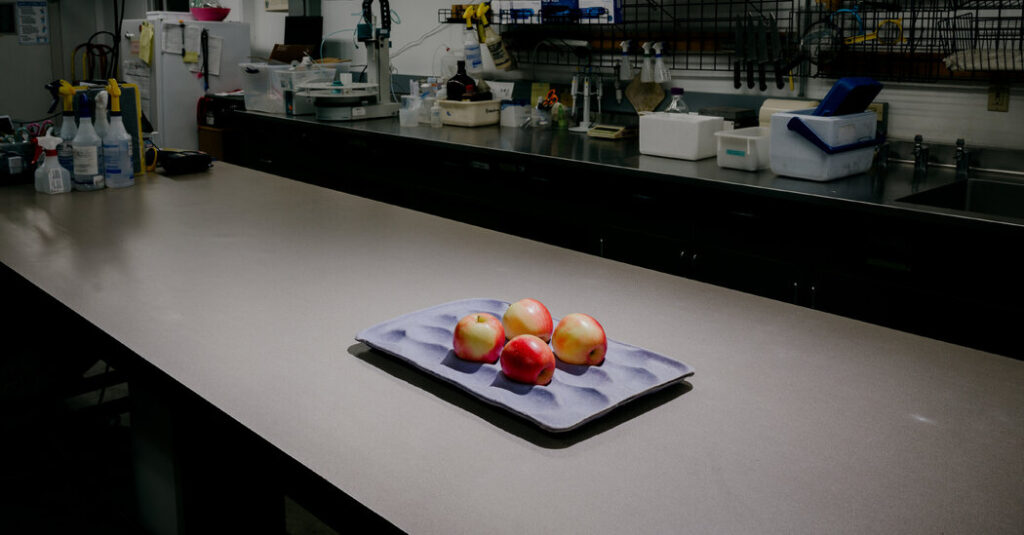
The new apple, dubbed Sunflare after a naming contest with 15,000 entries, was created when horticulturalists crossed a Honeycrisp, prized for crunch and juiciness but challenging to grow and store, with a Cripps Pink, known for tartness and comparative hardiness.
Like its parents, Sunflare — pinkish-red blush over yellow — has the balanced, sweet-tart taste that American consumers prefer but a quicker growing season and a tougher skin for heat and storage.
This winter, Sunflare has been touring colleges and farmers’ markets to build excitement among Washington growers, who will begin planting this spring and have exclusive rights for a decade. Consumers won’t see the apples in stores until 2029.
It will be the third named apple variety that Washington State has released since the tree fruit program began in 1994 and the first since 2019, when the Cosmic Crisp became an instant hit, helped along by a $10 million marketing effort. For that variety, the researchers and growers were also selling a product that they said tasted as good as the Honeycrisp but stayed fresh longer, from trees that yielded more fruit.
The Cosmic Crisp “attracted people who don’t normally eat apples,” Ms. Evans said, the dream for an industry competing in a crowded global snack market. They’re also central to the financial health of Washington State University, which earns licensing fees every time a grower plants a Cosmic Crisp or a box reaches retailers. Last year, orchardists grew 22.5 million Cosmic Crisp trees, half of them supplying Walmart, and the apple generated $8 million for the school.
Sunflare is likely to have a slower rollout. Tariffs and trade wars have hurt the market for American apples. And there are just so many new varieties: Stemilt Growers, one of the state of Washington’s largest apple producers, doesn’t plan to plant Sunflare this year.
“We’re in a place of supply struggling to align with demand,” Brianna Shales, Stemilt’s marketing director, said; there are too many new apples and “not enough shelf space.”
Anna Griffin is the Pacific Northwest bureau chief for The Times, leading coverage of Washington, Idaho, Alaska, Montana and Oregon.
The post After Cosmic Crisp, Scientists Unveil an Apple for the Climate Change Era appeared first on New York Times.