TERLINGUA, Texas — The Trump administration is building hundreds of miles of border wall through iconic national parks, public lands and ecologically sensitive wilderness, empowered by provisions in the One Big Beautiful Bill that provided $46.5 billion in funding and a 2005 law that waived dozens of environmental rules for border security projects.
The “Smart Wall” project calls for a wall in parts of rugged Texas desert that are experiencing historically low border crossings and a second wall across parts of California, Arizona and New Mexico that already have barriers from the first Trump administration, according to U.S. Customs and Border Protection documents recently posted online.
The aggressive pace — three new miles of wall a week — has alarmed advocates and national parks staff who say the construction will destroy pristine country, threaten endangered species, and cut off access to sacred Indigenous and archaeological sites. And it has sparked an unusual degree of bipartisan pushback, with sheriffs, conservative county judges, environmentalists and Texas state lawmakers lobbying Trump officials to change course.
“This is one of the largest public works projects in recent history for the U.S.,” said Eamon Harrity, wildlife program manager for Sky Island Alliance, a conservation nonprofit based in Tucson. “It’s fairly scary to think about the lack of oversight, the complete authority to build these walls without considering the environmental impacts.”
The Department of Homeland Security has issued waivers under the 2005 REAL ID Act, allowing the department to disregard the wall’s impact on plants and animals normally protected by the Endangered Species Act. The project is exempted from the National Environmental Policy Act — a sweeping law that mandates an extensive review of a federal action’s potential impacts and public consultation that can take years.
Sorting through complicated legal and property ownership issues slowed down border wall construction in Texas during the first Trump administration. But the federal government is now skipping meetings with local officials and landowners and awarding contracts to out-of-state firms. Last month, the Army Corps of Engineers sent packets to Texas landowners along the wall’s path containing maps showing the land they planned to take. The proposed construction could include anything from ground sensors and infrared cameras to 30-foot steel bollards affixed with floodlights and gravel roads for Border Patrol vehicles — and often all of the above.
Big Bend National Park has emerged as a political flash point in the new expansion, with many landowners and conservationists describing a border wall as an unnecessary encroachment from big government seizing one of the last vestiges of unspoiled freedom and frontier.
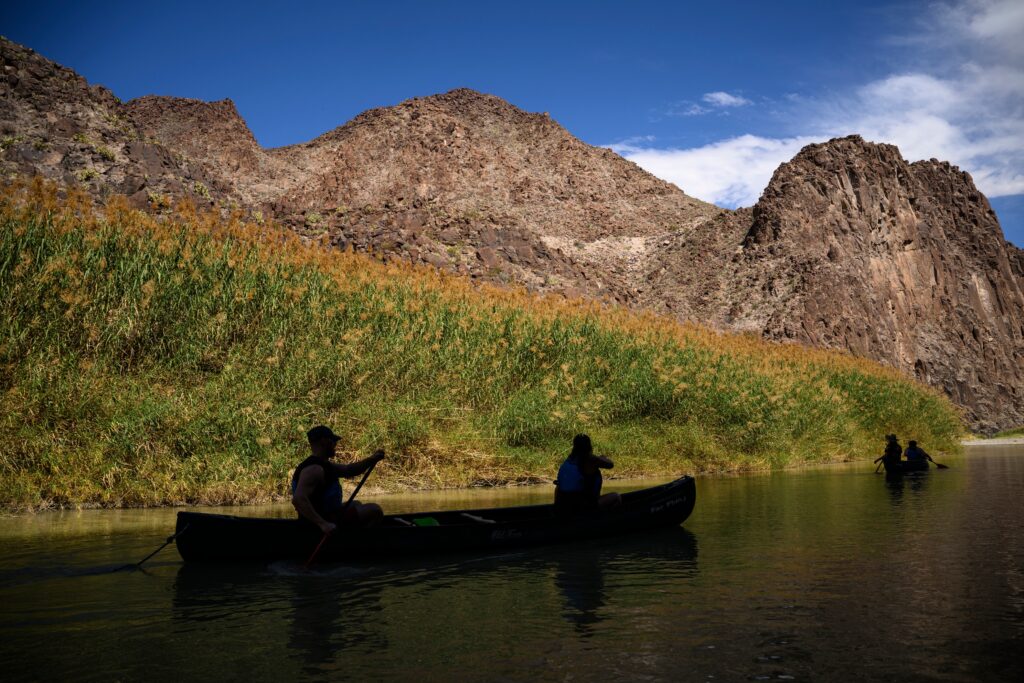
On a recent afternoon Charlie Angell, 59, who runs ecotourism canoe trips, pointed to the expanse of dinosaur-age limestone canyons carved by the jade-colored waters of the Rio Grande stretching beyond his home near Redford, Texas.
“This was where I planned on finishing my life,” Angell said. “Now I may lose my business, my home and my way of life. I guess I have to start over?”
Borderlands
Building a physical wall along the 1,954 miles of land that divides the United States and Mexico has long been a pillar of President Donald Trump’s border security agenda. But during his first term federal officials devoted most of their time and resources to replacing close to 500 miles of existing infrastructure, largely on federal land that attracted a large number of border crossers. In all, only about 80 miles of new barrier were installed.
Federal officials razed smaller barriers in environmentally sensitive locations like Arizona’s Organ Pipe Cactus National Monument and Cabeza Prieta National Wildlife Refuge and put in 30-foot-tall steel border wall instead. Human smugglers and migrants sawed through it, climbed over it or, on occasion, fell from it.
President Joe Biden said he would not build “another foot” of wall, even as illegal border crossings surged to record levels. But his administration said it was legally obligated to use the appropriated funds to finish work on 20 miles of wall in South Texas, fill in gaps elsewhere and repair concrete levees supporting the slats.
Now, despite illegal crossings dropping to historic lows, DHS and the Defense Department plan to construct more than 1,350 miles of new border wall in the Southwest, according to a Post analysis of CBP data. In addition to more than 750 miles of primary wall and roughly 600 miles of secondary wall, CBP is planning for more than 500 miles of water barriers, such as buoys, the data shows. Cameras, lights and other surveillance technology would complement the physical barriers in many places, with some areas without walls covered by sensors.
The Trump administration has issued at least $22 billion in contracts to construction crews.
“This border wall actually makes every single agent more effective,” said CBP Commissioner Rodney Scott during a February news conference. “Every investment we make in infrastructure and technology across all of CBP lets the actual agent, the human being, do things that only the human being can do.”
The new wall would include physical barriers along 62 miles of Arizona tribal lands and up to 175 miles in Texas’s Big Bend region. Critics say the secondary wall would create a “no man’s land” between the two segments that will exacerbate dangers.
Border residents say that in regions as remote as the Big Bend, maintaining roads for agents, greater broadband access and other technology can enhance border security better than a wall.
“We are killing a gnat with a sledgehammer and wasting a colossal amount of money,” said Republican Brewster County Judge Greg Henington.
Outgoing DHS Secretary Kristi L. Noem has said that when Americans elected Trump, they voted for a border wall that will “continue to protect us for generations to come.” Sen. Markwayne Mullin (R-Oklahoma), whom Trump has tapped to succeed her, also supports the construction.
Texas leaders and those living in the Big Bend region said they always thought they would be exempt. Trump himself has described the rugged terrain as being gifted with “natural boundaries.” The arid landscape, with its sheer cliffs, punishing heat, water scarcity, predators and rugged mountains, saw significant increases — 89,000 encounters — in unauthorized migration during Biden’s term. But that number was a small fraction of the millions of illegal crossings overall.
“Do people cross here? Yes,” said Terrell County Sheriff Thaddeus Cleveland, a former Border Patrol agent who joined four other regional sheriffs last week in opposing a border wall through the Big Bend national and state parks, which at 800,000 and 300,000 acres respectively span a territory nearly the size of the state of Delaware. “But they have a three-to-four-to-five-day walk often to get to the highway to get picked up.”
Brewster County Sheriff Ronny Dodson, whose jurisdiction includes Big Bend National Park, said exhausted border crossers often hail his truck in need of rescue after getting lost or running out of water. Dodson said GPS-enabled drones, surveillance beacons or improved broadband could help secure the border better than any wall ever could.
Since Trump entered office, he said, encounters are near zero in the Big Bend.
“Whatever he did to shut the border down,” he said, “Trump shut it down pretty good.”
‘On the brink’
U.S. Customs and Border Protection published an interactive map late last year indicating where construction had begun and where crews would soon begin work. But it wasn’t until the local newspaper, the Big Bend Sentinel, publicized the news in February that the wall would be built through the national park there that local officials started calling state lawmakers in an effort to lobby the White House. Residents panicked on social media, and soon the alarm was reverberating among Southwest nonprofits, businesses and environmentalists.
Tourism generates more than $54 million for the local economy — largely from hotel occupancy taxes, recreation and food sales. More than a half million visitors flock to the state and national parks annually to canoe the Rio Grande, hike the canyons and indulge in the delightful oddities of a place 100 miles from any big city.
That isolation has fostered a sense of community between the U.S. and Mexican towns on either riverbank, which a wall could sever. For $5, park tourists are ferried by boat across the Rio Grande to a pen of burros waiting to carry them into Boquillas for another $15 to eat tacos, buy souvenirs and drink Mexican beer.
At Big Bend National Park’s hot springs, sunbathers can swim 40 feet to the Mexican shore and buy $10 tamales from a family that prepares them beneath a thatched hut.
“Nosotros vivimos de esto,” said Juany Ramirez, a Boquillas resident selling hand-sewn tortilla warmers and beer koozies that say “No Wall” in blue and red thread. “We survive on this.”
Billy Bartko, who offers Jeep tours and river trips, said that if the wall is constructed it could cut his sales by 75 percent and deter many workers who cross over from Mexico via the river.
Bartko is among several locals pushing to designate the region a Dark Sky destination, which would protect stargazing views from light pollution, to draw more people to the region for epic stargazing and astronomical research. Any installation of bright lights for border security would also sink those aspirations.
Any wall construction, local leaders said, could also interfere with the hydrology of the Rio Grande. Contractors would bring in equipment, stage material, tear up local roads and stress the local infrastructure already burdened by hundreds of active-duty soldiers deployed on a border security mission.
“We are standing on the brink of oblivion,” said John Kennedy, who serves as the economic development chief for the majority-Hispanic city of Presidio and has sought to discuss the border wall plan with state and federal leaders.
A delicate balance
Construction of physical barriers in the fragile ecosystems of remote Arizona, New Mexico and Texas could deplete scarce groundwater resources and disturb animal migration patterns and other plants and wildlife, according to wildlife experts and other scientists.
In Texas, a small but growing black bear population in the Chiso Mountains of Big Bend depends on the annual influx of male bears from Mexico to sustain the population, according to retired National Park Service wildlife biologist Raymond Skiles.
Likewise, smaller groups of jaguars, antelope and bighorn sheep that live on one side of the border would be unable to pass through the border wall to find food and water to survive and link up with the main populations to reproduce, said Aaron Flesch, a research scientist at the University of Arizona.
“A jaguar is not going to climb a nine-meter border wall,” Flesch said. “Cutting off two or three isolated individuals that are in the U.S. from the many thousands to the south is going to basically end any potential for that population to recover, without human intervention.”
Crews have already drilled wells with capacity to pump more than a million gallons of water per day to support construction of one section of wall near Tucson. LED lights, which are described in CBP project documents for a 222-mile section of border, could disorient animals like bats, birds and insects, said Harrity, the Arizona conservationist.
The DHS waivers allow the wall to be built without first studying and minimizing these environmental harms, as is normally required.
“The Secretary’s waiver minimizes the risk of project delays and, in turn, puts DHS in a better position to continue to progress towards a secure southern border,” the CBP website says.
The double wall in Arizona is expected to be built 150 to 200 feet north of the existing wall. It could run through the Quitobaquito Springs in Organ Pipe Cactus National Monument and would probably trap animals, said three Interior Department staffers who spoke on the condition of anonymity because they fear being fired. The site contains the only surface water within hundreds of miles on the U.S. side of the border, making it critically important to local wildlife and Native Americans, said Lorraine Marquez Eiler, an elder of the Hia-ced O’odham Indigenous people.
Native Americans have used the springs for thousands of years, living there intermittently.
The springs are also home to the only U.S. populations of endangered Sonoyta mud turtles and Quitobaquito pupfish. The water level there fell as groundwater was pumped to build the first border wall. Heavy machinery reshaping the landscape could also disrupt their only remaining habitat, leading their populations to dwindle further toward extinction.
Three Interior employees said they fear the second wall will make it even more difficult to fight stinknet, a foul-smelling invasive plant with yellow ball-shaped flowers.
In the neighboring Cabeza Prieta National Wildlife Refuge, the structure would also run through an Indigenous grave site and an intaglio, a ground etching thought to look like a fish that was probably used for ceremonies more than 1,000 years ago.
“When we’re approaching America’s 250th birthday this year,” said Cary Dupuy, Texas regional director for the National Parks Conservation Association, “what does it mean to take care of the places that we said we were going to protect?”
Fighting for Big Bend
The bipartisan pushback in Texas may be prompting Trump officials to change their plans when it comes to Big Bend National Park.
At least 132 local businesses and organizations sent a letter to Congress, asking the appropriations committee to stop the use of federal funds for a project that would cause irreversible damage to the “integrity of our natural heritage.”
Texas oilman Rush Warren, a Republican, said he understands the need for a wall elsewhere but not in the national park: “It seems to me that whatever we’re doing is working. So why do we need a wall here?”
In Terlingua, residents packed the Cinnabar Theatre on a recent evening ready to mobilize. They have written lawmakers, formed committees to contact people who have come as tourists and posted on social media.
Archaeologist David Keller, who has surveyed the region’s artifacts, burial sites and cultural significance, encouraged the community to be disciplined but firm if construction crews come to town.
“We can be civil,” he said. “But we don’t have to be nice.”
In early March, the CBP released a new map that seemed to indicate a physical barrier would no longer be constructed in the national park. Instead, only “detection technology” would be used.
Some in the community declared victory after seeing the change.
This month, CBP solicited public comment on the plan, with the window closing in April.
Andrew Mahaleris, a spokesman for Republican Texas Gov. Greg Abbott, said in a statement that Abbott would prefer that the Trump administration deploy “technology to aid in securing the border” in isolated areas like Big Bend instead of a new wall. But Mahaleris added that Texas will support and assist the Trump administration in “deterring, arresting, detaining and deporting illegal immigrants.”
Asked whether the updated map indicates the CBP is reconsidering whether to build a physical barrier in Big Bend or a neighboring state park, the agency said it is still developing and finalizing its plan.
Local guide Mike Davidson, who fell in love with the Big Bend area as a visitor more than 50 years ago, said he doesn’t trust the federal government to be transparent about its plans and fears it is setting a dangerous precedent for protected lands.
“It’s like putting a giant billboard in Yellowstone or Yosemite,” the 73-year-old said. “They’re going to violate everything that a national park stands for and for a very small reward.”
The post A massive border wall expansion is underway appeared first on Washington Post.