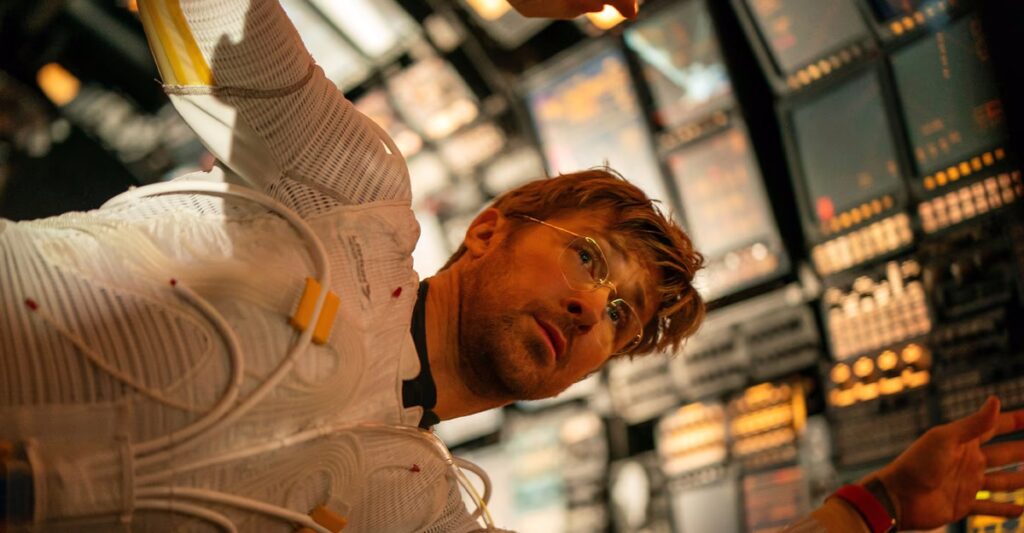
Here’s how you know Project Hail Mary is a work of science fiction: It’s about the disparate nations of Earth pooling together their resources and intelligence to confront an apocalyptic problem—in this case, the pending death of the sun, due to a mysterious alien substance. The film, co-directed by Phil Lord and Christopher Miller, is based on a novel by Andy Weir published in 2021, when the world was haphazardly confronting the coronavirus pandemic; intentionally or not, the book felt like a nakedly optimistic bit of counterbalance to international chaos and discord. The screen adaptation is similarly heartening, even cheerful—it suggests that a can-do attitude and some cutting-edge technology might be enough to see humanity through calamity. (Ryan Gosling’s sparkling smile and finely tousled hair have been thrown in for good measure.)
Is that perspective naive? Maybe, but Lord and Miller, who previously engineered similarly bouncy adventures such as 21 Jump Street and the Spider-Verse series (which they wrote and produced), are daring audiences to hope against hope. Project Hail Mary, despite its harrowing premise, is a Big Friendly Giant of a movie, told at epic scale and somewhat daunting length (156 roomy minutes). It’s the kind of dazzling-looking, all-ages adventure that’s become rare in Hollywood: a grown-up story that kids can also enjoy. Lord and Miller’s endeavor here should be easy to root for.
But Project Hail Mary’s self-conscious grandeur does sometimes get in its own way. The loose, sometimes flippant script is stuffed with goofy physical antics and nerdy in-jokes—yet the amusement occurs within a high-stakes, Interstellar-size space drama, outfitted with swanky visual effects and death-defying action sequences. The tonal mash-up is a tough needle to thread, though threading that needle is basically Lord and Miller’s specialty: They managed to invest some emotion and sincerity into a project as ludicrous-sounding as The Lego Movie without sacrificing any of the silliness.
[Read: Hollywood’s star power is shifting]
The directors’ insistence on maintaining a light atmosphere for their story about a world-ending catastrophe nevertheless sometimes set my teeth on edge. I had to remind myself how much worse the vibe could have been: Other filmmakers have fumbled as of late by trying to undermine whatever big-budget yarn they’re spinning with self-referential gags and winks to the audience; it’s as if they’re embarrassed by their source material. Lord and Miller are much more dialed into the pragmatic, chipper nature of Weir’s storytelling. The novelist loves to saddle his protagonists with a seemingly unsolvable problem, then have them roll up their sleeves and get ready to solve it with a good old-fashioned love of science. Lord and Miller, along with Gosling—starring as the one person who may be able to rescue Earth from certain death—are fiercely committed to that level of positivity.
Along those lines, it’s interesting to compare Project Hail Mary with the other big adaptation of a Weir novel, Ridley Scott’s The Martian. The 2015 movie saw Matt Damon playing an astronaut who tries to science his way off Mars, where he’s stuck with limited food or oxygen. Scott’s take was a little heavier on thrills and derring-do than Lord and Miller’s; Damon, although self-deprecating and winsome, still had the posture of an action hero. Gosling, despite his chiseled jaw and prominent biceps, is leaning as far away from that mode as he can. He plays a molecular biologist turned middle-school teacher named Dr. Ryland Grace, who finds himself alone on a spaceship when the story begins. He is plagued by amnesia, and his memory comes to him in bits and pieces, letting the viewer put together alongside Grace how he came to be there. The approach makes him more of an audience surrogate—yes, we eventually learn that he’s something of an expert in peculiar bacteria, but he figures it out slowly enough to be convincing as a lovable goof who’s still making sense of how all the buttons work.
Gosling is great at playing the dashing clown, of course. That talent is what made the flawed-but-fun The Fall Guy watchable; it’s why The Nice Guys is one of the most underrated comedies of the 21st century. Project Hail Mary, in fact, could be called The Nice Space Guy, because that’s how Gosling plays it—Grace is a regular Joe who merely happens to look like a Ken doll and has ridiculously stumbled into becoming the savior of Earth. I could roll my eyes (okay, maybe I did a couple of times), but Gosling is talented enough to make the character just plausible enough. The flashbacks eventually coalesce into backstory: Grace’s goal, he comes to remember, is to stop a species of extraterrestrial microbe that consumes solar energy. An international government coalition sent him as part of a team to a distant star that seems to hold the key, and his crewmates have died on the journey, making Grace the planet’s—and, as he soon learns, the galaxy’s—last hope.
Well, Grace and Rocky. Because although the film is basically a one-man show for Gosling (Sandra Hüller does strong work in flashbacks as Grace’s stiff but well-meaning superior), he spends a lot of it acting alongside an alien buddy called Rocky who is, well, made of rocks; think Baby Yoda, but mineral instead of animal. Rocky is from a world that’s dealing with the same issue, and most of Project Hail Mary’s tension lies in this unlikely pair learning how to communicate and work together to patch things up. The creature, an animatronic puppet, is almost too cute to function; it’s remarkable just how many big-budget sci-fi movies need a cute little guy who is destined to be turned into a toy (Baby Groot also comes to mind). But if I’m applauding Project Hail Mary for trying to be a good time for the whole family, perhaps I shouldn’t get too Grinchy about this latest example.
That was my overall takeaway from Project Hail Mary: Anytime Grace donned another T-shirt with a groany pun on it or figured out how to do a high five with his pebbly pal, I had to nudge my more cynical self in the ribs. This film is not quite the masterpiece its grand visual scale sometimes suggests it’s shooting for. Still, it’s pretty consistently enjoyable, with a message that the viewing public could afford to hear—that we’re better off joining forces than fighting one another. Project Hail Mary says that problem-solving is “for the win,” and who am I to argue with that right now?
The post Who Says You Can’t Have Fun During the Apocalypse? appeared first on The Atlantic.