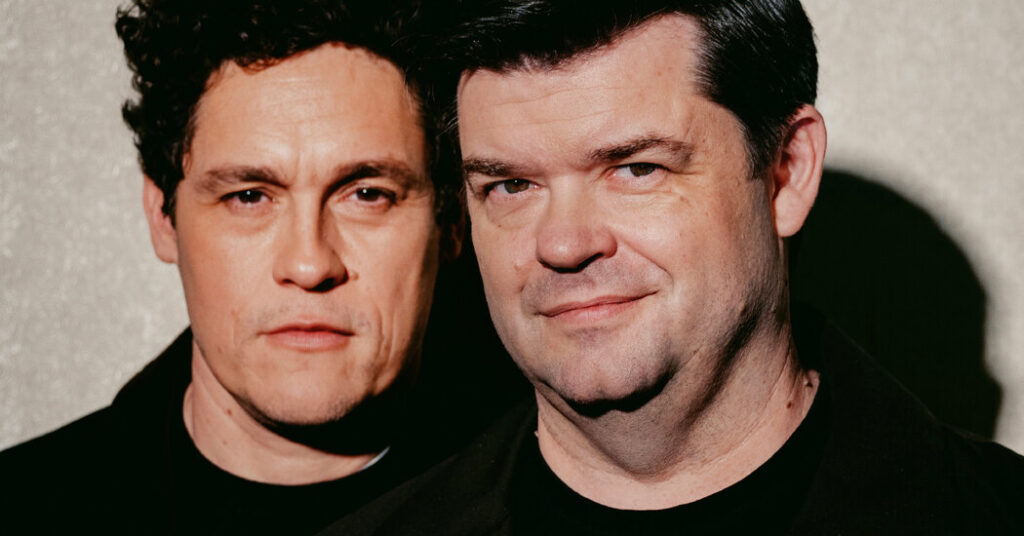
When the directors Phil Lord and Christopher Miller read the unpublished manuscript for Andy Weir’s novel “Project Hail Mary,” they quickly recognized that the story hit their sweet spot. It had all kinds of details that seemed, as Lord said, “impossible” to translate to the screen. “That’s right up our alley.” For instance, one of the main characters is a lovable but faceless alien with a rocklike skin. And while others might have balked at that challenge, Miller said they knew how to handle the impossible.
Lord and Miller have long relished tackling concepts that shouldn’t work, since their directorial debut, “Cloudy With a Chance of Meatballs” (2009), the animated adaptation of the classic children’s book, which has very little by way of story other than falling food. Next, they leveled up, turning a kitschy retro television property into a critically acclaimed comedy with “21 Jump Street” (2012). Their sequel to that, “22 Jump Street” (2014), came out the same year as “The Lego Movie,” which, instead of being the crass brand extension you might have expected, was a beloved, zany hit that celebrated creativity.
But the two filmmakers had not actually directed a feature in 12 years. They were working on Lucasfilm’s Han Solo spinoff movie, before being fired over “different creative visions” and replaced by Ron Howard, who would complete “Solo: A Star Wars Story” (2018). Since then, they have become best known as the Oscar-winning producers of the “Spider-Verse” movies, featuring adventurous animation that has often been imitated.
“Project Hail Mary,” with a screenplay by Drew Goddard, represents their return to directing and it does so on a grand scale. The adventure stars Ryan Gosling as Ryland Grace, a scientist stranded alone in space on an Earth-saving mission. As he nears the star he’s meant to be investigating, Grace discovers that he’s not alone: Another ship also contains a sole passenger, but this one is an extraterrestrial with a hardened carapace who happens to be quite charming. Grace and this stranger, whom he nicknames Rocky, soon start to work as a team. “It’s about the idea that to save the universe, you have to make a friend,” Lord said.
At a little nook off the lobby of a hotel on the Upper East Side of Manhattan, where the decorations above our table included a book on the cinema of George Lucas, Lord and Miller discussed what they brought from “Solo” into “Hail Mary,” their unusual inspirations and their desire to keep their set playful. These are edited excerpts from our conversation.
Why did the challenge of adapting this book make sense to you?
PHIL LORD The things that are daunting about the book — there’s lots of dense science experiments, it’s in the first person, there’s a rock alien with no face who speaks a musical language — those things all seemed exciting to us. I love a movie that’s about process. When we were reading the first few hundred pages it just felt like, oh, this is “Rififi” or “Thief” or something.
I love watching guys dig a hole in the ground for 20 minutes. I can’t believe how compelling that is. So we’re like, “I bet we could make you interested in just watching somebody look through a microscope.” We wanted to lean into all the things that were hard. We also come from animation, so we understand that something with no face can still express itself through movement.
CHRISTOPHER MILLER People are going to be like, “Put the eyes on it because the eyes are the window to the soul.” Or, “Do we really need to have a glass wall between them at all times?” There are all these barriers to entry. Like, no, that’s what’s going to make it interesting.
There have been a lot of changes in the industry since you made “22 Jump Street.” I know you went and did — —
LORD — — we almost finished a “Star War.”
After the “Solo” job didn’t go the way you hoped, what did you think your path was going to be?
LORD We’ve been busy the whole time. But I think we’re always looking to find ways to do something that no one else is doing. When we set out to make “Solo,” what I love about those movies is they’re independent films, so we were interested in that and in that character. And that’s the energy we brought to “Spider-Verse.” We can do something in animation that hasn’t been done yet.
Approaching [“Project Hail Mary”], it was almost contrarian to make a movie that’s so affirming about a topic that is on everyone’s mind, which is this idea that we’re doomed. What I love about Andy’s book and what we’ve always tried to do in our work is not just present problems but try to suggest solutions. This movie is suggesting that we are capable.
Hopefully the audience comes out and they feel a little more capable in part because Ryan was really interested in this choice that he was only going to be good at one thing, and he was going to be bad at everything else. He’s bad at space, he’s afraid constantly. Clumsy. And he has social anxiety, but he’s really good at microbiology.
Did you learn anything about making space movies on “Solo” that you took into this?
MILLER We made a lot of great relationships with crew members and a lot of them worked on this movie. Every time you make a movie you learn something.
LORD No matter how it turns out, they can’t take away what you’ve learned.
MILLER We met Neal Scanlan and the creature shop team that we worked with to make Rocky, for example. We had such a great experience with them, making these aliens and robots together. That experience made us very confident that we could get a lot of Rocky’s performance through puppetry.
LORD Sound department, costume department all came from the “Solo” crew.
You are very hands-on as producers, but was there a transition to directing again?
LORD I’m not even trying to be evasive: No.
MILLER Animation is a lot like live action, it’s just spread out and the process is kind of backwards, like you start with editing and you finish with lighting. There’s a lot of animation in this, too.
LORD We introduced a crew screening Sunday, and I was surprised because half the people were “Spider-Verse” crew members that had doubled up.
MILLER Crazily, some of the stuff that we did on this movie is leaching its way into the new “Spider-Verse” movie. There’s this process that we used with [Greig Fraser. the cinematographer] before we shot anything: a virtual preshoot with virtual sets and a guy with a suit and pingpong balls on.
LORD For two months we spent every morning on a motion-capture stage, shooting the movie.
MILLER Making sure the set for the inside of the spaceship was the right set and the outside of the spaceship was the right set.
LORD And being playful and discovering things in a way that you can’t when there’s 200 people. Rocky was a stick and we would run around the stage with a stick. Chris would chase me. It was so successful we hired Alice Brooks, who just finished shooting two “Wicked”s, to be the DP [director of photography] of “Spider-Verse.” It’s the first time we’ve ever had a live action DP, and we set up a virtual camera stage and she and her team are shooting the movie as we speak.
How do you maintain the playfulness you want with the demands of production?
LORD When Ryan is on wires?
MILLER You have to figure out where you want the wires to go for the zero gravity stuff. And you have to figure it all out in advance and plan and plan and plan. And then you want to give a playground for [Gosling and others] to figure out something new.
For the zero G wire stuff, we had this rig that allowed, instead of him just being a high school production of “Peter Pan” slowly going on a line, we had it so that he could spin his body any which way and do air parkour.
We had talked to NASA people about what it was like in zero G the first time, and they’re like, “It’s messy. You bonk into stuff, you’re awkward. You want to throw up. You don’t know what you’re doing.” So, we let Ryan use his creativity and his comedic timing to bonk into everything and find his way.
You mentioned “Rififi” and “Thief.” What were other touchstones you were looking to as you were making this?
MILLER A movie called “Dark Star.”
LORD The John Carpenter, very early student film.
MILLER The messiness of space. Lived-in, real space. Not slick, clean.
LORD It’s a keystone movie because Dan O’Bannon wrote it and is in it, and then that leads to “Alien” [which O’Bannon wrote] and its photography is something we looked at a lot. It’s weirdly warm looking and the ship is really lived in also.
MILLER Another weird touch point, which will make no sense, is “Harold and Maude.” Unlikely friendship.
LORD A funny movie about dying. Bridging a huge generation gap and finding your commonality. A lot of cool ’70s music.
You’ve spoken in the past about how there were low expectations for your early movies. Now the expectations are very high. How do you deal with that?
LORD We’re both high anxiety. But we were just as high anxiety making “Cloudy With a Chance of Meatballs.”
MILLER Nobody puts more pressure on us than ourselves. We came on this movie when it was a manuscript, before it became an international best seller with rabid fans around the globe. And even back then, we’re like, “We have to do justice to this story because it’s a beautiful story.”
LORD We’re not particularly strategic from a Hollywood business standpoint. Our strategy is to make things as good as we can, and then pray.
All of your films, including this one, have a reverence for pop culture. How did you think about filtering your own love of that through this character?
LORD We are like children of postmodernism. Went to college in the ’90s. And one of my favorite artists is Jeff Koons, who makes an appearance in “Spider-Verse” 2.
MILLER I feel like there’s no pop culture references in this movie that are from after 1992.
LORD We also are the “Simpsons” generation so there is something in our mitochondria, maybe.
MILLER There’s a “Close Encounters” reference that was really just a thing that— —
LORD Our only meeting with [Steven Spielberg] ever, before we left to shoot, it was just a general meeting. He was like, “What are you working on?” And we pitched him the movie and he was like, “Rocky speaks in music language? He should do the ‘Close Encounters’ thing.” OK I’ll take that as a green light.
The post What the ‘Project Hail Mary’ Directors Learned From a Firing appeared first on New York Times.