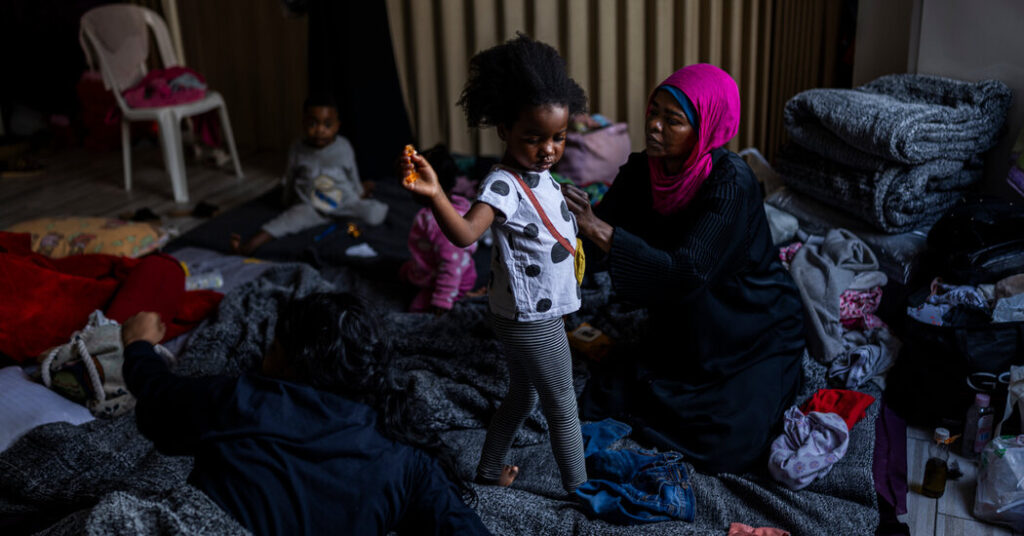
Sumeya Babaker gently tugged at her daughter’s hair, smoothed oil across her face and straightened her T-shirt . As Friday morning dawned in Beirut, Lebanon’s capital, Ms. Babaker wanted her middle child to look her best for Eid al-Fitr, the day marking the end of the holy month of Ramadan.
But this was no ordinary Eid.
Lebanon has been gripped by war for nearly three weeks since Israel began responding to rockets fired by Hezbollah, the Iran-backed militant group. Over 1,000 people have been killed in Israeli airstrikes since then; over a million have been displaced. For many, the spiritual stillness of Ramadan and the joy of Eid have been replaced by the constant hum of uncertainty: where to sleep, what to eat, whether home still exists.
“This is a difficult Eid day,” said Ms. Babaker, 36, a mother of three, originally from Sudan who had fled Kafra, in southern Lebanon, after Israel’s mass evacuation orders.
That’s when Ms. Babaker and Omar, her husband, bundled their children onto a borrowed motorcycle and drove 10 hours to Beirut. They left behind everything they had built with Mr. Babaker’s daily wages working on farms. In the rush, she said she forgot to bring her diabetes medication.
“Now we have no work, no money and that means the children cannot have any fun today,” she said.
Still, she added, they were safe. For now, that was enough.
Ms. Babaker and her family have found shelter in an unlikely place: The St. Joseph Church in east Beirut.
The church opened its doors to foreign migrants in the country as soon as the war began, largely because they have found it harder to find places in government-run shelters. Over 190 people — from countries including Sudan, Sri Lanka, Bangladesh and Sierra Leone, most of them displaced from southern Lebanon — have sought refuge there, according to Michael Petro, the emergency shelter director with the Jesuit Refugee Service, which is helping the church.
The decision to open the church’s doors, Mr. Petro said, was an act of charity but also reflected how Lebanon’s identity is shaped by overlapping faiths, and how the nation’s instinct for coexistence flickers stubbornly.
During the 2024 war between Israel and Hezbollah, the church hosted many Muslims and Christians, who at the time were marking Advent. This year, the war unfolded during Ramadan, as Christians observed Lent.
“It’s mutual sharing, it’s mutual fasting and a mutual preparation to hold space for one another,” said Mr. Petro, an American Jesuit.
“There’s a little corner for every community here,” he said.
This year, after Eid prayers, volunteers served tea alongside trays of biscuits and deep-fried dough balls known as zalabiya.
“We all have one God, and today, he likes us all,” said Indrani Manike, a Christian from Sri Lanka who is married to Ahmed, a Muslim from Sudan.
Ms. Manike, a 37-year-old cook, said she had been unable to carry much of her two children’s clothes or toys when she fled her home in Nabatieh, in southern Lebanon. The most she could afford for Eid was to decorate her daughter’s hand with henna.
“We lost everything,” she said. “We are at zero.”
For many in Lebanon, Eid is hardly the usual joyful holiday. Displaced families have left behind businesses, homes and ancestral farmlands.
Many had fled southern Lebanon during the 2024 war. Many now fear that Israel is preparing for a sweeping ground invasion of the area.
When the latest war began, Ali Fakih, a 54-year-old car mechanic, refused to follow evacuation orders and leave his village of Merouaniyeh in southern Lebanon. After an Israeli airstrike killed his cousin, he fled with his wife and three children.
For Eid, Mr. Fakih and his family usually pray, take the children out for a meal, then go to playgrounds or visit relatives. Now they are sleeping at a stadium in Beirut. Overnight rain had poured through concrete columns and seeped into their tent. Mr. Fakih’s children sat on a flimsy mattress, chewing on a flatbread.
“No one and nowhere is safe in this war,” he said.
Abdi Latif Dahir is a Middle East correspondent for The Times, covering Lebanon and Syria. He is based in Beirut.
The post ‘We Are at Zero’: War-Weary Lebanon Marks Eid With Muted Celebration appeared first on New York Times.