The U.S. military struck a boat in the eastern Pacific Ocean on Thursday, sinking the vessel and leaving three men adrift at sea, the Defense Department said on Friday.
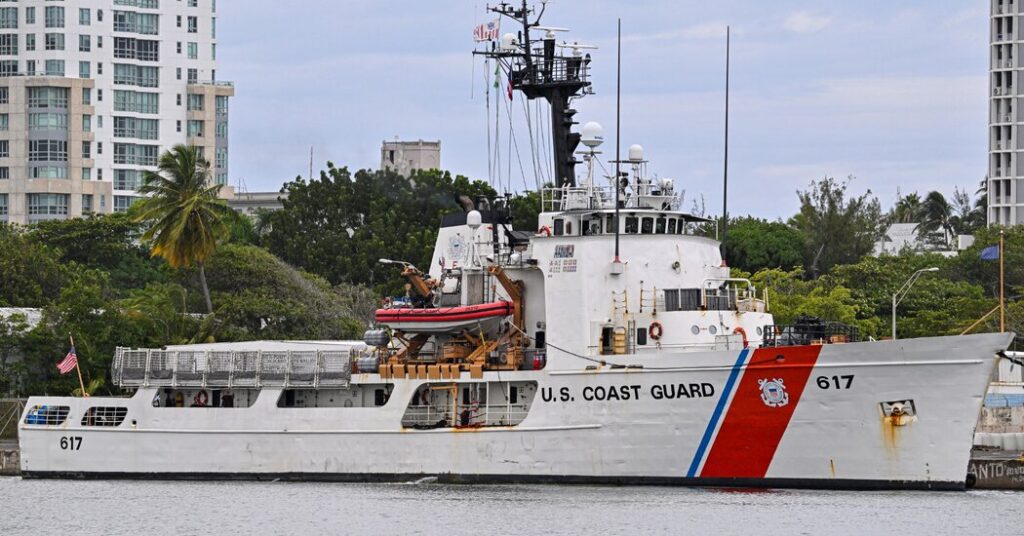
Hours later, the U.S. Coast Guard said it recovered two dead bodies and one survivor from the same area and turned them over to Costa Rica’s Coast Guard. A Coast Guard spokesman did not directly connect the rescue operation to the boat strike, instead saying that U.S. Southern Command notified them of “three individuals in distress,” a phrase usually used in a peacetime and civilian context.
The Trump administration has previously sent survivors of boat strikes out of U.S. jurisdiction as part of an effort to avoid legal scrutiny of President Trump’s campaign to kill people his administration accuses, without providing evidence, of smuggling drugs at sea.
The U.S. Southern Command announced the strike on social media with a 16-second video clip that showed a small boat moving in the water suddenly exploding. The end of the video shows the vessel burning. The U.S. authorities did not provide details about the survivor, whose nationality is unknown.
U.S. Southern Command had said in its own statement that it had “notified U.S. Coast Guard to activate the Search and Rescue system for the survivors.”
Thursday’s strike, the 46th of its kind since the campaign started in September, raised the death toll from the strikes to at least 159. Legal specialists on the use of lethal force have said the strikes are illegal, extrajudicial killings because the military cannot deliberately target civilians who do not pose an imminent threat of violence, even if they are suspected of engaging in criminal acts.
When people survive the initial strikes that blow up the boats, the Coast Guard is dispatched to find them. Most of those survivors are never found, and they are presumed dead. U.S. officials have been directed to send any rescued survivors back to their home countries or to a third country, to avoid potential court cases involving survivors in U.S. jurisdiction that could force the Trump administration to show evidence justifying the lethal boat strikes.
At one point last year, Pentagon lawyers asked whether two survivors of a boat strike could be sent to the Terrorism Confinement Center in El Salvador, a notorious prison known as CECOT, to which the Trump administration had delivered hundreds of Venezuelan deportees. The survivors were ultimately repatriated to their home countries of Colombia and Ecuador instead.
The Trump administration has so far not provided evidence of drug smuggling. It has instead relied on arguing that the boats it suspects of carrying drugs pose an imminent threat to the United States, though the surge in overdoses over the last decade stems mostly from fentanyl that comes from labs in Mexico, not cocaine that comes on boats from South America.
The Southern Command, which oversees military operations in Latin America and the Caribbean from headquarters near Miami, routinely cites unspecified intelligence in their announcements of the lethal boat strikes. On Friday, Southern Command said the boat had been traveling on “known narco-trafficking routes” and was “engaged in narco-trafficking operations.”
Chris Cameron is a Times reporter covering Washington, focusing on breaking news and the Trump administration.
The post U.S. Recovers Man From Pacific Boat Strike Area appeared first on New York Times.