Patrick Brown is a fellow at the Ethics and Public Policy Center.
The success of the Democratic Party’s “affordability” push seemed initially to catch President Donald Trump by surprise. Yet high housing costs don’t merely weigh on young people’s minds; they directly inhibit their ability to start families. Increasingly unaffordable housing has been shown to have a direct relationship to lower marriage and fertility rates. Good thing, then, that the real estate developer in chief has decided to get serious.
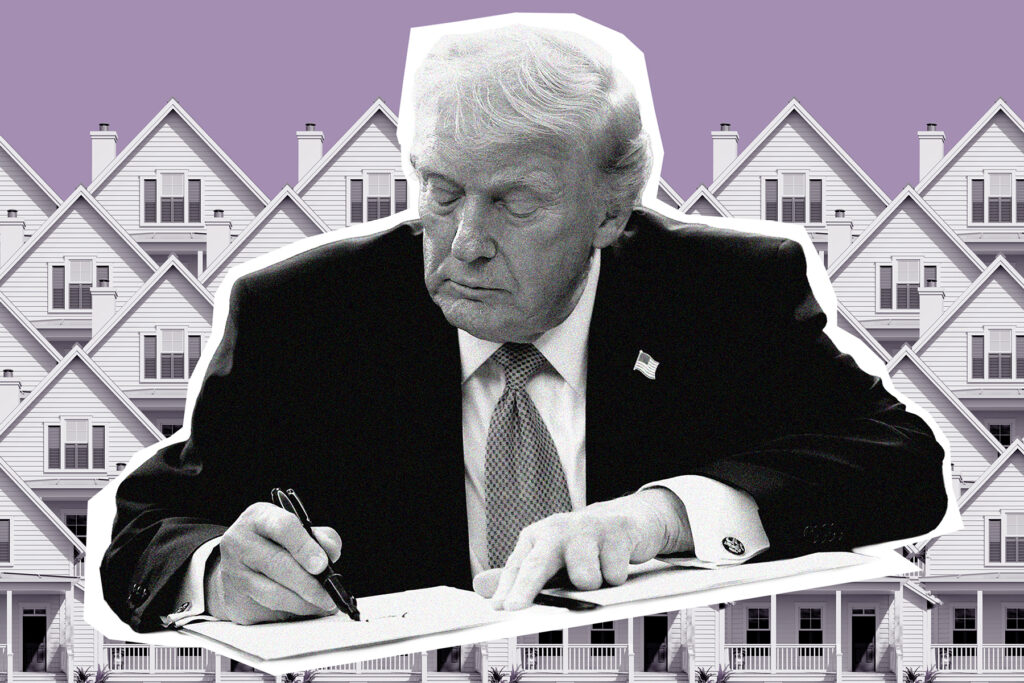
Enter the new executive order, “Removing Regulatory Barriers to Affordable Home Construction,” which the White House announced last Friday. The measure seeks to cut red tape and reduce associated costs. Most notably, however, it endorses the idea that the only way to make housing affordable is to build more of it.
Nothing takes up a bigger share of a typical family’s paycheck than its rent or mortgage payment, and no focus on “affordability” would be complete without a plan to make housing less expensive. Progressives, and even some populist conservatives, recommend simply subsidizing demand. Yet that’s a trap. Without limiting costs and unleashing supply, more money spent on affordable housing programs or filling new savings accounts would bid up the cost of units that are already bought or built.
The White House’s executive order, by contrast, correctly sees supply-side reforms as essential. In doing so, it also successfully threads a political needle. The order encourages states and localities to adopt more of the “yes in my backyard” spirit to ease the housing crunch — but in a way that is politically palatable to those who fear that progressive urbanists are out to destroy the suburbs.
Conservative housing policy has tended to fall into two camps: the market purists and the exurban defenders. The first school, identified with more libertarian scholars, has stressed the importance of stripping back regulations and letting markets do what markets do best. At times, it has made common cause with progressive housing analysts, who often see zoning and land-use regulations as bound up in race and class, and treat most state and local restrictions on property as inherently suspect.
The second cohort applies market principles with a different focus. Scholars such as Wendell Cox, Joel Kotkin and Stanley Kurtz warn that the abolishment of zoning regulations could lead to suburbs being “upzoned” into dense clusters of high-rise apartments. They endorse sprawl, eliminating environmental restrictions like urban growth boundaries and green belts, and favor single-family homes on big yards.
The president has now given each camp something to love. His executive order directly tackles fees associated with the Clean Water Act and the National Environmental Policy Act, both of which can add major costs for developers. Rightsizing those, along with scaling back some green-energy goals, could ease some costs builders pass along to buyers, sometimes to the tune of tens of thousands of dollars.
Even analysts on the center-left could applaud parts of the order. It directs the Department of Housing and Urban Development to develop best practices to help states and localities reduce the barriers between blueprint and finished homes. If adopted, these principles could lead states to cap the length of time properties sit on developers’ applications or to streamline various parts of the permitting process. The order even suggests allowing “by-right” development for single-family homes, which would give those wanting to build the presumption of being able to do so without being forced to seek a variance or zoning board approval.
Libertarians might object: Why not include duplexes, triplexes or “mother-in-law units” too? But the wisdom of the administration’s approach is that it is trying to coax states and cities to be more friendly to development without scaring them off. If a city or town wants to adopt more liberal guidelines, it’s free to do so. In general, red states have tended to be friendlier to new housing construction, of all types, than blue and purple ones.
Too many Republicans nevertheless feel as if their neighborhoods are already “large enough,” and that the influx of newcomers is evidence of a state becoming a “victim”of its own success. Many residents, counting on their paid-off mortgage as a kind of nest egg, likewise react negatively to proposals to increase the housing supply. Their voices were the ones in the president’s ear when he said he didn’t “want to drive housing prices down.”
All this suggests the importance of getting a Republican administration to put political and rhetorical muscle behind encouraging state and city officials to be more welcoming to more housing. If booming red states like Tennessee, Georgia and South Carolina want to maintain their standards of living, they will need to embrace housing growth. The president’s order gives them the political cover and practical ammunition to do so.
For the party that wants to claim the label of being pro-family, housing affordability has to be a major goal. Too many younger Americans see rising house prices and despair of ever feeling like they’ll be able to get on the ladder. Half of Americans age 25 to 34 owned a home in the decades following World War II. The share is now down to one in three.
That partly reflects declining marriage rates, but even among young, married Americans, homeownership rates have fallen more than 10 percentage points from their early-1980s peak. The median sale price of a house was four times the median household income for much of the 1990s before rising to five times median income in recent years.
The demands of a midterm election year sometimes nudge politicians into championing showy, if ineffective, stabs at affordability. But real change requires something deeper. The long-term gains of the Trump administration’s helping to convince more states and localities to adopt market-friendly reforms could be worth its weight in gold.
The post The real estate developer in chief notches a housing win appeared first on Washington Post.