Before it sank more than two centuries ago, the ship had been ordered by Lord Elgin, a British aristocrat, to carry precious Greek antiquities to England, leading to one of history’s most bitterly contested cultural disputes over the future of the Parthenon Marbles.
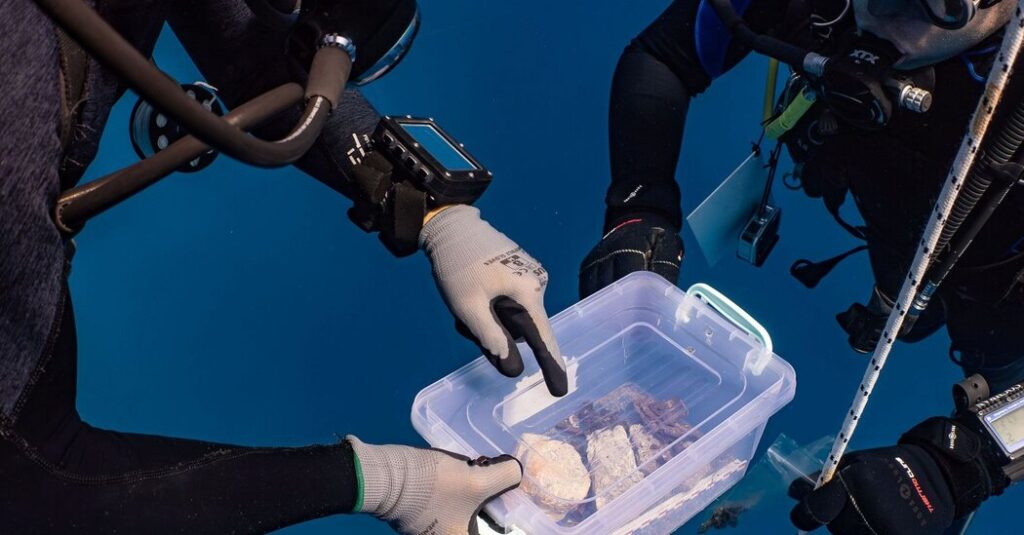
Greece’s culture ministry announced on Monday that divers who carried out an underwater excavation last year had uncovered a decorative marble fragment from the wreck of the ship, the Mentor. Though most of the antiquities were salvaged and taken to England soon after the Mentor sank in 1802, the discovery suggests that some remnants could still be on the seabed for Greece to recover.
The stone recovered by divers from the Greek culture ministry resembles a piece of the decorative trim that rested on the capitals of columns or elsewhere on ancient buildings. It is the first time that a piece of a sculptural decoration has been recovered from the shipwreck, the ministry said in a statement. Although further study is needed, the dimensions of the piece matched those for buildings such as the Parthenon in Athens, the statement said.
The recovery is a win for the Greek government, amid a bitter, enduring debate over Lord Elgin’s decision to bring — or some say steal — the precious ancient Greek sculptures and friezes from the Parthenon to England. The Greek government has lobbied for their return, accusing Lord Elgin, who died in 1841, of looting precious symbols of the country’s heritage.
British governments, however, have said that the artifacts, which are around 2,500 years old, were legally obtained by Lord Elgin at a time when Greece was ruled by the Ottomans. The Parthenon Marbles were sold to the British government and transferred to the British Museum in London, where they remain. Since 2021, the British Museum and Prime Minister Kyriakos Mitsotakis of Greece have held secret negotiations over the return of some of the artifacts, but the museum is only offering to loan items, whereas Greece wants their permanent return.
The recent find is evidence that not all of the precious cargo from the wrecked “Mentor” was successfully salvaged, said Samuel Gartland, an associate professor in ancient Greek history at the University of Leeds. Researchers had been excavating sites around the wreck to investigate whether pieces of the ship’s hull had been preserved.
The description of the fragment, with its Doric, drop-like decorative element, was consistent with decoration found on major Classical buildings, including the Parthenon, Dr. Gartland said. He added that its reported dimensions, which align with the published measurements for the Parthenon, were “particularly noteworthy.”
But Dr. Gartland cautioned that it was too early to definitively tie the fragment to the Parthenon or other buildings on the Acropolis, the ancient citadel that sits on a rocky outcrop above Athens. “Given the context of the Mentor’s cargo, a Parthenon origin is certainly plausible, but it is not the only possible one,” he said.
Still, Dr. Gartland said, the find was “unquestionably significant,” because it appeared to be the first plausible fragment of sculptural or architectural material recovered directly from the wreck of the “Mentor,” in modern times. The ship sank in September, 1802, outside the port of Avlemonas on the Greek island of Kythira.
Almost since the day they were taken, the Greek antiquities have been a source of tension between Britain and Greece. The romantic poet, Lord Byron, was among the early critics of their removal.
The artifacts are largely split between the Acropolis Museum in Athens, the British Museum in London, and other collections such as the Louvre in Paris and the Vatican Museums. In 2022, the Vatican said that Pope Francis would return to Greece three pieces of the Parthenon from the papal collection.
Isabella Kwai is a Times reporter based in London, covering breaking news and other trends.
The post Stone Fragment Is Found in Wreck of Ship That Carried Parthenon Marbles appeared first on New York Times.