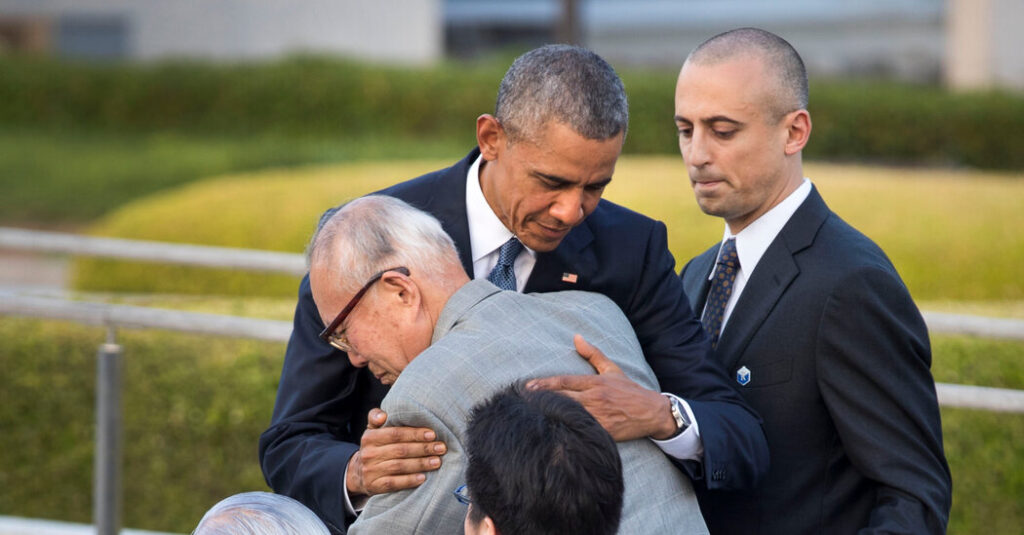
Shigeaki Mori, who survived the first American atomic bomb as a boy in Japan and then spent decades as an adult researching what happened to 12 American prisoners who were killed in the attack, an effort that led to a widely photographed, tearful encounter with President Barack Obama, died on Saturday in Hiroshima, Japan. He was 88.
His death, at a hospital, was confirmed by Barry Frechette, a filmmaker who directed “Paper Lanterns,” a 2016 documentary about Mr. Mori’s research.
Mr. Mori was an 8-year-old student on his way to school in Hiroshima when, at 8:15 a.m. on Aug. 6, 1945, an American B-29 dropped an atomic bomb over the center of the city. He was about a mile and a half from the explosion, which blew him off a small bridge into a shallow stream filled with weeds that broke his fall.
He climbed out of the water and, fearing more bombs, began to run toward the hills outside the city. Everywhere, he saw the charred and mangled bodies of people — mostly dead, but some still alive, moaning. The sky was black, and the air thick with smoke; at times, he said, he could barely see his fingers in front of his face.
“All I could do was run, run away, with tears running down my cheeks,” he said in “Paper Lanterns.”
He eventually found cover in an air-raid shelter.
In the days that followed, he reconnected with his family members, who had survived thanks to their air-raid shelter at home. Decades later, Mr. Mori recounted the grim details of the scenes he took in, wandering around the flattened center of Hiroshima: a playground turned into a mass grave; bodies floating in the Ota River; neighbors with blisters covering half of their bodies.
The Americans dropped another atomic bomb, on Nagasaki, on Aug. 9. Six days later, Emperor Hirohito of Japan announced the country’s surrender, bringing World War II to an end. An estimated 140,000 people in Hiroshima died immediately or within a few months of the bombing.
Like many in Japan, Mr. Mori’s family tried to rebuild. But the legacy of the bomb stayed with them: One of his sisters died of cancer, and he suffered health problems for the rest of his life.
More than the physical effects, the memory of what had happened drove him to learn more. He was especially interested in rumors that there had been American prisoners in Hiroshima on the day of the bombing — rumors that both the American and Japanese governments had long denied.
But after the two governments began declassifying materials in the 1970s, he started piecing together the story. During a major air raid on Hiroshima’s port on July 28, 1945, several bombers had been shot down, resulting in the capture of more than a dozen American airmen.
A few of the prisoners were sent to Tokyo for interrogation, but the rest were being held at a military police station in central Hiroshima when the bomb was dropped.
Beginning in the early 1980s, Mr. Mori spent more than 25 years figuring out who the men were and what had happened to them. Ten, he discovered, had been killed instantly; the other two died of radiation poisoning a few days later.
“They died in obscurity, and for a long time were neglected,” he said in the documentary.
He then set out find their families in the United States. Borrowing American phone books from the city library, he began making cold calls, running up hundreds of dollars in phone bills each month. It took him three years to find the first family; he didn’t locate the 12th until 2009.
Mr. Mori was also instrumental in getting the airmen added to the Hiroshima Atomic Bomb Victims Registry, a record of the names of some 349,000 people who died because of the attack, either immediately or from health complications later.
In 2016, Mr. Obama became the first American president to visit Hiroshima. In his remarks, he spoke about Mr. Mori, “a man who sought out families of Americans killed here, because he believed their loss was equal to his own.”
Afterward, Mr. Mori approached Mr. Obama with tears in his eyes. The two men embraced, an image that appeared in newspapers around the world.
“It was emotional,” Mr. Mori later told reporters. “I don’t even remember what I said.”
Shigeaki Mori was born on March 29, 1937, in Hiroshima. His father, Toshio, was an engineer who helped build the airport in Hiroshima; his mother, Toshiko, managed the household.
After graduating with a degree in economics from Chuo University, Mr. Mori worked for a brokerage firm and a piano manufacturer, devoting himself to his research at night and on weekends.
His survivors include his wife, Kayoko Mori, who also lived through the bombing; a son, Yoshiaki; a daughter, Tamami; and several grandchildren.
He compiled his research in a book, “The Secret History of the American P.O.W.s Killed by the Atomic Bomb,” published in 2008.
Mr. Frechette sought out Mr. Mori after hearing about his efforts through a family friend. He and his filmmaking partner, Max Esposito, traveled to Japan several times to interview him, bringing the relatives of two of the American airmen along with them on one visit.
When “Paper Lanterns” was screened at the United Nations in 2018, they raised enough money to fly Mr. Mori and his wife to New York City. It was the first time either had been on an airplane.
Mr. Mori “wanted to make sure people knew what happened there, so we never repeated it,” Mr. Frechette said in an email. “He made a difference in people’s lives and never once asked for recognition. That he received it made all of us so damn happy.”
Clay Risen is a Times reporter on the Obituaries desk.
The post Shigeaki Mori, Hiroshima Survivor Photographed With Obama, Dies at 88 appeared first on New York Times.