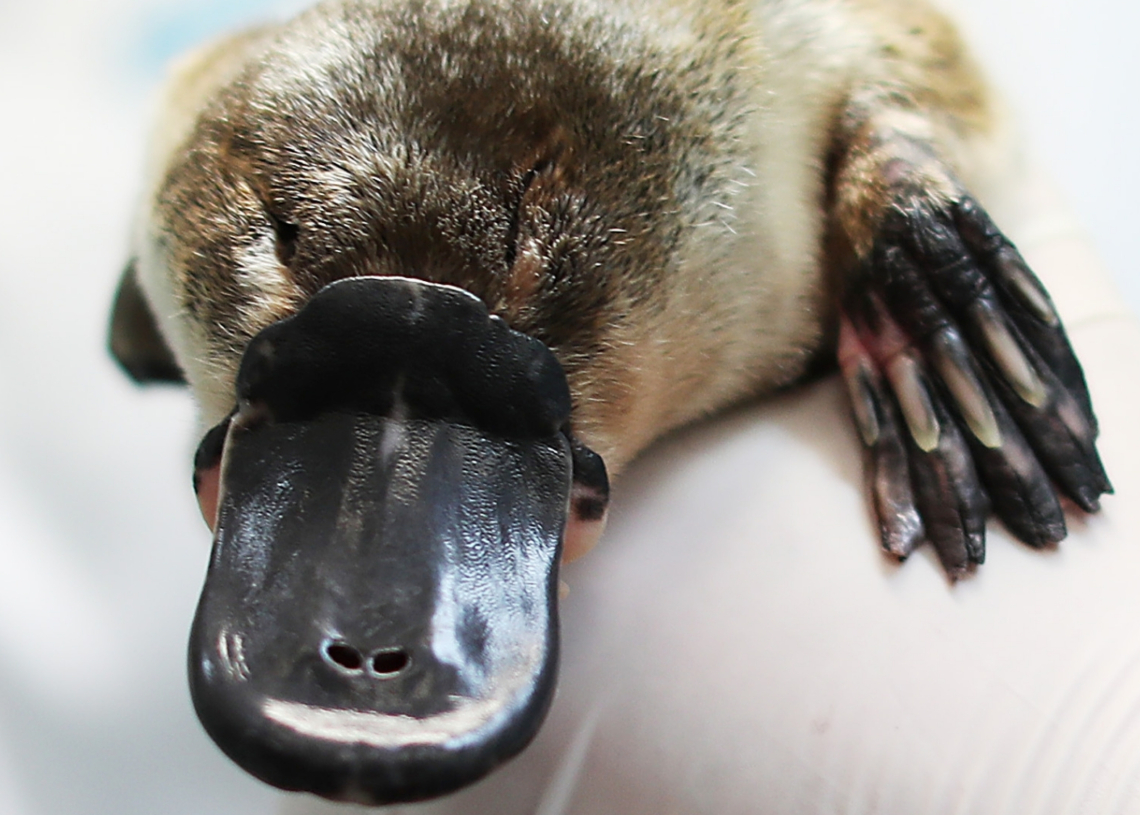
The platypus has long been nature’s practical joke. It’s a silly, unserious creature that looks like the product of having hit the randomizer button on a video game Create-a-Character mode one too many times. Now, scientists, who published their findings in Biology Letters, found that a platypus’ weirdness isn’t just surface-level; it can be found deep down at the microscopic level.
Researchers led by Jessica Leigh Dobson examined the tiny structures inside cells that produce pigment, known as melanosomes. They found that no one had ever seen hollow, spherical melanosomes in a mammal before. Unusual, because scientists long believed that mammal melanosomes were always solid and that hollow ones were a feature unique to birds.
Fittingly, nature’s oddball, the platypus, has broken that assumption.
Scientists Just Found a New Reason the Platypus Is Nature’s Weirdest Mammal
In birds, hollow melanosomes are part of what creates bright, iridescent colors. Their structure helps manipulate light, making feathers shimmer. Platypuses, on the other hand, are traditionally rather dull colored. Their fervor is a drab brown, and they have no other obvious visual eye candy besides looking like a beaver trying to disguise itself among ducks. So what gives? What does this mean for our existing theories of how color works in animals?
The platypus’s closest relative is the echidna (think Knuckles from the Sonic the Hedgehog universe), and the researchers didn’t find similar structures in them or in over 100 other mammal species. This likely suggests that this trait is an evolutionary leftover that was somehow preserved in platypuses, or platypuses evolved it for some yet unknown reason.
One possible explanation is that the platypus and the echidna shared an aquatic ancestor with hollow melanosomes that provided insulation as they swam through cold water. As the theory goes, echidnas eventually lost it as they adapted to life on land, where platypuses kept it for whatever reason.
While it’s just a theory, there is a logic to it. Evolution is weird and not always so tidy. Sometimes, unnecessary things stick around for far longer than they should. The human tailbone is a good example.
One thing that’s for sure is that the more we learn about the platypus, the more it seems like it’s the product of Mother Nature going through a weird experimental phase.
The post Scientists Just Found Out the Platypus Is Even Weirder Than We Thought appeared first on VICE.