The concept of “cryosleep” — spending prolonged periods of time in suspended animation in a deep freeze state — has been a mainstay in the world of science fiction.
While the idea of slumbering peacefully while covering vast distances in space on board a spacecraft remains a distant dream, researchers are inching ever closer to turning it into a reality.
As detailed in a study published in the journal Proceedings of the National Academy of Sciences earlier this month, a team of researchers at the University of Erlangen–Nuremberg in Germany managed to return activity to mouse brains after carefully preserving the tissue in a glass-like state, a method called vitrification, before slowly thawing them.
“If brain function is an emergent property of its physical structure, how can we recover it from complete shutdown?” lead author and University of Erlangen–Nuremberg neurologist Alexander German told Nature.
Instead of suspending entire human bodies, like Sigourney Weaver’s Ellen Ripley in the horror sci-fi blockbuster “Alien,” German and his colleagues suggest that their findings could lay the groundwork for protecting the brain following severe injury, preserving donor organs, or even suspending the entire bodies of mammals through cryopreservation.
The act of freezing is incredibly damaging to organic tissue, as ice crystals can rupture cellular walls. And that’s just the tip of the proverbial iceberg the researchers had to face.
“Beyond ice, we must account for several considerations, including osmotic stress and toxicity due to cryoprotectants,” German told Nature.
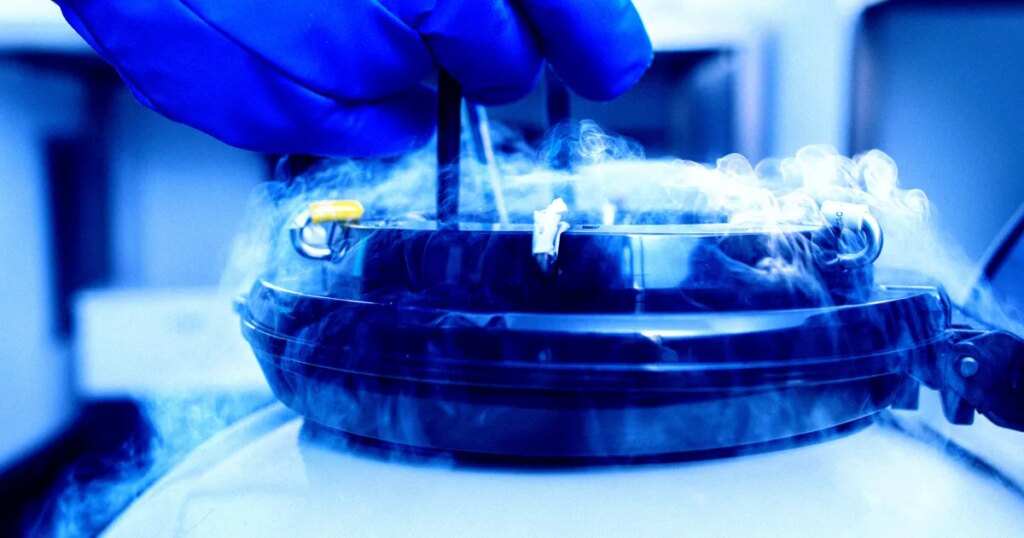
To avoid forming any ice crystals, the team focused on vitrification for their attempts to restore activity in frozen mouse brains, which traps molecules in a glass-like state by cooling liquids at extremely fast speeds.
“We wanted to see if function could restart after the complete cessation of molecular mobility in the vitreous state,” German explained.
The team started small, vitrifying 350-micrometer-thick slices of mouse brains for their study. They were dipped in a solution of cryopreservation chemicals and then cooled down to -320 degrees Fahrenheit using liquid nitrogen.
After spending anywhere between ten minutes and seven days inside a deep freezer, the team thawed the slices. They examined them using microscopy and discovered that neuronal and synaptic membranes had stayed intact despite the ordeal.
“Notably, hippocampal long-term potentiation (LTP) was well preserved, indicating that the cellular machinery of learning and memory remains operational,” the paper reads, referring to the persistent strengthening of synapses between neurons that is widely considered the cellular foundation for learning and memory.
The neurons also responded to electrical stimuli that deviated, but remained largely normal as well.
“These findings extend known biophysical limits for cerebral hypothermic shutdown by demonstrating recovery after complete cessation of molecular mobility in the vitreous state and thus contribute to achieving the objective of structural and functional preservation of neural tissue,” the researchers concluded.
The team is now excited to try out the technique on human tissues as well as entire organs for long-term preservation.
“We already have preliminary data showing viability in human cortical tissue,” German told Nature.
But before we can start suspending all biological activity to lie in stasis while awaiting our reawakening in an alien planetary system, plenty of work remains.
For one, German admitted that we will need “better vitrification solutions and cooling and rewarming technologies” before the method can be applied to “large human organs” — let alone entire mammals.
More on cryopreservation: Rich People Who Get Cryogenically Frozen Are Hoarding Their Money for When They Get Thawed Out
The post Scientists Bring Mouse Brains Back to Life After “Cryosleep” Deep Freeze appeared first on Futurism.