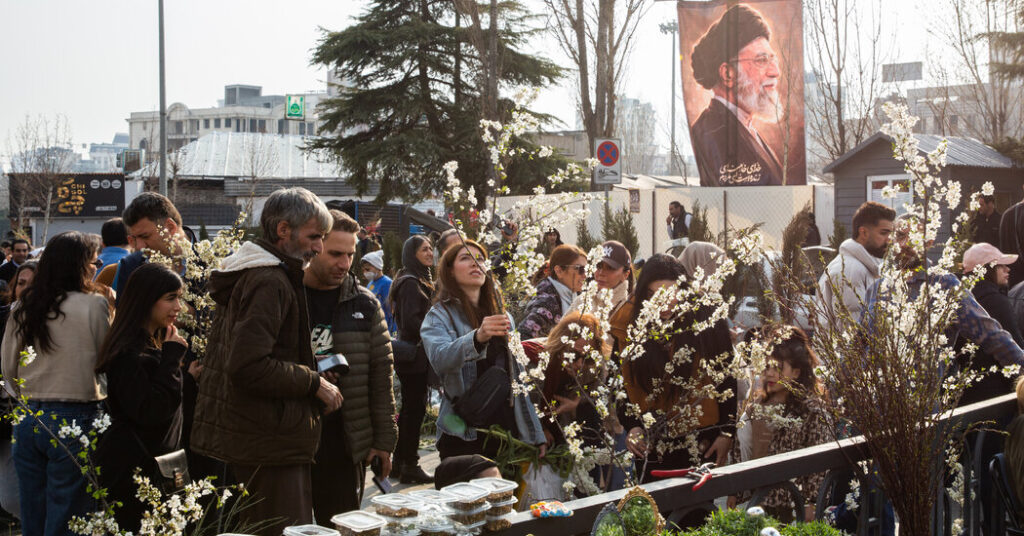
Usually, in the days leading up to the Iranian new year, Tajrish Square in Tehran is an explosion of color and joyful clamor. Merchants and customers haggle over the flowers, tableware and painted eggs that Iranians use to decorate their homes for the holiday, Nowruz.
This year, though, the mood throughout the country is subdued, as Iranians close out a year in which they have endured deepening economic misery, a brutal massacre carried out by government forces and U.S.-Israeli bombardment.
Nowruz, which falls on Friday and is believed to have been celebrated in ancient Iran since at least the fifth century B.C., marks the first day of spring and symbolizes new beginnings. Iranians traditionally set out tables adorned with objects representing renewal, health and prosperity. They buy new clothes, spring clean their homes and visit family and friends. In significance and mood, it resembles a combination of Christmas, New Year’s Eve and Independence Day.
This year, the holiday falls during the most difficult and perilous time in modern memory, giving Iranians little to celebrate. Thousands of families are still mourning loved ones killed by state forces during mass protests in January. Three weeks of U.S. and Israeli bombardment has killed civilians, destroyed homes and put the nation on edge.
Armed men aligned with the government patrol city streets, man checkpoints and question passers-by, frightening people into staying home, several Iranians told The New York Times. And persistently high inflation and the disruptions of war mean that fewer Iranians can afford the new clothes, nuts, fruits and sweets that they usually buy to celebrate the new year.
Outside Iran, several Nowruz celebrations in Iraqi Kurdistan have been canceled. Even in Akre, known in Iraq as “the capital of Nowruz” for its massive torch parades along the mountains, public events with music or dancing are being called off over security concerns.
A strict internet blockade imposed by Iran’s government makes it impossible to get a full picture of the national mood. But limited interviews, social media posts, domestic news coverage and video verified by The Times show a people who, despite being in the midst of a crisis, are still holding fast to their traditions.
“Today Tajrish was alive and tired, full of Nowruz and full of fear, full of hope and sorrow,” Golshan Fathi, an activist in Tehran, wrote Thursday on her public Instagram account. “How strange to want the new year to begin and to fear it too.”
On the last Tuesday evening of the year, Iranians traditionally jump over small fires, a ritual signifying purification and shedding the year’s misfortunes. This year, Iranian police warned the public that “the enemy” could infiltrate the celebration through “spies and agents.”
Despite the veiled threat, on Tuesday evening, a group of people gathered around a fire in Chitgar, a neighborhood in Tehran, according to a video verified by The Times. Law enforcement officers arrived to break up the celebration.
Dire economic realities are also dampening the mood. Even before the bombing, the economy was creaking under the weight of persistent double-digit inflation and the plummeting Iranian rial.
Now the war is keeping shoppers at home. In a video published by the Haft-e Sobh newspaper on March 15, a vendor in Tehran said his business was seeing just 20 percent of the usual volume of sales.
Many Iranian businesses have had no revenue in what should be the busiest shopping period of the year, and thus can’t pay their employees, said a businessman in Tehran who asked to speak on condition of anonymity for fear of government reprisal.
The beauty of Nowruz was often the week leading up to it, when people were excited, crowding markets, he said, but that week has been lost.
Even supporters of the government are not feeling celebratory, he said, as they mourn the officials who have been killed in the U.S.-Israeli attacks. And with the government still in place, many Iranians who oppose the leadership feel worried and hopeless that anything will change.
At times, celebration of Nowruz in Iran takes on a valence of resistance. Its emphasis on joy and renewal can be at odds with the Islamic government’s ethos of martyrdom and mourning.
And Iranians have held fast to a celebration that predates Islam, despite attempts by the state and clerics to wipe it from their collective memory, said Abbas Amanat, an Iranian historian, professor emeritus at Yale University, and author of a book about the history of the holiday and Iran’s solar calendar.
“In a very deep fashion it became part of the Iranian psyche,” he said. “People tend to emphasize that this is something very authentic, this is something very ancient, this is something that belongs to them.”
Maryam, an activist in Tehran who sent messages through an intermediary and asked that only her first name be used, expressed similar sentiments, saying she would observe Nowruz this year.
“Nowruz isn’t something that we would put aside,” she said. “Iranians have learned to endure during these years. One of the ways to be resilient is collective participation in collective rituals.”
Erika Solomon, Sanjana Varghese and Parin Behrooz contributed reporting.
Yeganeh Torbati is the Iran correspondent for The Times.
The post On a Holiday of Renewal, Iranians Are Mourning and Fearful appeared first on New York Times.