New Data Shows Where ICE Has Been Most Active This Year
March 20, 2026
The pace of ICE arrests nationwide has topped 1,100 per day on average in 2026, far higher than the rate last spring of roughly 600 arrests per day, despite a slight dip in recent weeks.
New data analyzed by The New York Times reveals that the pace of these arrests has varied across the country in sometimes surprising ways.
Some places that did not have high-profile ICE operations this year, such as Florida and San Antonio, have still seen high and steadily increasing numbers of arrests. In other areas like Los Angeles and Chicago that were targeted by ICE with aggressive enforcement operations last year, the number of arrests has fallen steeply in recent months. And in some areas — notably many places with so-called sanctuary policies in place — the arrest rate is flat, or up only slightly.
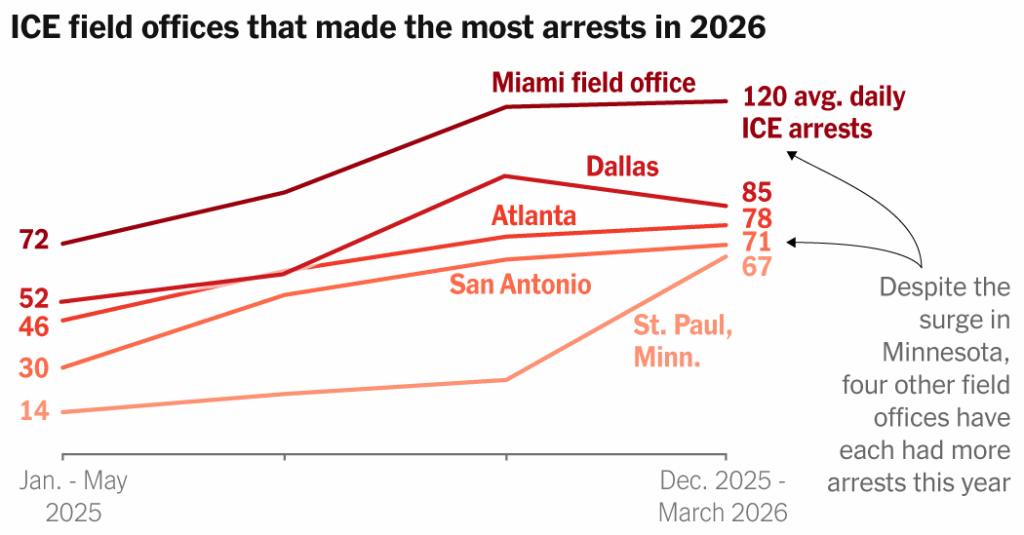
The administration’s high-profile operation in Minnesota this year, in which two U.S. citizens were killed, resulted in a steep increase in arrests there: ICE’s St. Paul field office arrested more than 5,000 people from mid-December through March 10. But four other field offices arrested more people during this same time period, led by the Miami area — with nearly 10,000 arrests — followed by the field offices in Dallas, Atlanta and San Antonio.
ICE divides its enforcement operations into 25 so-called areas of responsibility around the country, some of which encompass small geographic areas like the counties around New York City or San Diego, while others cover cities as well as multiple individual states, like the Chicago field office.
Since mid-December, three ICE field offices in Texas — Harlingen, El Paso and San Antonio — have arrested more people per capita than the St. Paul field office, despite the surge there. So have the field offices in San Diego, Phoenix and Dallas.
“What this data shows me is that the surges actually slowed immigration enforcement” in places from which officers were temporarily reassigned, said Jason Houser, the chief of staff at ICE during the Biden administration. “Many of the areas that went about their business and didn’t have their staff pulled away to be sent somewhere else — that’s where we’ve seen increased enforcement,” he added.
About half of ICE immigration arrests nationwide in 2025 were from what the agency calls “custodial” arrests, in which ICE takes someone who is already in custody from another law enforcement agency. These arrests were much more common in states led by Republicans, where law enforcement is more likely to cooperate closely with federal immigration authorities.
They were less common in places where “sanctuary” policies limited local law enforcement from cooperating with ICE and handing over people who have been arrested in connection with other crimes, but may or may not have been convicted.
“We need state and local law enforcement cooperation, so we don’t have to have such a presence on the streets,” said a Department of Homeland Security spokesperson.
That said, in high-profile crackdowns in cities like Chicago, Los Angeles, Minneapolis, and Washington, D.C. that officials said were necessary because of those policies, ICE mostly arrested people with no criminal record.
In the Los Angeles and Denver areas, arrests were at their highest levels last summer and have since fallen. And in the six states overseen by the Chicago field office, the rate of arrests was highest in the period from September to December during Operation Midway Blitz, a crackdown that started in September — but even then, the per capita rate of arrests was well below the national average.
According to an internal document viewed by The Times, ICE has more than seven million people on its “non-detained docket” — people ICE believes can be deported but who are not currently in detention. Many of these people may be awaiting an immigration court hearing. Some of them may have been detained by ICE in the past and released on supervision or monitoring. Or they may have already been issued a deportation order in the past, but either they did not comply or ICE was unable to deport them.
Many may also be people, including large numbers from countries like Venezuela and Haiti, who entered the country legally through humanitarian programs created during the Biden administration that the Trump administration has now revoked or is trying to revoke.
More than a million of the people on the non-detained docket were in the Miami field office area, which covers Florida, Puerto Rico and the Virgin Islands. More than 700,000 were in the New York City area, which covers the five boroughs, Long Island and the Hudson Valley.
With just about 10,000 arrests in the New York City area, that field office has arrested the lowest share of people on the non-detained docket of any field office.
Methodology
The data for this article comes from an internal ICE document viewed by The New York Times that lists the numbers of arrests by each field office through March 10, 2026, as well as from detailed records of ICE immigration arrests through Dec. 18, 2025, obtained by The Times through a Freedom of Information Act lawsuit. The data covers only arrests by ICE, not arrests by Customs and Border Protection.
Population figures used to calculate the arrests per 100,000 residents figures in the map come from the Census Bureau’s 2024 estimates.
The charts show the average number of daily arrests by each field office in four time periods: from Jan. 1, 2025, to May 31, 2025; from June 1 to Aug. 31; from Sept. 1 to Dec. 18; and from Dec. 19 to March 10, 2026.
Albert Sun is a data reporter and graphics editor at The Times who covers immigration.
The post New Data Shows Where ICE Has Been Most Active This Year appeared first on New York Times.