Have you ever turned to look at something at the exact moment something unbelievably cool happened? Imagine if you did that, but in the wide-open vastness of space. That’s essentially what happened when astronomers pointed a telescope at a comet just as it started to break apart.
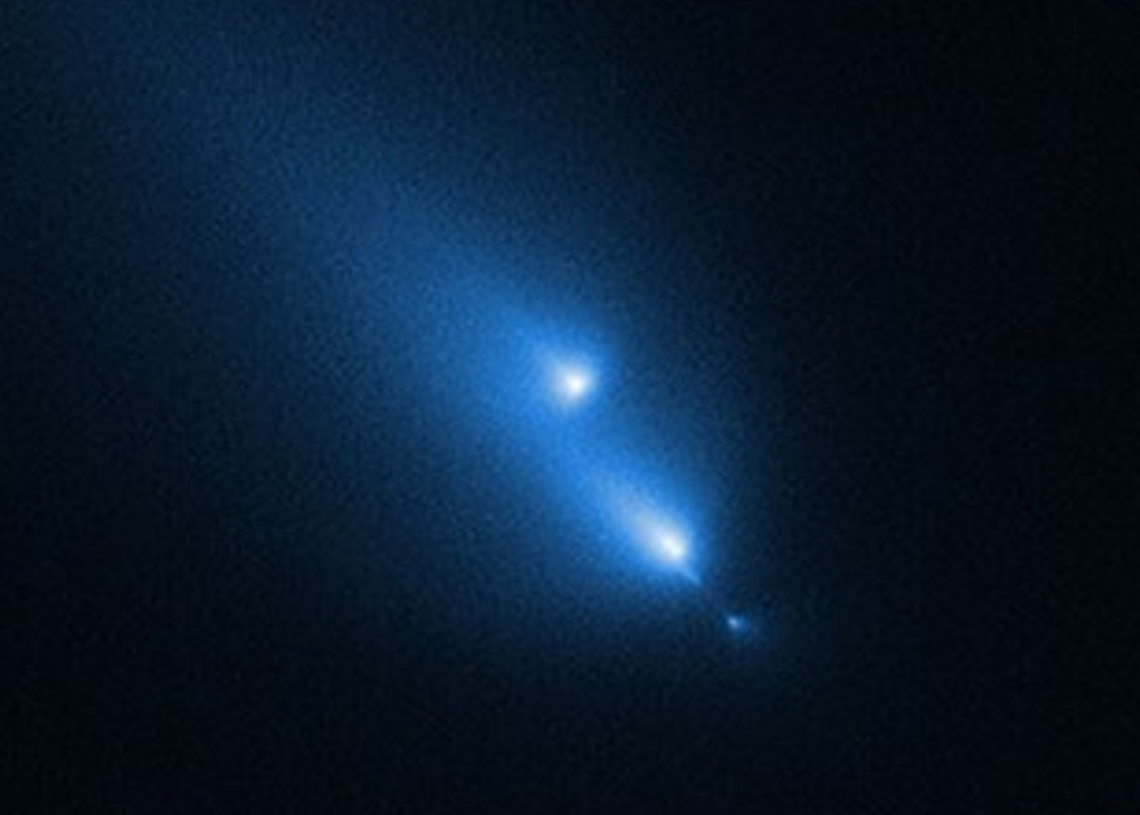
As the New York Times reports, using the Hubble Space Telescope, researchers captured detailed images of comet C/2025 K1 (ATLAS) as it began to tear itself apart. Over a span of just a few days in November, the roughly five-mile-wide space rock split into four or five fragments, each surrounded by clouds of vaporized ice.
From here on earth, telescopes mostly saw some blurry smears. The Hubble managed to capture the comet’s collapse in real time.
NASA’s Hubble Just Caught a Comet Breaking Apart in Real Time
Comets break up all the time. They are, essentially, just a loose collection of ice, dust, and rock. They’re kind of like dirty snowballs. If you were to sit a snowball near a fire, it would quickly melt. The same thing happens to a comet when it travels near the sun. The intense heat causes it to rapidly vaporize, building pressure until its nucleus fractures. It doesn’t explode like the Death Star at the end of A New Hope as much as it just kind of cracks apart.
So if it happens with some degree of regularity, what makes this one so special? The timing of it all. Scientists rarely catch a comet at the exact moment it starts to break apart. And in this case, the observation wasn’t even planned. Researchers intended to study a different comet, but some technical limitations forced them to pivot to K1 so they could study something. Luckily, they did, because as soon as they pointed the telescope at it, it started falling apart.
The fortuitous observation also yielded new insights into how comets break apart. Each fragment that broke away appeared to delay its bright flare-up by one to three days after separating, prompting researchers to reevaluate previous assumptions about how quickly exposed ice should react to solar heat. That tiny little delay is now a tiny little but still meaningful mystery that needs to be solved.
As for the fragments, they are spreading out across the solar system about 250 million miles from Earth, never to be seen again, making the observation of their breakup all the more extraordinary.
The post NASA’s Hubble Caught a Comet Breaking Up in Real Time, and the Images Are Wild appeared first on VICE.