Gustavo Dudamel seems to love a soft launch.
He doesn’t start as the New York Philharmonic’s music and artistic director until the fall, but he has been introducing himself all season. In September, he led two weeks of traditional-looking but fascinatingly radical concerts. In January, he conducted the orchestra’s Radio City Music Hall debut, a brassy pops evening in which he pattered with Bernadette Peters before breaking out a Bernstein show tune.
Earlier this month, he hosted a glamorous unveiling of his first Philharmonic season, with help from Lin-Manuel Miranda and accompanied by a rebranding for the orchestra, new merchandise included. And, because he is a conductor after all, he stuck around to lead two weeks of world premieres written for the 250th anniversary of the United States.
It has taken so long to introduce Dudamel because there is so much to introduce: conductor, showman, celebrity, contemporary music whisperer and, most recently and intriguingly, politically conscious citizen.
He is often circumspect when discussing news out of Venezuela, his home country, where his artistry was shaped by the music education program El Sistema. But Dudamel is eager to talk about the potential of music, which, unlike some idealistic musicians, he doesn’t see as a substantial form of resistance; rather, he has described it as a necessity, a kind of sustenance and moral shelter with a political strength of its own to observe and comment on world events.
It’s a view of art that you could imagine Dudamel sharing with Beethoven, whose “Eroica” Symphony he conducted at the Philharmonic last week. Beethoven originally dedicated the piece to Napoleon, but when he named himself emperor, the composer quickly soured on him. He withdrew the dedication and made the symphony a celebration in “memory of a great man,” a testament to heroism manqué.
Dudamel and the Philharmonic have yet to establish themselves as a reliable Beethoven partnership. A performance of the Fifth Symphony in September lacked the load-bearing details that hold up its delicate architecture. But the “Eroica” this month sounded like the work of a different ensemble: lean and well paced, as attuned to specific moments as to the bigger picture.
The series of variations in the symphony’s finale made for a subtle transition to the premiere of a new, orchestrated version of Frederic Rzewski’s “The People United Will Never Be Defeated!” An exhausting, nearly hourlong work for solo piano, it is another kind of tribute to heroism. Written in the 1970s, after the rise of Pinochet in Chile, it turns a protest song from the streets into a monument, putting the tune through 36 encyclopedic variations and, by the end, inviting its performer to join in the metaphorical march with a long improvisation.
Orchestrated by 18 composers, the Philharmonic’s version of “The People United” was an attempt at an even bigger musical monument, with an admirable, democratic message in having so many artists contribute to the new score. It was extraordinary to see 17 of the composers bow together afterward.
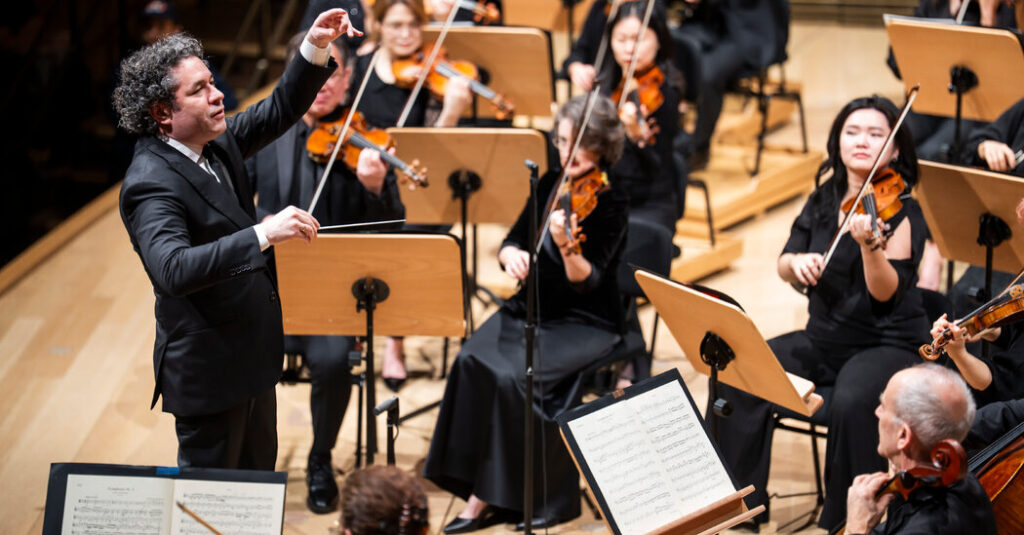
But this “People United” didn’t deliver on its promise. Dudamel led with conviction, his silhouette changing as he channeled each section. The new score, though, scraps a dozen of the variations (as well as the big improvisation), losing some of the work’s stylistic breadth and shrinking its running time to 35 minutes. Strangely, the whole exercise ended up flattening the music and its hard edge, with few variations or composers standing out. You could have admired the Webernesque textures by Nina Shekhar or the alluring clarinet and alto saxophone solos by Joel Thompson, but unless you had a score in hand, those moments passed anonymously.
Less promising on paper, and more successful in practice, was David Lang’s “the wealth of nations,” which premiered on Thursday. An oratorio based on Adam Smith’s 1776 book of the same name, one of those foundational but frighteningly immense works that are more discussed than read, the music’s setting of select texts is an exercise in finding a needle not so much in a haystack as an entire meadow.
Economic doorstops aren’t usually the stuff of oratorios, but Lang has a gift for finding epiphanic poetry in texts that may seem mundane or downright boring. He is also one of the most gently political composers today, allergic to polemics but constantly wrestling with big questions, and so he supplements and complicates Smith with passages by Ralph Waldo Emerson, Frederick Douglass, Edith Wharton, Eugene V. Debs and more.
The oratorio was inspired by Handel’s “Messiah” but is less than half its length. Lang borrows devices from that classic, like an opening Sinfony and a prevailing spirit of populism, but his music is not made to ramble, in part because he isn’t a lyrical melodist like Handel. His melodies are more like plainchant, unremarkable on their own but elevated by the richness of his harmonies, which contain the bottomless compassion that his scores are known for, and that motivated his dedication of “the wealth of nations” to everyone who works at the Philharmonic, whether Dudamel or a janitor.
Lang begins with a kind of lightness and wonder, as if awe-struck and seduced by the truths in Smith’s text. But the piece deepens as it goes on, not least because of the earthiness of the vocal soloists, the mezzo-soprano Fleur Barron and the bass-baritone Davóne Tines. Earlier phrases built on simple, angular rhythms turn contemplative, as when Tines gives a creamy howl to an abolitionist speech (by Maria W. Stewart) about basic necessities, over descending harmonies in the chorus. The score becomes starkly pointed for a climactic setting of a court statement by Debs before returning to Smith, having taken the audience on a journey from the bedrock of capitalism to the world that rose up from it.
This, and the concert a week earlier, was not the stuff of casual listening. But Dudamel, through unflappable charisma and sheer energy, made it all seem like necessary listening, with a persuasive sincerity that, encouragingly, the orchestra is beginning to share, too.
Joshua Barone is an editor for The Times covering classical music and dance. He also writes criticism about classical music and opera.
The post Gustavo Dudamel’s Portrait Emerges From a Season of Introductions appeared first on New York Times.