Spring is the season of creation, a time of renewal and new beginnings. In Los Angeles, alas, we were, last spring, a city of cinders. It was a time to mourn.
A hard year followed with floods, ICE, AI, etc., menacing our native optimism. Making matters worse, in December we lost L.A.’s grand visionary vizier, the architect who time and again built us out of civic funk and transformed L.A., inspiring the city he so loved to look good, feel good and do good.
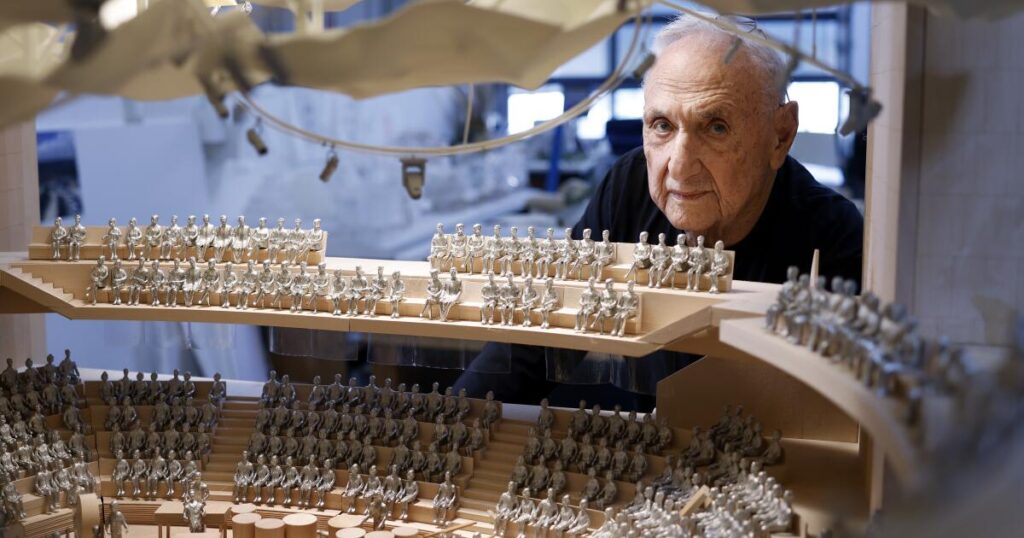
But that is still the case. So many plans Frank Gehry imagined for L.A. still remain. Gehry bequeathed blueprints and models, sketches and concepts, for his large and devoted team of younger architects and next-generation visionaries equipped to fabricate our way out of angst.
Isn’t there supposed to be an Olympics on the way for which the city appears ill-prepared? Spring 2026 is the time to build.
A couple of springs ago, L.A. County dubbed the blocks around Gehry’s masterpiece, Walt Disney Concert Hall, the Grand Avenue Cultural District. This includes the rest of the Music Center, Museum of Contemporary Art, the Broad and Colburn School. The Grand, Gehry’s resplendent complex across the street from Disney, had recently opened and ground was about to be broken for the Colburn Center, a 1,000-seat concert hall equipped to also serve dance, opera and whatever yet-to-be-invented genres Gehry designed it to enable.
The Colburn Center is well on its way to completion next year. Bits of the building’s pink skin have started to peek out like spring blossoms on the construction site at 2nd and Olive. The Broad has begun an expansion. But after two years, nothing else has been done to make this the cultural district it must become, one unlike anything else in any city.
Four springs ago I toured Grand Avenue with Gehry to gather what he had in mind for an arts district. When Disney Hall opened in 2003, it instantly became an enduring symbol of L.A., overtaking the Hollywood sign in many cases. The Dodgers want to parade joy in winning their second World Series in row last October, where else but in front of Disney? But not in front of all Gehry had in mind.
We will soon have a pair of futuristic new museum buildings to show off this year: the David Geffen Galleries, the controversial Los Angeles County Museum of Art’s Peter Zumthor building (I predict it will prove a sensation), and the new Lucas Museum of Narrative Art (no predictions on that one) next door to the Coliseum. But the fact that each is a 15-minute ride away from the cultural district’s new Metro station only makes the district even more of a center.
A center, indeed. Gehry’s vision included completing the original plans cost-cut out of Disney a quarter-century ago, along with new modifications and much more throughout the area. Some are more costly than others. Enough could be done on Grand Avenue in time for the Olympics to make a difference if we begin this minute.
Since its opening, Disney has been — shamefully — the most poorly lit building of its stature in the world. Gehry had chosen the specific steel for its capacity to reflect light. His idea was to project on the building whatever concert was taking place that night. No sound, just imagery. Belt-tighteners didn’t want to commit the $2 or $3 million or whatever and go through the trouble.
It was spectacularly tested at the hall’s 10th anniversary, but with tacky prerecorded video and crummy amplification. Facilities are now included in the Grand for projectors. It would have been amazing in 2003 and will be amazing now. The Grand has been disappointingly slow to attract the restaurants, bars, cafes and shops it needs to create a scene. The projections could change all that and even create enough of a ruckus to get a reluctant, car-crazed city to make that Grand Avenue block pedestrian.
There is much more for Disney. Gehry wanted to turn BP Hall, where preconcert talks occur, into a small chamber music hall with a suspended balcony. He had plans for reconfiguring the seldom-used small outdoor Keck Amphitheater into an enclosed jazz club for Herbie Hancock and turning the little-used 1st Street entrance into a glass-enclosed bar that would be named the Ernest, in tribute to Ernest Fleischmann, the L.A. Phil executive director who was responsible for building Disney.
Disney was supposed to have a pit for the orchestra, allowing for staging opera and dance. The plans exist. That could be done in a summer for a couple million. Bottom-liners had also nixed Gehry’s original design for a more gracious lobby with a cafe out front, not the gloomy one installed against his will.
The Colburn Center has the potential for being another game changer for the area, a vibrant new hall where we are promised upward of 200 events a year from all walks of musical life, local and international. But Gehry had in mind even more.
He intended to lower the steep and pedestrian unfriendly 2nd Street hill, so that it would be an easy walk from the new Metro station two blocks away, and add two more pedestrian blocks by diverting traffic to the 2nd Street tunnel. This would connect the cultural district with Grand Central Market on one end and the Broad on the other. Then 2nd could itself become a lively street with the stores and restaurants a “district” needs.
The extraordinary original plans for the Colburn Center included turning the parking lot across 2nd from the hall into a public plaza with a giant video wall and high-end outdoor sound system, for projecting nightly concerts in the hall. Gehry was a devoted outdoor-indoor architect, and he designed for the hall a balcony on which musicians can perform.
That initiative has thus far been blocked by City Hall officials, fearful of the tunnel’s aging infrastructure. Although if that’s the case, I’m not all that eager to be in the tunnel as it currently is when the Big One comes along. This is where L.A. shows its moxie. Upgrade the tunnel. Now! If this were Beijing, New Delhi or Hanoi, it would be a no-brainer.
Gehry next proposed building low-cost artist housing in Grand Park directly across from the Music Center, which would further create a true arts community. There has been talk of renovating the Dorothy Chandler Pavilion for three decades and that’s all it’s been. The corporate-esque recent Music Center plaza could use a little excitement, maybe a Phase II.
Arts make a city. The Edinburgh Festival in Scotland was created after World War II to help bring the city back to life. After its fire-bombing, Tokyo founded a bevy of symphony orchestras as a phenomenal experiment in mass antidepression. Beethoven’s Ninth Symphony played no small role in lifting the collective mood, preparing Tokyo to create what now feels like the world’s most arresting capital.
Unlike Scotland, unlike England, unlike Germany, unlike France, unlike Italy, unlike Poland, unlike Russia, unlike Finland, unlike the Czech Republic, unlike China, unlike any number of countries, America has no major international arts festival these days. We had one in L.A. in 1984 with the Olympic Arts Festival. The Cultural Olympiad in 2028 has shown no bones. But if we make the cultural district what it could be, there would be no better place anywhere for a major festival.
We have the goods. L.A. artists helped make the modern Salzburg Festival the meaningful model for all others. In 1992, the summer before Esa-Pekka Salonen became music director of the Los Angeles Philharmonic, he and the orchestra were invited to shake up clinging Austrian tradition. With the help of director Peter Sellars, they staged Messiaen’s epic opera “Saint François d’Assise,” with pyramids of televisions, resulting in music and monitors upending, in Mozart’s hometown, the role of the modern opera and, so to speak, the sound of music.
Over succeeding decades, both Sellars and Salonen have been Salzburg Festival lodestars. Last summer they were back staging two monodramas, Schoenberg’s “Erwartung” and “Abschied” (the last movement of Mahler’s symphonic song cycle “Das Lied von der Erde”). Conductor and director looked with shocking depth into the “Expectation” of death and gave a “Farewell” to the “Song of the Earth” we all await. I saw it twice and can’t imagine how anyone came away from it quite the same person, not more alive, not more fragile. Art on the stage doesn’t get deeper than “One Morning Turns Into an Eternity,” as Sellars named the production. Salonen, who conducted the production with Vienna Philharmonic, is now about to become the L.A. Phil creative director in the fall and will bring the production to Disney with the L.A. Phil next season. It is thus far the most important opera news of next season in America. All the more reason to build that pit in the hall and get started on much bigger plans.
Salzburg, which manages to come up with around $80 million from here and there, also helped with the question I’ve evaded: Who’s going to pay for all this? I’ve evaded it because it’s the wrong question. Money only started pouring into the building of Disney Hall when people got wind of what it was going to become. Five years ago, Crypto.com paid more than $700 million to change the name of Staples Center. That amount, which created nothing but an advertisement for a product of dubious value to society, is the price of two Walt Disney Concert Halls and probably all of Gehry’s projects put together. It is the amount that could fund nearly nine Salzburg-scale festivals.
If we let ourselves believe that L.A. wealth only cares for mega-crypto advertising, mega-mansions and mega-yachts, then L.A. is over. It isn’t. Do we want to show only that to the world? Downtown, and prominently Crypto.com Arena in L.A. Live, have been designated a center for LA28, as we’re calling the Olympics. That makes a graciously glorifying cultural district, which functions as creation being existential not commercial, just up the road from L.A. Live, L.A. live.
When one morning turns into an eternity, you don’t ask for the bill.
The post Frank Gehry’s unrealized vision for Grand Avenue could transform downtown L.A. before 2028 appeared first on Los Angeles Times.