Republicans on Capitol Hill have given President Trump wide latitude to wage war on Iran with no congressional approval or limits.
They have deferred to him almost entirely on his justifications for the conflict, echoing the rationales offered by him and his top officials, even as they have given shifting and contradictory explanations.
Now, nearly three weeks after the first strikes on Tehran, G.O.P. lawmakers are resisting the idea of calling top administration officials before Congress to give a public accounting for an escalating war with uncertain objectives, a rising price tag and no clear exit strategy.
It is the latest example of how the Republicans controlling Congress, who have ceded power to Mr. Trump on matters large and small, are refraining from using their oversight authority as a coequal branch of government and have instead taken on the role of cheerleaders for his policies at a critical time.
“You don’t want to show that kind of division to your enemy when you’re in the midst of a war,” said Senator Ron Johnson, Republican of Wisconsin. “I don’t have a problem with the administration avoiding showing our enemy that they don’t have 100 percent support of the Congress.”
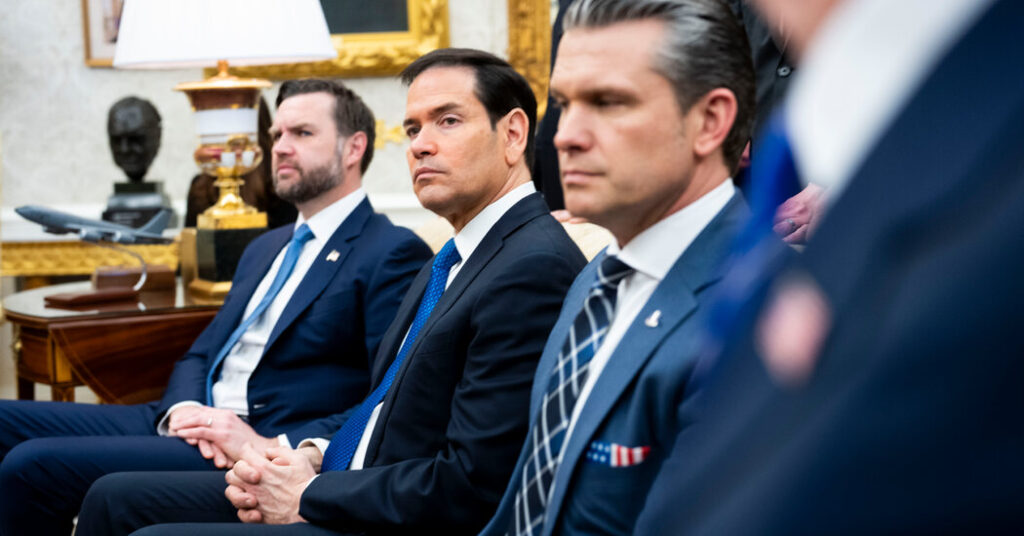
Democrats have demanded that Defense Secretary Pete Hegseth and Secretary of State Marco Rubio make the case under oath in congressional hearings for why the United States barreled into a war in the Middle East that has endangered American citizens, diplomats and allies across the region and caused oil prices to spike.
But even as the Pentagon requests $200 billion to fund the conflict and Mr. Trump has not flatly ruled out committing ground troops, many Republicans argue that summoning Mr. Hegseth and Mr. Rubio to Capitol Hill for televised hearings would be harmful because it would put the divisions over the war on display for the country, and for Iran, to see.
“I think it would be very unhealthy at this point in time,” said Senator Bill Hagerty, Republican of Tennessee. “We’ve got men and women in harm’s way.”
“The more cameras on someone in the Democrat party, the more bombastic they get,” said Representative Derrick Van Orden, Republican of Wisconsin. “It can be counterproductive.”
Republican leaders and rank-and-file members have said Mr. Trump is firmly within his authority to deploy forces into hostilities with Iran for up to 60 days without congressional authorization.
Democrats note that under the law, that power applies only if the United States faced an imminent attack, and they argue that the Trump administration has failed to prove that the threat posed by Iran met that benchmark. Mr. Hegseth and Mr. Rubio have rejected that reasoning, but testimony from two top intelligence officials on Wednesday directly contradicted the claim that an imminent threat existed.
House and Senate Democrats are pressing to publicly question cabinet officials about the strategic goals of the campaign and the expected total cost of an operation that exceeded $11.3 billion in just the first week, among other topics. And they want to ask about efforts to mitigate civilian deaths after an initial Pentagon investigation found that the United States launched a deadly Tomahawk missile strike on an Iranian elementary school.
But Republicans have said they are satisfied with the information senior Trump administration officials have provided in several classified briefings since the war began, and see no need for a public accounting.
“The case has been very clearly made by the administration in public comments,” said Representative Brian Mast, Republican of Florida and the chairman of the Foreign Affairs Committee. He called the request from Democrats for public hearings “total B.S.”
In recent days, Republicans in the House and Senate have made the remarkable argument that there is no need for them to question Trump administration officials under oath about the war because those officials are already fielding news media questions about it.
“They’re holding news conferences,” Senator John Thune of South Dakota, the majority leader, told reporters last week. “You guys are covering them and putting out all the relevant information about the status of the conflict.”
Polls show a majority of Americans disapproving of Mr. Trump sending U.S. forces to attack Iran, with support for military operations registering far lower than at the outset of past wars.
But at a news conference on Tuesday, Speaker Mike Johnson essentially argued that Americans should trust members of Congress to pass on whatever information they might need to know about the conflict. He called the operations against Iran “very sensitive” and said they could not be discussed outside the classified settings where lawmakers had been briefed on them “because it would adversely affect our mission.”
“I have just relayed to you the summary of the nonclassified information,” Mr. Johnson told reporters. “All members are out talking about it around the clock. You’re following them around with microphones getting their clips and insights and their opinions.”
While Mr. Hegseth has held several news conferences since the start of the war, the Pentagon has limited access and invited pro-Trump outlets to take the place of journalists from national media organizations that refused to accept the department’s reporting restrictions. Mr. Rubio has not held a news conference at the State Department since December, though he took questions from reporters while on Capitol Hill to brief lawmakers in the opening days of the war.
Democrats have accused their colleagues across the aisle of rubber-stamping the president’s war without performing any oversight. A military operation as significant as the one unfolding in the Middle East is analogous to the invasion of Iraq in 2003, they have argued, noting that Colin L. Powell, the secretary of state at the time, made the case to Congress for that mission, and lawmakers voted to authorize it, before it began.
Senator Christopher S. Murphy, Democrat of Connecticut, said it was “unprecedented in American history to launch a war of this scale without open hearings.”
He is part of a group of Senate Democrats forcing a series of votes on war powers resolutions on Iran to try to pressure Republicans into holding public hearings.
“They want to circumvent the Constitution,” Senator Cory Booker, Democrat of New Jersey, said on the floor on Wednesday before Republicans voted again to block a measure that would curb Mr. Trump’s ability to wage war without congressional authorization. “They want to go around public oversight. They want to avoid the glare, the questions of the American people.”
Mr. Booker and Senator Tim Kaine, Democrat of Virginia, both said on Wednesday that Senator Jim Risch of Idaho, the Republican chairman of the Foreign Relations Committee, told them during a classified briefing that morning that he was not planning to call Mr. Rubio to testify about the conflict.
Mr. Risch declined to comment, noting in an interview that the exchange occurred in a classified setting.
Senator Roger Wicker, Republican of Mississippi and the chairman of the Armed Services Committee, said he “expects” Mr. Hegseth would eventually be called to testify before his committee in public, but he left the timing vague and said it would not be before lawmakers return from a two-week recess in mid-April.
Mr. Thune has suggested the next time the cabinet members would appear before Congress would be for hearings on the president’s annual budget request. “I’m sure all these issues will be litigated,” he added. “But this is a very fast-moving situation.”
A small group of Republicans have pressed for a more open dialogue on the war.
Senator Susan Collins of Maine, the chairwoman of the Appropriations Committee, said on Wednesday that she would probably want a public hearing on the supplemental funding request that will be required to pay for the operations. “It’s considerably higher than I would have guessed,” she said of the $200 billion figure being discussed.
Senator Lisa Murkowski of Alaska, a member of the Appropriations subcommittee that controls military spending who has participated in classified briefings in recent days, called for public hearings and expressed frustration that the Trump administration had attacked Iran unilaterally, without consulting Congress.
“I’m asking others, ‘Why are we not talking about the war?’” Ms. Murkowski said.
She added: “As a sitting United States senator, I think I deserve to have honest answers. So when I see the secretary of defense and the president of the United States, who are not giving clear answers publicly, that makes it hard for me to go back and tell my constituents, ‘OK, here’s what we think we should expect going forward.’”
Representative Brian Fitzpatrick, a Pennsylvania Republican facing a competitive re-election race, said he wanted to see senior officials testify, and “the sooner the better.”
“Of course it’s necessary,” Mr. Fitzpatrick said. “We should have oversight.”
Megan Mineiro is a Times congressional reporter and a member of the 2025-26 Times Fellowship class, a program for early-career journalists.
The post Deferring to Trump, G.O.P. Lawmakers Resist a Public Accounting on Iran appeared first on New York Times.