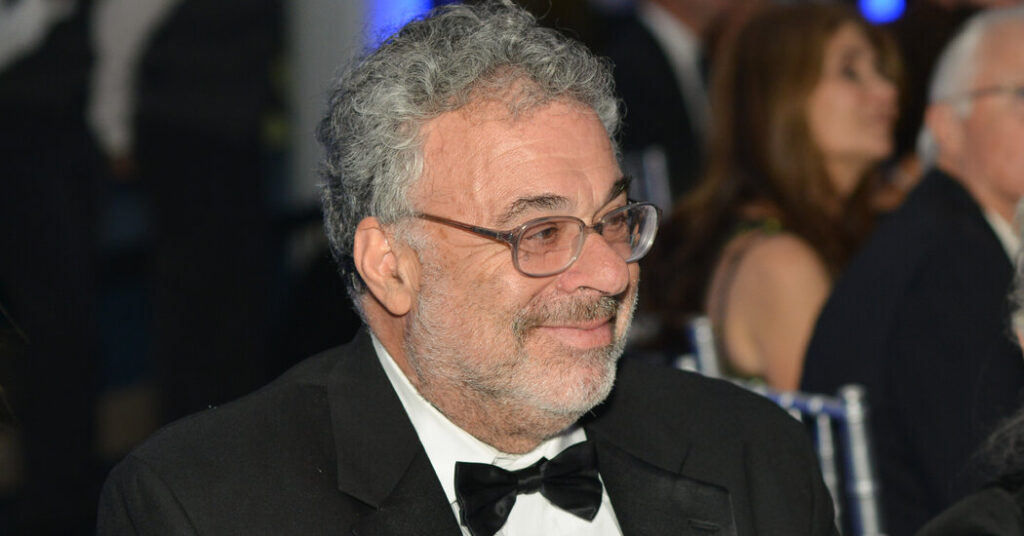
David Botstein, a molecular biologist who changed the course of genetics by discovering a method for locating genes in human DNA — allowing researchers to find disease-causing genes and to map the entire, sprawling human genome — died on Feb. 27 in Palo Alto, Calif. He was 83.
The cause of death, at an assisted living facility, was Parkinson’s disease, his wife, Renee Fitts, said.
Dr. Botstein began his career at the Massachusetts Institute of Technology in the early 1970s, when little was known about genes and how they interact. The human genome was understood to be a vast stretch of DNA, and the idea of locating within it any one of the approximately 20,000 individual genes that build and operate the body was daunting.
“I can’t tell you how huge a problem this was,” Eric Lander, a molecular biologist at the Broad Institute of M.I.T. and Harvard University, said in an interview. “David Botstein is the first person who solved that problem. It was a heroic, amazing contribution. He cracked open the biggest problem in human genetics.”
Dr. Botstein came up with the solution in 1977, while doing experiments with yeast. He realized that he could locate genes by looking for small variations in the “spelling” of DNA. He used these variations as markers of nearby genes.
But he was not thinking about human DNA until the next year, when he went to a meeting at the University of Utah, where geneticists were discussing a disease, hemochromatosis, the inheritance of which was confusing.
Dr. Lander said that Dr. Botstein blurted out, “If you just had a nearby genetic marker, you could tell.”
The epiphany swiftly allowed scientists to find genes for cystic fibrosis, Huntington’s disease and an inherited risk for breast cancer, among thousands of other conditions.
Shirley Tilghman, a molecular biologist and the former president of Princeton University, said that the discovery also proved crucial to sequencing the human genome. The genome is so big that scientists had to sequence small stretches at a time and then figure out how to put the bits together. It was like a huge jigsaw puzzle.
Dr. Botstein’s findings “gave us the landmarks we needed,” Dr. Tilghman said. “It really launched the idea that we could sequence the genome.”
According to Tim Stearns, a molecular biologist and the dean of the Rockefeller University, Dr. Botstein “was perhaps one of the most skilled persons in understanding the intricacies in genetics in the last century.”
David Botsztejn was born on Sept. 8, 1942, in Zurich, the oldest of three children of Chaim and Anna Botsztejn. The Botsztejns, clinical research physicians at the University of Zurich, had come to Switzerland from Poland as medical students about 10 years earlier.
Because they were Jewish, the Swiss government would not allow them to become citizens. Leon Botstein, Dr. Botstein’s brother and the president of Bard College, said in an interview that the family applied for visas to immigrate to the United States, but had to wait until 1949 for them to come through.
When the Botsztejns arrived in New York, their names were changed to Charles and Ann Botstein, and they took jobs as physicians at Montefiore Hospital in the Bronx. Charles Botstein became chair of the radiology department there; Ann Botstein became chair of pediatrics.
David Botstein said in a 2003 interview with The New York Times that as a child he “did everything possible to fit in. I lost my German accent. I joined the Cub Scouts and the Boy Scouts. I was the pioneer in the family in all things American.”
Their parents wanted all three children to become doctors, and one did: Dr. Botstein’s sister, Eva Griepp, became a pediatric cardiologist.
But David preferred research science from an early age. He became known for his brilliance, and his intensity. Even as a child, he “was a formidable presence,” Leon Botstein said, adding, “He liked to be right, but he was quick to admit when he was wrong.”
David attended the Bronx High School of Science and received his undergraduate degree in biochemistry from Harvard in 1963. He shifted to studying human genetics and earned a Ph.D. from the University of Michigan in 1967 before joining the M.I.T. faculty.
In 1987, he left the school to join the biotech company Genentech as a vice president. Three years later, he became the chair of the genetics department at Stanford University. In 2003, he moved to Princeton before becoming chief scientific officer of the biotech company Calico in 2013. He retired in 2023.
“He didn’t like being complacent,” Dr. Stearns said. “Moving every 10 years or so had to do with his intellectual restlessness.”
Dr. Tilghman recalled Dr. Botstein calling her soon after she became Princeton’s president in 2001 and demanding that he hire her. She said he told her, “I want to reform science education.”
Dr. Botstein became the director of the university’s Lewis-Sigler Institute for Integrative Genomics, and also created an innovative program of undergraduate study. Instead of focusing on a single area, students in the program would spend their first two years doing intensive work in molecular biology, physics, chemistry, computer science and applied mathematics.
“David saw that the future of science was interdisciplinary,” Dr. Tilghman said.
Dr. Botstein was elected to the National Academy of Sciences in 1981 and to the Institute of Medicine (now the National Academy of Medicine) in 1993.
He met his wife, a biologist who later became a patent attorney, during his time at Princeton. His two earlier marriages ended in divorce.
In addition to Dr. Fitts and his brother and sister, Dr. Botstein is survived by a son, Sam Botstein; a daughter, Ruth Botstein; and two grandchildren.
Loud and brash, Dr. Botstein brimmed with insights. “Ideas came into his head and out of his mouth,” Dr. Lander said.
As much as he loved science — shouting the Yiddish word “azoy!” when an idea excited him — it was not his only passion. Dr. Botstein also enjoyed classical music and played the piano, violin and cello, and sang.
“Our home was always full of music, friends and scientists,” Dr. Fitts said. “There was never an ‘outside of the lab’ persona. We were all absorbed into his world.”
Gina Kolata reports on diseases and treatments, how treatments are discovered and tested, and how they affect people.
The post David Botstein, Gene-Mapping Pioneer, Dies at 83 appeared first on New York Times.