Chuck Norris once gave a horse an uppercut and now we have giraffes.
Chuck Norris doesn’t sleep. He waits.
Chuck Norris is so tough he can slam a revolving door.
Chuck Norris’s calendar goes straight from March 31 to April 2, because no one fools Chuck Norris.
There was a time — in the days when the internet was still a force for fun — when Chuck Norris jokes roamed our screens.
It was the mid-2000s. Twitter and Facebook were not yet ascendant. We weren’t yet glued to our phones. People were still making prank calls using Jack Black soundboards. We allowed Daniel Powter’s “Bad Day” to become a megahit.
And Norris unwittingly became a pioneer of memedom.
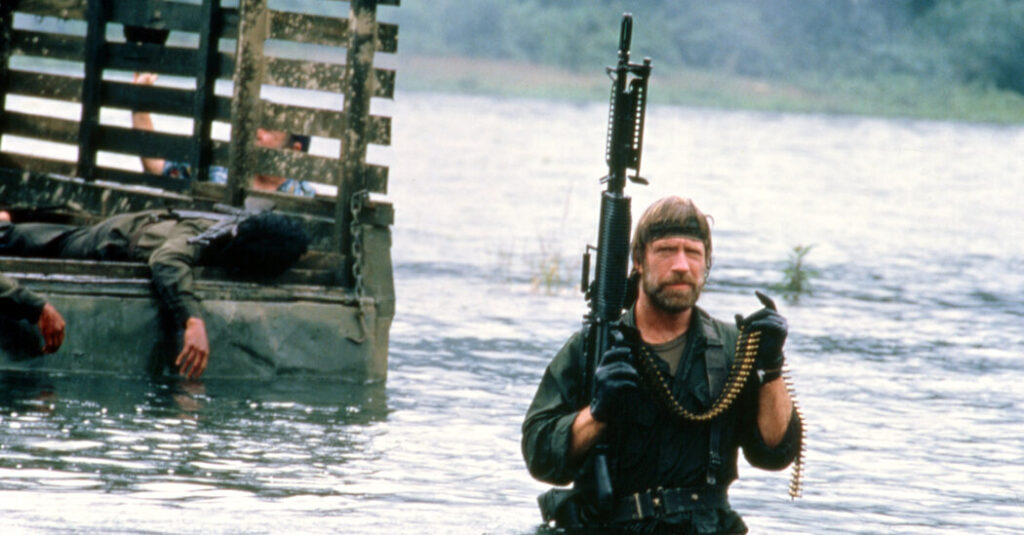
Norris, who died at 86 on Thursday, was the butt-kicking star of the television show “Walker, Texas Ranger” and action films including “The Delta Force,” “The Hitman” and “Sidekicks.” The general plot of anything involving Norris went something like this: Norris came. Norris saw. Norris kicked.
He had an air of invincibility, an over-the-top American machismo that endeared him to audiences and made him a box office and television draw — and also a prime target for parody.
“Chuck Norris Facts” originated in April 2005 with two simple ingredients: Vin Diesel and boredom. Ian Spector, a high school senior from Long Island, N.Y., logged on to the web forum Something Awful and saw one-liners being thrown around about Diesel’s new movie, “The Pacifier,” in which he plays a military man turned babysitter.
Amused, Spector copied and pasted the best ones into a rudimentary open source script to create a meme generator, posted a link to it and then went to bed. The next day, his site, 4Q.cc, had 10,000 hits. In the weeks that followed, Spector posted a poll asking which celebrity he should sub in for Diesel, listing several options, including Samuel L. Jackson and Dick Cheney.
Voters kept writing in another name: Chuck Norris.
In an interview, Spector theorized that this stemmed from Norris’s cameo in the 2004 comedy “Dodgeball: A True Underdog Story,” starring Ben Stiller. Spector, now 38, obliged, and users submitted their favorite Norris one-liners.
Chuck Norris beat the sun in a staring contest.
Chuck Norris is suing NBC claiming that “Law and Order” are the trademark names of his left and right legs.
Chuck Norris doesn’t wear a watch. He decides what time it is.
Spector would later collect some of the better examples into a book, “The Truth About Chuck Norris: 400 Facts About the World’s Greatest Human” (2007). The recipe for a Norris joke, he said, “was usually one part ordinary and one part outrageous.”
The appeal of the meme had a lot to do with Norris’s hypermasculinity and “the idea that if Chuck Norris can do it, he can save us all,” said Rebecca Ortiz, an assistant professor at Syracuse University who has studied Chuck Norris’s endurance in pop culture.
“He played very similar roles over and over again, and because he had such a distinct character, everyone could relate to it,” she said in an email. “That created a common understanding, which made it translate perfectly into memes.”
Of course, Norris became aware of the memes. In a 2011 column for the conservative news site World Net Daily, he wrote, “Some are funny. Some are pretty far out. And most are just promoting harmless fun and times of laughter.”
He added, “The fact is we always should be free enough from life’s burdens to laugh. It doesn’t take much time or effort to pause and laugh several times a day.”
Spector and Norris did eventually meet, when Spector was on spring break during his freshman year at Brown University. After his site launched, Spector said, he received a call from Norris’s wife, Gena O’Kelley, who said Norris wanted to meet him. So Spector and his father spent an hour in a suite with Norris at a Connecticut casino.
“I didn’t feel intimidated. It was what I would call good kind of nervous. When I got in there, it was just a very casual conversation,” Spector said.
On the way out of the meeting, however, there was one point of potential tension: Norris had no ownership of the jokes.
“At that time, there were no talks of books or anything like that on the horizon,” Spector said. “It was just a website. And so, on the way out, there was a sidebar conversation that was really quick that was more or less like, ‘Hey, you know, if you think you’re going to be monetizing this somehow, please talk to us.’”
After Spector’s book came out, Norris sued him, arguing that it painted him in an unflattering light.
“He takes himself very seriously,” Spector, then 19, told The New York Times in 2008. “Maybe because he takes himself so seriously, it makes it all the more ridiculous.”
The suit was eventually settled in 2008. Spector declined to disclose the terms, but the suit helped boost the sales of the book, which became a New York Times best seller. Spector, who eventually graduated from Brown with a degree in cognitive neuroscience, issued four more Norris books, including “Chuck Norris Vs. Mr. T” and “Chuck Norris: Longer and Harder.”
Norris was never publicly critical of the original book, despite the lawsuit. He even read a list of the jokes once on the television show “The Best Damn Sports Show Period,” and revealed his favorite one: “They wanted to put Chuck Norris’s face on Mount Rushmore, but the granite wasn’t hard enough for his beard.” He even put out his own book in 2009: “The Official Chuck Norris Fact Book: 101 of Chuck’s Favorite Facts and Stories.”
Chuck Norris and the internet culture that he, through the sheer force of his screen presence, helped pioneer, will endure, Spector said on Friday.
“He stands for his principles,” he said. “You know what they are. They don’t really change and that makes up a character that can win in many ways and in many situations. There is a timeless aspect to that.”
Sopan Deb is a Times reporter covering breaking news and culture.
The post Chuck Norris Punched This Article Into the Sun appeared first on New York Times.