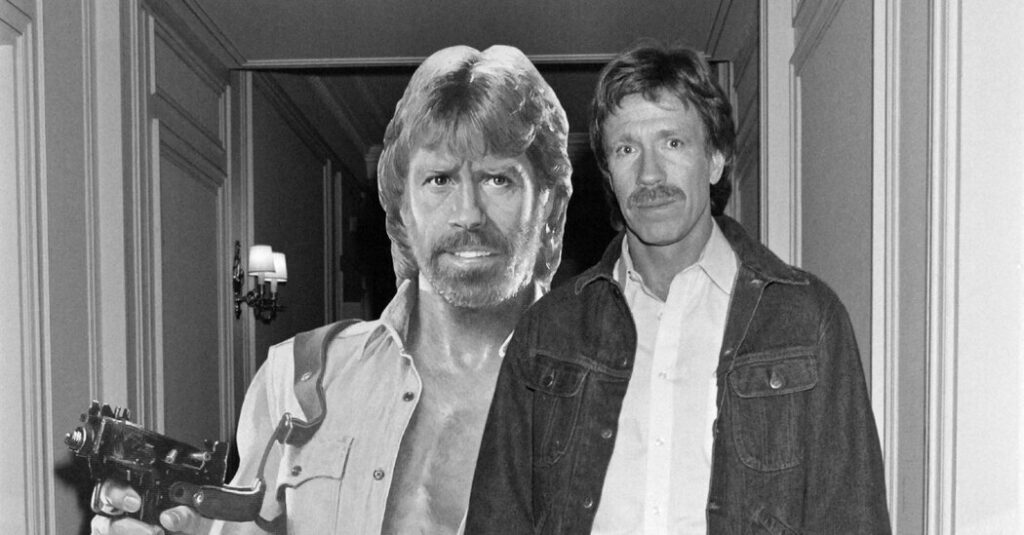
Chuck Norris, who channeled his skills as a martial arts black belt into a durable acting career that left film critics largely unimpressed but delighted millions of fans savoring his good-guy triumphs and fortune-cookie musings, died on Thursday. He was 86.
His death was announced by his family through his official Instagram account. He was hospitalized on Thursday in Hawaii after experiencing a medical emergency, the family said, giving no other details.
As an actor, Mr. Norris was well aware that no one was about to mistake him for a latter-day Henry Fonda or Laurence Olivier. In most of his films and in “Walker, Texas Ranger,” a television series that ran from 1993 to 2001, he played a warrior who comes to the rescue not with words or guns but, rather, with spinning back kicks and other techniques that had made him a leading martial arts practitioner.
“I play the man in the arena who’s pushed to the wall and forced to blast his way out,” he once told The San Francisco Chronicle. And blast away he did, in film after film.
His most fertile period on screen stretched from the late 1970s to the early 2000s with movies that included “Good Guys Wear Black” (1978), “An Eye for an Eye” (1981), “Lone Wolf McQuade” (1983), “Code of Silence” (1985), “Invasion U.S.A.” (1985), “The Delta Force” (1986), “Delta Force 2: The Colombian Connection” (1990) and three “Missing in Action” offerings in the 1980s that gave him a chance to rescue Americans held captive in Vietnam.
On occasion, he showed a lighter side and a measure of vulnerability, as he did as a police detective in “Hero and the Terror,” a 1988 film that had him as a sensitive romantic who even faints watching a baby being born. But in the main, he was the solid fellow who didn’t look for trouble — until the bad guys left him no choice. His dialogue, while scant, could come laden with menace.
“I didn’t fight, I gave a motivational seminar,” he says after dispatching skinhead bullies in “Delta Force 2.” In “Code of Silence” he mutters, “If I want your opinion, I’ll beat it out of you.” And in “Braddock: Missing in Action III,” he says evenly, “I don’t step on toes. I step on necks.”
Film critics, to put it charitably, were generally unimpressed, though as the years passed they acknowledged that Mr. Norris had sharpened his acting skills. Not untypical was a 1977 New York Times assessment of him in “Breaker! Breaker!” as “about as emotional as a statue.” Time magazine once described him as “an expressionless blank” and as “the most successful really terrible actor since Audie Murphy.”
Nonetheless, audiences flocked to his films, some of which, along with episodes of “Walker, Texas Ranger,” were directed by his younger brother Aaron, a one-time stuntman. “Dodgeball: A True Underdog Story,” a 2004 movie in which he played himself, had worldwide grosses of $168 million.
Mr. Norris was an action hero in a class with Sylvester Stallone, Arnold Schwarzenegger and Charles Bronson, with the monosyllabic manner of early Clint Eastwood tossed in. He appealed to millions who liked seeing America win — for a change, some would add — whether by rescuing captive G.I.’s in Vietnam, saving the country from terrorists in “Invasion U.S.A.” or defeating skyjackers and drug kingpins in the “Delta Force” series.
Assessing his success in “The Secret of Inner Strength: My Story,” one several books that he wrote, Mr. Norris said that “many people want and need someone to identify with, a man who is self-reliant, stands on his own two feet, and is not afraid to face adversity.”
“They want to believe in me,” he said, “just as I believed in John Wayne when I was a boy.”
A complete obituary will appear soon.
Ash Wu contributed reporting.
The post Chuck Norris, Crowd-Pleasing Star of Action Movies, Dies at 86 appeared first on New York Times.