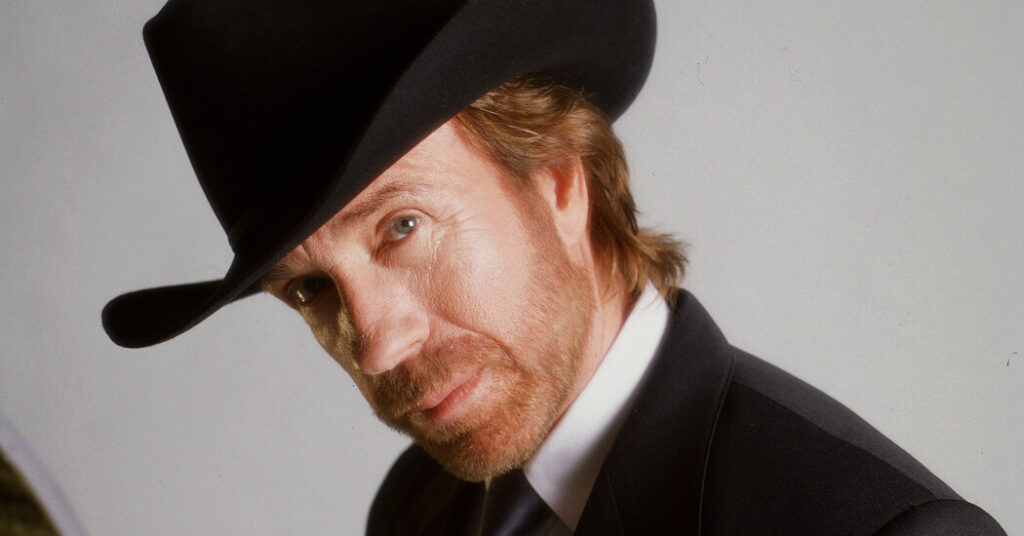
Chuck Norris, who channeled his skills as a martial arts black belt into a durable acting career that left film critics largely unimpressed but delighted millions of fans savoring his good-guy triumphs and fortune-cookie musings, died on Thursday. He was 86.
His death was announced by his family through his official Instagram account, but no further details were immediately available. He was hospitalized earlier that day in Hawaii after experiencing a medical emergency, the family said.
As an actor, Mr. Norris was well aware that no one would mistake him for a latter-day Laurence Olivier. In most of his films and in “Walker, Texas Ranger,” a CBS television series that ran from 1993 to 2001, he played a warrior who comes to the rescue not with words or guns but rather with spinning back kicks and other techniques that had made him a leading martial-arts practitioner.
“I play the man in the arena who’s pushed to the wall and forced to blast his way out,” he once told The San Francisco Chronicle. And blast out he did, in film after film.
His most fertile period onscreen stretched from the late 1970s to the early 2000s with action thrillers like “Good Guys Wear Black” (1978), “An Eye for an Eye” (1981), “Lone Wolf McQuade” (1983), “Code of Silence” (1985), “Invasion U.S.A.” (1985), “The Delta Force” (1986), “Delta Force 2: The Colombian Connection” (1990) and three “Missing in Action” offerings in the 1980s that gave him a chance to rescue Americans held captive in Vietnam long after the war had ended.
On occasion, he showed a lighter side and a measure of vulnerability. In “Hero and the Terror” (1988), he was an action-minded police detective as well as a sensitive romantic who faints watching a baby being born. But in the main, he was the solid fellow who didn’t look for trouble — until the bad guys left him no choice. His dialogue, while scant, could come laden with menace.
“I didn’t fight. I gave a motivational seminar,” he says after dispatching skinhead bullies in “Delta Force 2.” In “Code of Silence,” he mutters, “If I want your opinion, I’ll beat it out of you.” And in “Braddock: Missing in Action III” (1988), he says evenly, “I don’t step on toes. I step on necks.”
Film critics, to put it charitably, were generally unenthusiastic, though as the years passed, they acknowledged that Mr. Norris had sharpened his acting skills. Not untypical was a 1977 assessment in The New York Times of his performance in “Breaker! Breaker!” as “about as emotional as a statue.”
Kurt Andersen, writing in Time magazine, described him as “an expressionless blank, conveying nothing but tenacity and absolute cool. His body is impeccable, but the voice is flat and high pitched. He has instructed writers to give him as few lines as possible, yet he rushes the elemental dialogue that remains.”
Nonetheless, audiences flocked to Mr. Norris’s films, some of which, along with episodes of “Walker, Texas Ranger,” were directed by his younger brother Aaron, a onetime stuntman.
Mr. Norris, whose beard became part of his signature look, was an action hero in a class with Sylvester Stallone, Arnold Schwarzenegger and Charles Bronson, with the monosyllabic manner of early Clint Eastwood tossed in. He appealed to millions who enjoyed seeing America win — for a change, some would say — whether that meant rescuing captive G.I.s in Vietnam, saving the country from terrorists in “Invasion U.S.A.” or defeating skyjackers and drug kingpins in the “Delta Force” series.
Assessing his success in “The Secret of Inner Strength: My Story” (1988), written with Joe Hyams, Mr. Norris noted that “many people want and need someone to identify with, a man who is self-reliant, stands on his own two feet, and is not afraid to face adversity.”
“They want to believe in me,” he said, “just as I believed in John Wayne when I was a boy.”That boyhood, as he described it, was defined by poverty, with his family moving 13 times in his first 15 years.
Carlos Ray Norris was born on March 10, 1940, in Ryan, Okla., the oldest of three sons of Ray Norris, a bus and truck driver, and Wilma (Scarberry) Norris, who managed the home. He grew up in Wilson, Okla., and later Torrance, Calif., south of Los Angeles.
After his parents divorced in 1956, his mother remarried. Later, Mr. Norris recalled his father’s alcoholism and absenteeism, and said that he had regarded Hollywood western stars like Mr. Wayne and James Stewart as “surrogate fathers.”
Mr. Norris described himself as “shy and inhibited” as a boy, not notably athletic, and “content to fade into the background.” After his graduation in 1958 from North High School in Torrance, he enlisted in the Air Force and became a military policeman.
The same year, at 18, he married Dianne Holechek, a schoolmate. They divorced in 1989. Nine years later, Mr. Norris married Gena O’Kelley, a former model.
She survives him, along with two sons from his first marriage, Mike and Eric Norris; two children from his second marriage, Danilee and Dakota Norris; a daughter from another relationship, Dianna Di Ciolli, who goes by Dina Norris; his brother Aaron; and many grandchildren. Mr. Norris’s brother Wieland died in combat in Vietnam in 1970.
The Air Force assigned Mr. Norris — by then nicknamed Chuck by his buddies — to an American base in South Korea. It was there that he developed an interest in martial arts, among them a Korean style of karate called tang soo do. At 5-foot-10 and roughly 165 pounds, he was not physically imposing, but he was strong and agile. By the time he left the Air Force in 1962, he had earned a black belt in karate.
Back in the United States, he continued honing his martial arts techniques, and from 1968 to 1974, he was the world’s reigning middleweight karate champion. A form of the sport known as chun kuk do even came to be called the Chuck Norris System.
In the late 1960s, he fell into a financial hole after a string of karate schools he owned in Southern California went bust. That’s when one of his celebrity students, Steve McQueen, told him, “If you can’t do anything else, there’s always acting.” Mr. Norris decided to try it, heeding Mr. McQueen’s advice that “movies are visual” and dialogue should be pared down.
Another major influence was Mr. Norris’s friend and fellow martial-arts practitioner, Bruce Lee, who initially helped him land bit parts in movies. Mr. Norris’s first significant film appearance was in “The Way of the Dragon” (1972) — released in the United States as “Return of the Dragon” — in which he was one of many opponents finished off by the swift-of-hand, strong-of-foot Mr. Lee.
A self-described conservative Christian, Mr. Norris said in 2012 that if President Barack Obama, the country’s first Black president, were re-elected, “our country as we know it may be lost forever,” and he encouraged evangelicals to vote against Mr. Obama.
Some of Mr. Norris’s endorsement deals raised eyebrows, especially his 2019 agreement to be the public face of the gun manufacturer Glock. But he also founded the widely praised organization Kickstart Kids, which began in 1990 as the Kick Drugs Out of America Foundation, promoting martial arts as a path to better character.
Throughout, Mr. Norris offered aphorisms encapsulating his formulas for a better life, among them, “I will develop myself to the maximum of my potential in all ways” and “I will forget the mistakes of the past and press on to greater achievements.”
He understood fully that he was not going to land on any list of great actors.
“Most of my movies are very one-dimensional,” he acknowledged to The Chicago Sun-Times in 1988.
Five years later, he told a reporter at The Times: “I never wanted to be Dustin Hoffman or Al Pacino. I mean, I never dreamed of being an Ac-tor,” he said, drawing out the word. “I do what I do.”
The post Chuck Norris, Black-Belt Action Star of Movies and Television, Dies at 86 appeared first on New York Times.