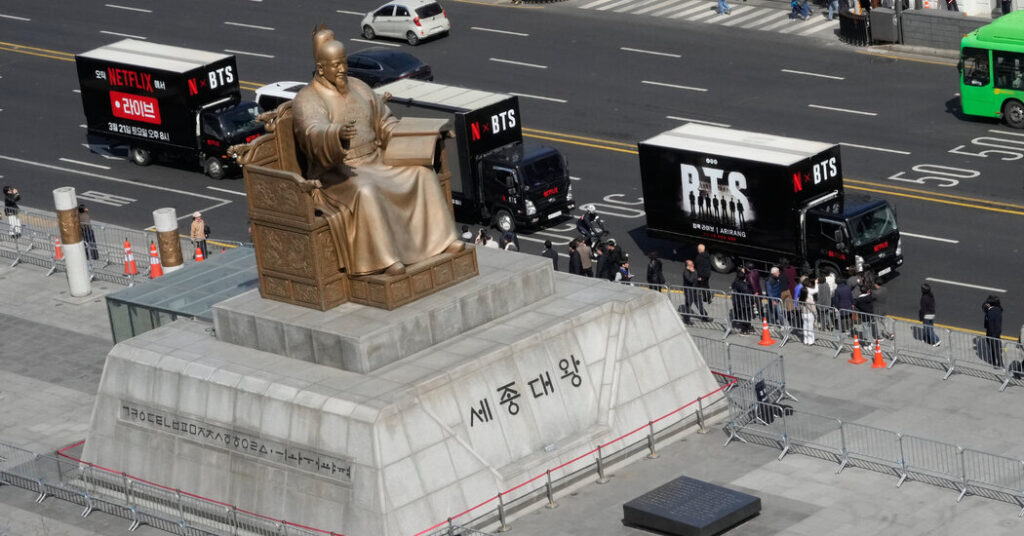
Credits on the BTS comeback album include the Australian musician Flume, the American DJ Diplo and the Spanish singer El Guincho. They are a sign of the K-pop supergroup’s worldwide appeal.
But the album “Arirang,” which was released on Friday, also firmly anchors BTS at home in South Korea. The album is named after a Korean folk song that has been passed down through generations. Most South Koreans learn it at a young age and consider it an anthem of resilience and national identity.
“BTS is where they need to be and want to be, both local and global at the same time,” said Bernie Cho, the president of DFSB Kollective, a Seoul-based creative-services agency that works with local musicians.
But at a time when K-pop is increasingly global, “Arirang” is a sign of how the group is straddling loyalty to fans overseas and at home. Naming the album “Arirang” signals a shift away from external expectations toward a more unapologetic Korean identity, said Professor Ray Seol, a K-pop expert at Berklee College of Music in Boston.
“What ties the seven members together is that we are Korean,” RM, the band’s leader, said in a livestream on Friday.
Here are a few Korean references in the album.
Folk Song
The last third of the first track of the album, “Body to Body,” has a rendition of the “Arirang” motif. The fast-paced pop track is overtaken by a medley of traditional string and percussion instruments as a choir of voices sings a line from the folk song: “Arirang, gogaero neomeonganda,” or “You are crossing over the Arirang Pass.” The song, experts say, is a metaphor for letting go.
(Versions of the folk song are also sung in North Korea.)
The track also contains a sample of another folk song called “Moon, Moon, Bright Moon,” according to the album’s credits.
Historic Bell
“No. 29” is a minute-and-half long recording of the Divine Bell of King Seongdeok, which was built in 771 during the Silla era, according to the Gyeongju National Museum, where it is displayed. (The Silla kingdom’s capital was in Gyeongju, in southern South Korea.)
It is the largest bell in the country, standing at nearly four meters tall and weighting 19 tons, according to the Korea Heritage Service. The bell took 34 years to build and is a symbol of the pinnacle of Buddhist art metal craft. It is listed by the service as a national treasure.
The bell was struck for the first time in several decades to create the track, RM said on the livestream on Friday. He added that the museum had reached out to the group first. The track’s duration matches the exact time it takes for the bell’s resonant frequencies to completely fade, he said.
Freedom Fighter
A line in the track “Aliens” says “Pardon Kim Koo, tell me how you feel.” Kim Koo, born in 1876, was a pivotal leader of the Korean independence movement against the Japanese occupation. He is famed for killing a Japanese lieutenant in 1896 to avenge the murder of Korea’s Queen Myeongseong by Japanese assailants.
Another line from the track is, “Everybody know now where the K is,” a nod to the global rise in Korean culture across the world.
Jin Yu Young is a reporter and researcher for The Times, based in Seoul, covering South Korea and international breaking news.
The post BTS Leans Into the K of K-Pop With Comeback Album appeared first on New York Times.