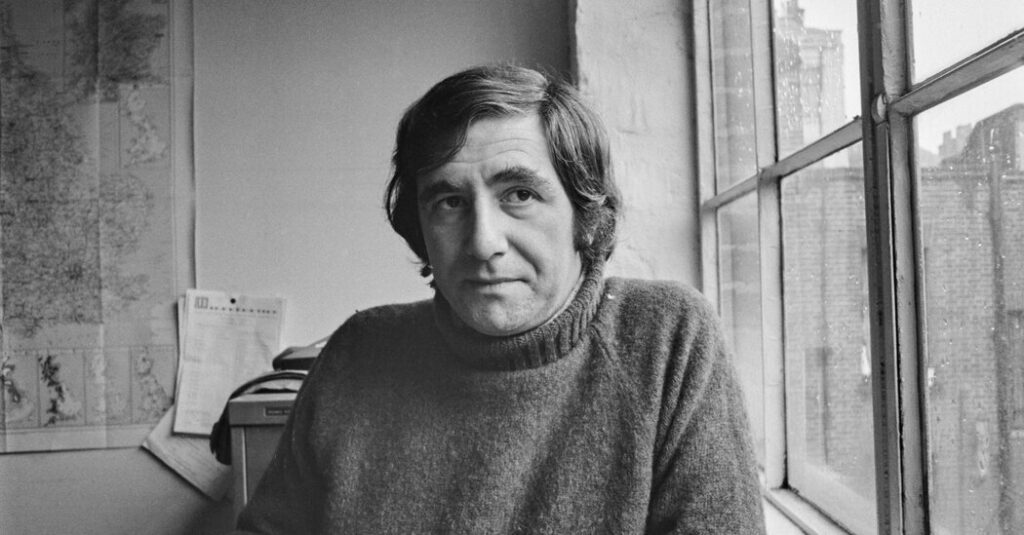
Bernard Rands, a composer whose career traced a path from youthful spiky austerity toward a more accessibly lyrical style that made him one of the more widely performed of his peers and earned him a Pulitzer Prize, died in Chicago on March 4. He was 92.
His death, in a hospital, was confirmed by his wife, the composer Augusta Read Thomas.
The son of a school janitor from the coal-and-steel country of northern England, Mr. Rands was propelled into music’s vanguard by a childhood determination to join the ranks of the great composers and by his teenage attendance at concerts by the Hallé symphony orchestra of Manchester.
He began as a promising inheritor of mid-20th-century European modernism. His career was launched by his teachers Pierre Boulez, Luciano Berio and Bruno Maderna, among the high priests of early 1960s serial composition, at what amounted to that style’s temple, the summer music institute at Darmstadt, Germany.
Mr. Rands came to the United States in 1975 to teach at the University of California, San Diego, and, by the time he was established in his new life as an American, he had moved onto a somewhat different track.
He evolved into a composer whose music was compared by critics to that of Debussy, with shimmering orchestral textures and hints of tonality that helped engage listeners wary of Boulezian high modernism.
Mr. Boulez, who was also an important conductor, continued to champion Mr. Rands’s music, as did other celebrated maestros, including Riccardo Muti, Daniel Barenboim and Zubin Mehta.
In 1983, Mr. Mehta and the New York Philharmonic premiered the work that put Mr. Rands definitively on the map in America: “Canti del Sole” (“Songs of the Sun”), for tenor and orchestra. This intense setting of 14 poems by modern masters like Paul Celan and Eugenio Montale revolves around the theme of the sun’s beneficence.
There is dramatic declamation in its 25 minutes, as well as the kind of seductively varied orchestration that was one of Mr. Rands’s preoccupations.
“The coloristic sensuousness of the instrumentation is everywhere apparent,” John Rockwell wrote in The New York Times after the piece won the 1984 Pulitzer Prize for Music.
Critics noted Mr. Rands’ sensitivity to words; Ms. Thomas said in an interview that an entire room in their home was devoted to books of poetry.
“Canti del Sole” was the middle of three “Canti” orchestral song cycles, coming between “Canti Lunatici” (1981), for soprano, and “Canti dell’Eclisse” (1992), which included texts by Mr. Celan, René Char, Emily Dickinson and others, for bass.
“What is most impressive about Mr. Rands’s deployment of these texts,” the critic Alex Ross wrote of “Canti d’Eclisse” in The Times, “is that he does not become hypnotized by their density and complexity. Rather than try to match each iamb with a quaver, the music lays out a general mood beneath the poetry or imitates its fundamental rhythm.”
Mr. Rands’s flexibility in capturing the mood of poetic texts embodied his artistic journey. He had left behind the slavish adherence to the rigid compositional techniques of his younger days.
He told Harvard Magazine in 1991 that such strict techniques involved “an exclusion of things very dear and natural to me, a certain sound world, maybe more related to the French than to to the Teutonic. In general, by temperament, I’m drawn away from the dogmatic, the theoretical.”
His rejection of systems of composition extended to Minimalism, which he criticized in the same interview for being “so banal” and for “trivializing the monumental tonal achievements of the past.”
Melody, and a move away from the frenetic harmonic changes that sometimes characterized the 1960s avant-garde, had become newly important to him.
“In the last 15 years or so, I’ve developed longer melodic lines and a functional harmonic flow,” he told the Times critic Paul Griffiths in 1997. “And though the music may sometimes be complex, I still feel that this singing quality is something I need now.”
Bernard Rands was born in Sheffield, England, on March 2, 1934, the older of two sons of Benjamin Rands and Eveline (Kay) Rands. She was the caretaker at Woodhouse West Council School in Sheffield, where her husband also worked.
His uncles and many of the neighbors were coal miners, and Mr. Rands told Harvard Magazine that “my parents, my brother and I lived in a slum, as dreary as you can get.”
But there was a piano in the house, which his father would play in the evenings. Indeed, the familial atmosphere was musical, with his uncles singing and playing in colliery bands and choirs. Mr. Rands began piano lessons at the age of 5 and, by 7, his teacher was asking him to harmonize simple melodies.
He studied at Woodhouse Grammar School and earned bachelor’s and master’s degrees at the University of Wales in the mid-1950s. In 1960, he became a lecturer in music at the university and, over the following years, he also traveled to Germany and Italy for further studies.
An early piece for flute, viola, cello, harp and percussion, “Actions for Six,” had what Roger Marsh and Mark D. Porcaro described in The New Grove Dictionary of Music and Musicians as a “stormy” premiere at Darmstadt under Mr. Maderna’s baton in 1963. In the late 1960s and early ’70s, Mr. Boulez premiered three of Mr. Rands’s works, “Wildtrack 1,” “Mésalliance” and “Aum,” with the BBC Symphony Orchestra.
With his move to the United States — he became a naturalized citizen in 1983 — he began to display “a new directness of musical language,” The Grove Dictionary noted, and a “latent lyricism came to the fore.”
.
Later works, like the oboe Concertino and a concerto for English horn, won praise for their lyricism and sense of drama, pitting the small voice of the solo against the larger ensemble. “Patches reminiscent of Debussy seascapes and early Stravinsky lullabies,” Steve Smith wrote in The Times of “Chains Like the Sea” (2008), “floated in a dreamlike drift, meant to evoke the tedium of slow, pious Sundays.”
An active teacher, Mr. Rands was a professor at Harvard from 1988 until his retirement in 2005 and was composer in residence with the Philadelphia Orchestra from 1989 to 1995. He worked for years on an opera based on the life of Vincent van Gogh, “Vincent,” which premiered, with a libretto by J.D. McClatchy, at Indiana University in 2011.
In addition to his wife, whom he married in 1993, Mr. Rands is survived by his sons from an earlier marriage to Ann Fisher, Siôn Philip Rands and Stephen Jon Rands; a brother, John; four grandchildren; and four great-grandchildren.
“Music is to be enjoyed,” he said in a 2008 interview with the New York Philharmonic. “I never assume about writing for an audience, because I don’t know who they are. I only assume they are like me, they are humans, with all the frailties of humans.”
Sheelagh McNeill contributed research.
Adam Nossiter has been bureau chief in Kabul, Paris, West Africa and New Orleans and is now a writer on the Obituaries desk.
The post Bernard Rands, Pulitzer-Winning Composer, Dies at 92 appeared first on New York Times.