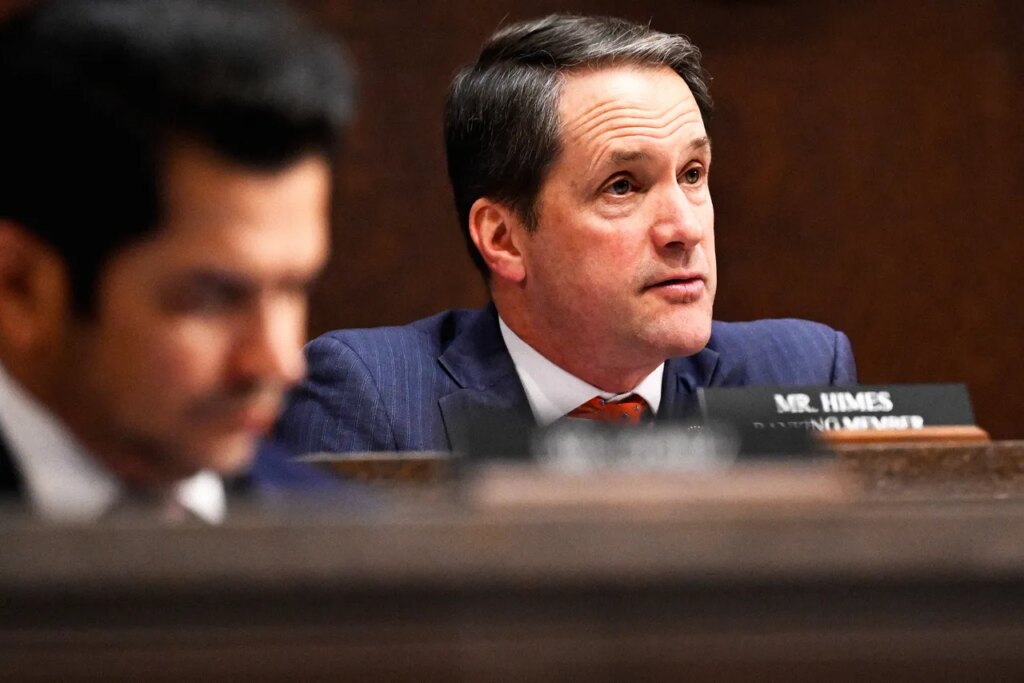
United States congressman Jim Himes, the ranking Democrat on the House Intelligence Committee, is privately lobbying colleagues to preserve the FBI’s power to conduct warrantless searches of Americans’ communications, WIRED has learned, arguing that he has seen no evidence that the Trump administration is abusing its authority.
In a letter obtained by WIRED, Himes urges fellow Democrats to support the White House’s request to renew a controversial surveillance program that intercepts the electronic data of foreigners abroad. While targeted at foreigners, the program—authorized under Section 702 of the Foreign Intelligence Surveillance Act—also sweeps in vast quantities of private messages belonging to US citizens.
Himes’ pitch relies on the “56 reforms” passed by Congress in 2024, which codified the FBI’s own internal protocols as a substitute for constitutional warrants. In the letter, Himes claims these changes are “working as intended” to prevent domestic misuse, citing a compliance rate “exceeding 99 percent” over the past two years.
The structural foundations of that defense, however, have been fundamentally altered by recent changes within the FBI. Himes’ “99 percent” compliance metric was produced by the Office of Internal Auditing, for instance—a unit that long served as a smoke alarm designed to detect illegality, but no longer exists.
The unit was shuttered by FBI director Kash Patel last year. Historic court opinions based on its data had previously exposed hundreds of thousands of improper FBI searches. Without the auditors required to calculate failure rates, the compliance mechanisms Himes points to have effectively ceased to function.
In a statement, Himes’ office largely reiterated the positions laid out in his letter to colleagues. “I am open to making further reforms to Section 702, building on the many successful reforms we made in reauthorization legislation two years ago,” he says. “A short-term reauthorization of Section 702 will enable Congress to thoroughly debate the pros and cons of these suggested reforms—and to determine if compromise is possible—without placing our national security in peril by allowing the program to expire.”
As a member of the so-called Gang of Eight—a bipartisan group of lawmakers who are briefed on highly sensitive classified information—Himes possesses some of the deepest knowledge of the spy program. Nevertheless, his letter contains several other claims that appear fundamentally at odds with the mechanics of FISA oversight.
“Because of how heavily it is overseen by all three branches of government,” Himes says, “any effort to misuse the program would almost certainly become known to the Foreign Intelligence Surveillance Court and to Congress.”
The Foreign Intelligence Surveillance Court is a secret court that possesses no investigative arm to audit FBI databases. Similar to Congress, its oversight role is purely reactive, relying entirely on the US Justice Department to self-report violations.
“Neither Congress nor the FISA Court conducts independent audits of the FBI’s queries,” says Liza Goitein, senior director of the Brennan Center’s Liberty and National Security Program. “They rely on the Department of Justice to conduct thorough audits and to report the results truthfully and promptly. This particular Department of Justice has gutted internal oversight mechanisms and has been rebuked by dozens of federal courts for providing inaccurate, misleading, or incomplete information.”
There are no judges standing between the FBI and the private communications of millions of Americans, something that Himes and other members of his committee claim is necessary for the government to react quickly to terrorist threats. Critics argue that, given the current administration’s efforts to dismantle internal checks at the FBI, this is a massive vulnerability, leaving Americans exposed to surveillance abuses that will take years to declassify—if they’re ever reported at all.
No members of Congress are actively calling to end the 702 program; even its harshest critics acknowledge its intelligence value. Proponents of constitutional guardrails have also accounted for the need to react quickly: Bills that mandate a warrant for American data—like the recently introduced Government Surveillance Reform Act—consistently feature broad emergency carve-outs.
Under that bill, if a threat is imminent or lives are at stake, agents can still quickly access the necessary intelligence without a judge’s approval. It also includes defensive cybersecurity exceptions that allow the government to search for malicious code or infrastructure without a warrant.
Under the proposed privacy reforms, the FBI would be barred from running warrantless searches through American data simply to look for spies. Because espionage is a slow-moving and rarely violent threat, agents would need to go to court and present evidence in advance.
Current safeguards rely on FBI attorneys and supervisors to approve sensitive searches. But under last year’s overhaul of the federal workforce, personnel in those legal and management tiers were stripped of key civil service protections. Failing to “implement administrative policies” is now a fireable offense.
The change has effectively neutralized the independence of the bureau’s middle management, which has been further gutted by politically motivated firings that—according to a federal lawsuit filed by former high-ranking FBI officials—Patel privately acknowledged were “likely illegal.”
As a consequence, the “high-level approval” Himes cites as a key shield against abuse now exists as a mechanism for political loyalists to promote domestic surveillance targets that align with the administration’s agenda.
Himes addressed those concerns, writing to colleagues: “We fundamentally lack faith in Trump administration leaders. The administration has shown an appalling willingness to violate laws and flout norms in both foreign and domestic affairs.” He adds that were he aware of the administration abusing its surveillance authority, he would not urge members to reauthorize the program. “I have not seen evidence of misuse, despite being on the lookout for any hint of it,” he said.
Recent public disclosures from 2025 and 2026 detail a series of FBI surveillance abuses and oversight violations. According to a FISA court opinion released last fall, FBI personnel deployed a tool that conducted searches of Americans’ data that were never logged or audited. Notably, the incident occurred after the reforms touted by Himes. In October, the Justice Department’s own inspector general’s office noted in a report that, “in view of the history of the FBI’s Section 702 compliance issues, we are not able to conclude based on that limited time period that the FBI’s querying compliance issues are entirely in the past.”
The current administration has also raided the homes of journalists, infiltrated chat groups of activists tracking immigration raids, and redirected counterterrorism resources toward domestic political groups.
As recently as last month, Himes skipped Trump’s State of the Union address, posting on Facebook that the president and “his administration are blatantly corrupt, [have] shattered our democratic norms, and broken precedent time and time again.”
In 2024, Himes and other surveillance hawks successfully convinced Congress to reject the inclusion of any constitutional guardrails in the 702 program. Both he and the bureau—then led by Christopher Wray—argued that requiring high-level supervisor approval for sensitive searches was all that was needed to prevent rogue agents from abusing the system.
While Himes’ letter cites “56 reforms” implemented two years ago, not all of them apply to the FBI’s access. Of those that do, a significant number are aimed at simply adding internal bureaucratic friction to the process, making it administratively tedious for rank-and-file agents to execute a search. The FBI says this was accomplished by limiting the pool of people legally allowed to do so by roughly 90 percent.
At the same time, a former FBI deputy director, Paul Abbate, issued a 2024 directive urging agents to actively run queries on Americans to justify the program’s existence, as WIRED first reported.
The remaining reforms cited by Himes include the use of permission slips: the requirement that a deputy FBI director approve searches targeting elected officials, journalists, and religious leaders. Congress further requires the agents to type a justification into a text box and perform an additional mouse click to “opt in” before a search.
The process is enforced by the FBI’s own system administrators and was implemented because the bureau has consistently attributed improper searches to agents it claims were unaware that they were accessing wiretap data.
Himes’ letter goes on to say that “because of how Section 702 is structured, it is not an especially good vehicle for abuse.” But the program’s history is rife with abuse.
“According to the government’s own audits, FBI agents have searched for the communications of members of Congress, protesters from across the political spectrum, journalists, and congressional campaign donors,” says Goitein.
The Congressional Progressive Caucus (CPC) voted this week to formally oppose reauthorization without reforms, binding its 98 members to vote no on a clean extension of the 702 program. In a statement, CPC chair Greg Casar said Democrats should not be “handing them massive surveillance powers they will abuse.”
Representative Pramila Jayapal, a Judiciary Committee member and longtime privacy advocate, warned that the Trump administration has already demonstrated a willingness to use surveillance tools against domestic political targets, citing the Justice Department’s apparent monitoring of lawmakers’ search histories during the review of the Jeffrey Epstein files.
Despite those warnings, congressional sources say Himes is currently seeking approval from Democratic leadership to cut a deal with Republicans to pass a clean reauthorization, asking for nothing in return.
“I think it’s incredibly dumb for Democrats to give away leverage,” one congressional staffer familiar with the negotiations said on the condition of anonymity. “Especially on a bill that is very controversial, given all the domestic spying by this administration.”
The post A Top Democrat Is Urging Colleagues to Support Trump’s Spy Machine appeared first on Wired.