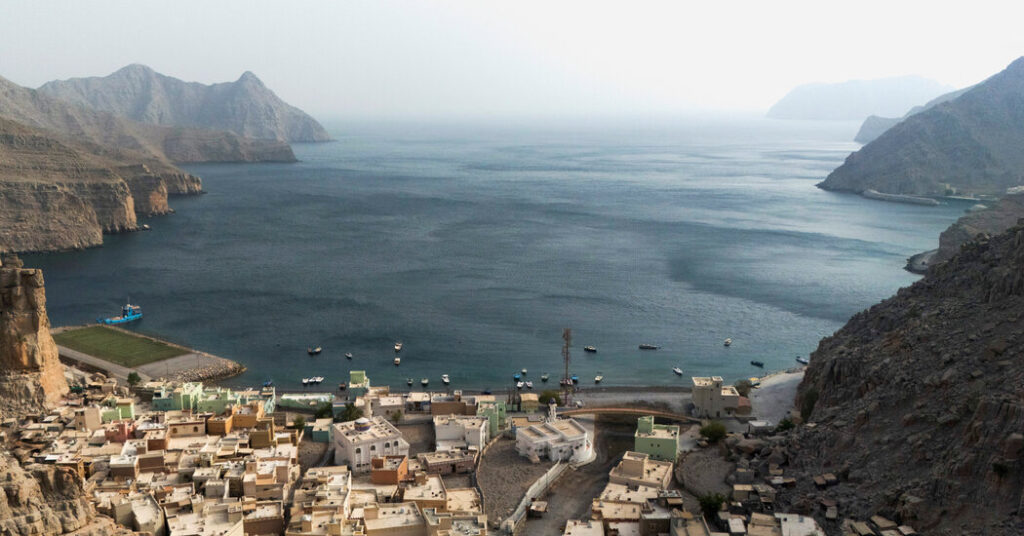
As the United States presses ahead with its military campaign against Iran, the Strait of Hormuz has emerged as the war’s most pivotal battlefield.
In response to U.S. and Israeli airstrikes, Iran has largely blockaded the strait, snarling oil shipments and rapidly causing the price of gasoline to rise.
With the war approaching the three-week mark, President Trump is facing a battery of military and diplomatic choices that are testing his abilities as a leader.
The United States has been flowing military resources into the region to deal with the problem, and carrying out waves of attacks against Iranian forces and installations in the hopes of reopening the strait — a goal vital to ending the war and addressing the economic and political pressures on the White House.
The president has also pushed for allies to send warships to protect oil tankers in the strait. But he has built up little good will with those countries, after repeatedly subjecting them to punishing tariffs, insults and threats.
On Friday, Mr. Trump said he would leave reopening the strait to the countries that use it, claiming the United States did not. “If asked, we will help these Countries in their Hormuz efforts, but it shouldn’t be necessary once Iran’s threat is eradicated,” he wrote on social media.
It was one in a string of mixed messages the Trump administration has sent about the war.
Here are the options under consideration to attempt to reopen the Strait of Hormuz, all of which are complex and carry substantial risks. None of them would guarantee a quick end to the conflict.
Eliminate threats to shipping from land-based attacks
Before the Navy escorts commercial vessels through the strait, U.S. commanders want to destroy as many of Iran’s missiles and drones as possible.
What it would take: In recent days, American warplanes have ramped up strikes against missiles and their launchers along Iran’s southern flank that could target slow-moving oil tankers and giant cargo ships.
Earlier this week, the military’s Central Command said that Air Force F-15E fighter-bombers had dropped several 5,000-pound bombs to penetrate layers of rock and concrete to destroy underground bunkers storing cruise missiles and support equipment.
Gen. Dan Caine, the chairman of the Joint Chiefs of Staff, said that Iran’s ability to launch missiles had declined by 90 percent since the start of the war. But he acknowledged that Iranian forces still had some firepower left.
General Caine added that some regional allies, which he did not identify, were using Apache helicopter gunships to “handle one-way attack drones,” one of the most potent weapons Iran has used to threaten shipping, as well as neighboring Arab countries and their energy sites across the Persian Gulf.
Sweep the strait for mines
U.S. officials appear to disagree about whether Iran has already started mining the strait. Intelligence officials say yes, while Pentagon officials say they have not seen clear evidence.
What it would take: Clearing the narrow waterway of Iranian mines would be a weekslong operation, according to one former naval officer who was stationed on a minesweeper in the Persian Gulf. And it could put U.S. sailors directly in harm’s way.
Iran is believed to maintain a variety of naval mines. They include small limpet mines containing just a few pounds of explosives that divers place directly on a ship’s hull and typically detonate after a set amount of time. Iran also has larger moored mines that float just under the water’s surface, releasing 100 pounds or more of explosive force when they come in contact with an unsuspecting ship.
More advanced “bottom” mines sit on the seafloor. They use a combination of sensors — magnetic, acoustic, pressure and seismic — to determine when a ship is nearby, and explode with hundreds of pounds of force.
“All it takes is for one of those things to get through to shut down traffic,” said Rear Adm. John F. Kirby, a retired naval officer. “The fear alone can be paralyzing to the shipping industry, as we have already seen.”
The Navy had four minesweepers in the Gulf, each with 100 sailors aboard, based in Bahrain. But those ships are gone now, one official said, replaced with three littoral combat ships that can sweep for mines but are also used for other purposes. And two of the ships, the U.S.S. Tulsa and the U.S.S. Santa Barbara, were spotted far from the Middle East this week, between Malaysia and Singapore, according to the military website The War Zone.
Go after Iran’s navy and fast boat fleet
The Pentagon has targeted the Iranian navy since the opening hours of the war, destroying or damaging more than 120 vessels, including several submarines. The goal was to blunt Iran’s ability to shut down the strait and threaten neighboring countries.
But Iran’s Islamic Revolutionary Guards Corps also has hundreds of speed boats. A fighter armed with a rocket-propelled grenade aboard one of these boats could slip through U.S. defenses and land a deadly blow to a tanker or warship.
What it would take: Low-flying Air Force A-10 Warthog planes are “hunting and killing fast-attack watercraft” in the contested sea lanes, General Caine said. The A-10 was developed to provide close air support for U.S. ground troops, but has been repurposed to strike ships at sea, he said.
U.S. warplanes are also striking speedboats hiding in coastal redoubts, but Iran has positioned some of them in civilian ports, increasing the risks to civilians from any American attacks.
The U.S. military is also attacking storage areas for naval drones before the drones can be launched.
Invade Kharg Island
Adm. Brad Cooper, the head of the military’s Central Command, said the U.S. attack against Iranian military sites on Kharg Island, the country’s oil export hub, had destroyed more than 90 targets, including bunkers for naval mines and missiles.
That has softened the island’s defenses if Mr. Trump follows through on his threat to seize the island and put a stranglehold on Iran’s oil economy, a possibility the Pentagon has gamed out in war-planning scenarios for years.
But Iranian troops are still on the island, and U.S. commanders say that such a mission would be risky.
What it would take: Some 2,200 Marines on three warships — armed with drones, attack helicopters and warplanes — have cut short a patrol in the Indo-Pacific region, and are expected to arrive in the Persian Gulf region later next week. The Marines are trained to conduct amphibious landings.
The U.S. military is dispatching 2,500 additional Marines to the Middle East next month, officials said Friday. They are expected to replace or augment those en route to the region now.
Another option involves Special Operations forces and paratroopers from elite units, like the Army’s 82nd Airborne Division, taking the island. Once in control, the Americans would likely be subject to attack from any remaining land- or sea-based Iranian forces.
On Thursday, the president said he had no plans to commit ground forces to the war, before qualifying: “If I were, I certainly wouldn’t tell you.” He added that he would “do whatever’s necessary to keep the price” of oil down.
Use naval escorts to escort oil tankers
Mr. Trump said on Friday that escorting oil tankers through the Strait of Hormuz was “a simple military maneuver.” Naval experts say it is anything but.
In fact, of all of Mr. Trump’s options for opening up the strait, naval escorts are perhaps the trickiest.
What it would take: Naval escorts are cumbersome operations that require not just Navy destroyers and littoral combat ships, but also attack aircraft.
The Navy has deployed around 12 destroyers and littoral combat ships to the region and could certainly send more, although that could take weeks, Navy officials said. A Navy destroyer, which is equipped with the Aegis Combat System that uses computers and radar to track and target, can protect oil tankers by firing cruise and ballistic missiles at land targets in Iran, while Standard antimissile systems can intercept incoming threats.
But one Navy official said that would require a high ratio of Navy destroyers to commercial ships, and would likely be a huge strain on naval assets. The Pentagon has already requested an additional $200 billion in funding for the war.
Mark Montgomery, a retired rear admiral, estimated that about a dozen Navy destroyers, with armed helicopters and other aircraft overhead, would be needed to escort five or six tankers or cargo ships at a time through the strait — a transit he said could take roughly 10 to 12 hours.
During the so-called tanker war between Iran and Iraq in the 1980s, the United States escorted reflagged Kuwaiti tankers through the Persian Gulf and the Strait of Hormuz, part of Operation Earnest Will. The U.S.S. Samuel B. Roberts was nearly destroyed by a mine, and the U.S.S. Stark was heavily damaged by Iraqi missiles. In the end, 37 American sailors were killed.
Luke Broadwater covers the White House for The Times.
The post A Look at the Escalating Battle for the Strait of Hormuz appeared first on New York Times.