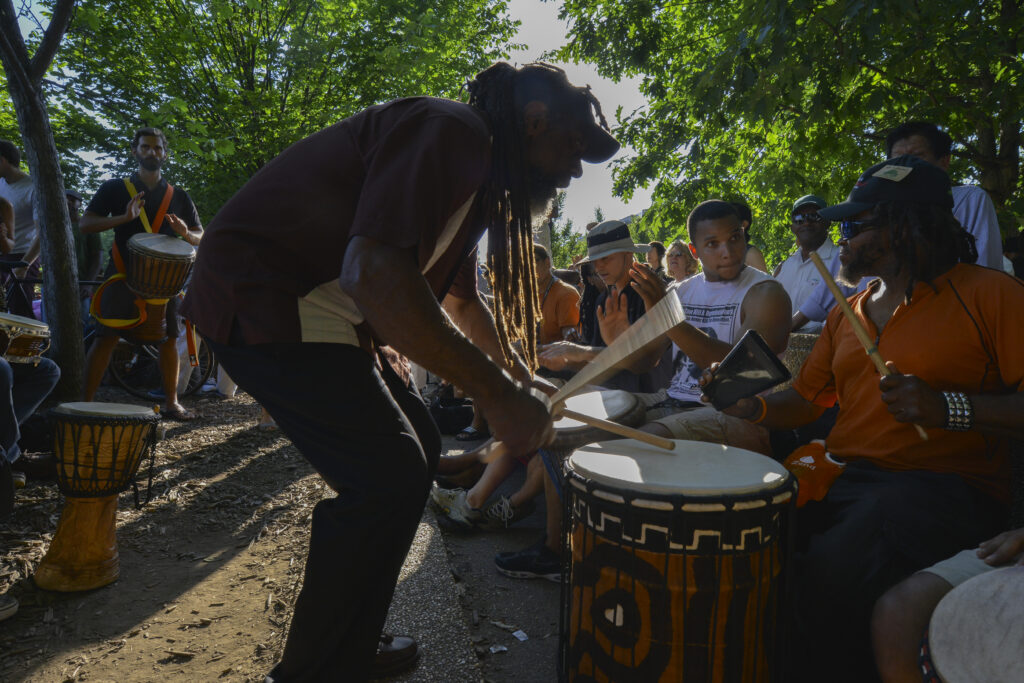
On any given Sunday, the beat of drums fills Malcolm X Park and reverberates throughout the surrounding streets in Northwest Washington. Since the 1960s, the drum circle has been among the defining features of the park, which has served as a center of community in that corner of D.C.
“It’s a beautiful event, and we get a lot of people who come just to watch us,” said Doc Powell, 78, a longtime member of Malcolm X Drummers and Dancers.
But Powell said the drums will go silent over the next several months as a new wave of construction from the National Park Service will force most of the park — also known as Meridian Hill Park — to close beginning Monday.
The $15 million project includes work already underway to repair the 13-basin Italianate cascading fountain, which the National Park Service says is among the longest in North America, as well as to restore the grass on the upper level. “This work will help protect and strengthen this special historic park for years to come,” Autumn Cook, a spokesperson at the National Park Service, wrote in an emailed statement.
Cook said the upper grass areas will be fenced for four to six months after the landscape work “so the new turf can take root.” The Park Service’s notice said the upper and lower levels could reopen in September.
But while some community members and local officials said they appreciate the long-needed maintenance, they’re also frustrated with what they consider to be poor communication from the Park Service — and the fact that the site will be closed when they want to enjoy it the most.
“No one will deny that the lawn needed replacement, but losing that amenity for an entire season is very tough,” said Miguel Trindade Deramo, an advisory neighborhood commissioner whose district includes the park. “To not be consulted or even just notified that things like this are happening is indicative of a certain type of approach that just feels disrespectful of the community.”
Trindade Deramo said his desire to champion the park is what got him into politics in the first place. “It is my backyard,” he said. “It’s everyone’s backyard.”
The park has a long history. Native Americans once inhabited the land, and Union troops camped there during the Civil War. Several Black families were displaced for the creation of the park, which opened in 1936. Over the past few decades, people have gathered there to protest everything from alcohol and war and in support of everything from gay rights to feminism. When crime was rampant in Washington in the 1990s, the park was considered a particularly dangerous place to venture; now it hosts concerts and other activities.
The National Park Service initially announced in December that the park’s lower level would be closed for repairs on the fountain before later amending the announcement to include work on the upper level. “This temporary and partial closure is not of a nature, magnitude and duration that will result in a ‘significant alteration in the public use pattern,’” Brian Joyner, superintendent of Rock Creek Park, wrote in the announcement.
But some community members disagree.
“Hollowing out the core of the park will significantly disrupt how it functions as a community space,” said resident Jan-Michael Archer. “There’s no confidence among the community that we’re going to be kept informed of progress on the restoration.”
In response, Archer and other local residents launched an initiative called Keep Malcolm X Open. To date, more than 1,600 people have signed their petition calling on the National Park Service to reconsider the planned full closure of the upper level. The group is also hosting a “park party” on Saturday to enjoy the space before it closes. “We cannot live without this park,” said Kendall Schrohe, another member of the initiative.
The park’s cascading fountain has long run dry, and the majority of the Park Service’s investment — about $10.7 million — will go toward repairing the structure, reflecting pool, auxiliary fountains and water and plumbing systems, so the water features can operate again, Cook said. The agency will also improve the surrounding landscape, including pruning trees, removing invasive plants, repairing lights and benches, and restoring the large upper grass panels, she said.
Sidewalks along the outside of the park on 15th and 16th streets will remain open during construction, Cook said. “All closures are at the same time, though some sections may reopen sooner than others,” she said.
Trindade Deramo said he asked the National Park Service to stagger the construction to prevent the entire park from being closed at the same time. “I did ask them to consider it, and they’re working on it. I think there’s a lot that they don’t quite know because the funding is a bit unpredictable,” Trindade Deramo said.
D.C. Council member Brianne K. Nadeau (D-Ward 1) agreed that funding for these kinds of projects can be erratic.
The investments “don’t come very often, and when they do, you have to seize them, because that money goes away,” she said. “It’s hard for people to understand, because some people are just hearing this is a space I like using, and now it’s being taken away.”
Powell said the drum circle won’t move to another park during the construction. Instead, it will return when the park reopens. “The drum circle will continue because we have been doing this for over 60 years,” Powell said. “Hopefully the construction will make the park a better place.”
The park’s upper level is slated to close at 7 a.m. Monday.
Joseph Snowaert plans to be there. For three years, the 31-year-old contractor has led free community workouts in the park every Monday at 6:30 in the morning. He said he hasn’t yet decided how he’ll adapt with the construction.
“It sucks, but we’ll figure it out,” Snowaert said. “We’ll squeeze in one last workout while they’re putting up the fence.”
Kendall Staton contributed to this report.
The post Why the iconic drum circles at D.C.’s Malcolm X Park are going silent appeared first on Washington Post.