The White House raced to find ways to reassure Americans as oil prices seesawed again on Thursday after a series of Iranian strikes on oil and gas facilities deepened a global energy crisis nearly three weeks into the U.S.-Israeli war with Iran.
President Trump, speaking during an Oval Office meeting with the Japanese prime minister, Sanae Takaichi, said that he would do whatever was necessary to ease the crisis but that it was temporary.
“I thought there was a chance it could be much worse,” he said. “It’s not bad. And it’s going to be over with pretty soon.”
Prime Minister Benjamin Netanyahu of Israel said at a news conference on Thursday that the war could end “a lot faster than people think,” though he did not offer a concrete timeline. He said that Iran no longer has the ability to enrich uranium or manufacture ballistic missiles, but “there’s still more work to do, and we’re going to do it.”
He spoke after Iran hit oil and gas facilities in Israel, Saudi Arabia, Qatar, Kuwait and the United Arab Emirates on Wednesday and Thursday, in retaliation for an Israeli strike on the South Pars natural gas field, a vast gas reservoir in the Persian Gulf that supplies Iran with much of the energy for its businesses and homes.
The strikes further rattled global energy markets, which have already been shaken by Iran’s effective blockade of most Western oil shipments in the Strait of Hormuz, a conduit for about one-fifth of the world’s oil.
Oil prices have been surging since the start of the conflict on Feb. 28, with international crude futures up close to 50 percent in less than three weeks. As crude rises, so do gasoline, diesel and jet fuel, driving up the prices of everyday goods.
On Thursday, the average price of a gallon of gas in the United States hit $3.88, up from $2.93 a month ago. Mortgage rates also jumped this week, the third increase in a row, as high oil and gas prices weighed on housing costs for Americans.
The shock to household budgets is unlikely to deter home buyers for now, experts said, but “the longer this goes on, the more it’s likely to affect buyer behavior,” said Michael Pearce, the chief U.S. economist at Oxford Economics.
Treasury Secretary Scott Bessent told Fox Business that the Trump administration, in an effort to lower prices, may remove sanctions on Iranian oil that was already being shipped, about 140 million barrels. The strategy would be a sharp reversal from years of tough sanctions aimed at crippling Iran’s economy.
Mr. Bessent said he hoped that increasing the supply of oil on global markets would make up for what Iran was obstructing through the Strait of Hormuz. Iran sells most of its oil to China. But Mr. Bessent said that unsanctioned oil could go to countries such as Malaysia, Singapore, Indonesia, Japan and India.
Mr. Bessent said that the United States could also release more oil from its own strategic reserves, on top of the 172 million barrels it had already pledged to tap earlier this month.
He floated the ideas as the Pentagon asked for $200 billion in additional funding for the war, according to a military official and an administration official. The sum, which is nearly a quarter of the entire annual U.S. defense budget, must be reviewed by the White House before it is formally submitted to Congress.
“Obviously, it takes money to kill bad guys,” Defense Secretary Pete Hegseth said when asked about the request on Thursday, adding, “As far as the $200 billion, I think that number could move.”
Mr. Hegseth declined to offer a timeline for when the war might end, but the request suggested the U.S. military was preparing for a long campaign.
Mr. Trump told reporters on Thursday that the funding would be “a small price to pay to make sure that we stay tippy top.” Asked about using ground troops in Iran, Mr. Trump said: “I’m not putting troops anywhere. If I did, I wouldn’t tell you.” On Tuesday, he said he was not afraid to deploy U.S. troops in Iran.
The Trump administration on Thursday also moved to send more weapons to Middle Eastern allies, which have been targeted by Iranian missiles and drones.
The State Department said that it had declared an emergency to allow it to bypass Congress and sell about $16 billion in munitions, counter-drone technology, medium-range missiles, and air- and missile-defense systems to the United Arab Emirates, Kuwait and Jordan. The department declared a similar emergency to advance an arms sale to Israel earlier this month.
The Trump administration has also been pressing Japan for military assistance in the Middle East, possibly by sending minesweepers to the Strait of Hormuz.
During his meeting with Ms. Takaichi on Thursday, Mr. Trump was asked why the United States did not warn Japan and other allies before it started bombing Iran.
“We didn’t tell anybody about it because we wanted surprise,” Mr. Trump said. “Who knows better about surprise than Japan, OK? Why didn’t you tell me about Pearl Harbor, OK?”
As he spoke, Ms. Takaichi widened her eyes and appeared to take a deep breath, but kept her arms crossed on her lap and did not say anything.
While an end to the war could reopen oil shipments in the Strait of Hormuz, economists are also worried that Iran’s attacks may cause lasting damage to valuable oil and gas sites in the Persian Gulf.
Qatar, a major global energy supplier, said that Iranian attacks had damaged its gas sites, including the Ras Laffan terminal, the world’s largest liquefied natural gas facility. Saad Sherida al-Kaabi, the chief executive of QatarEnergy, a state-owned energy company, told Reuters that the attacks had knocked out nearly a fifth of the company’s liquefied natural gas export capacity, and that repairs would take three to five years.
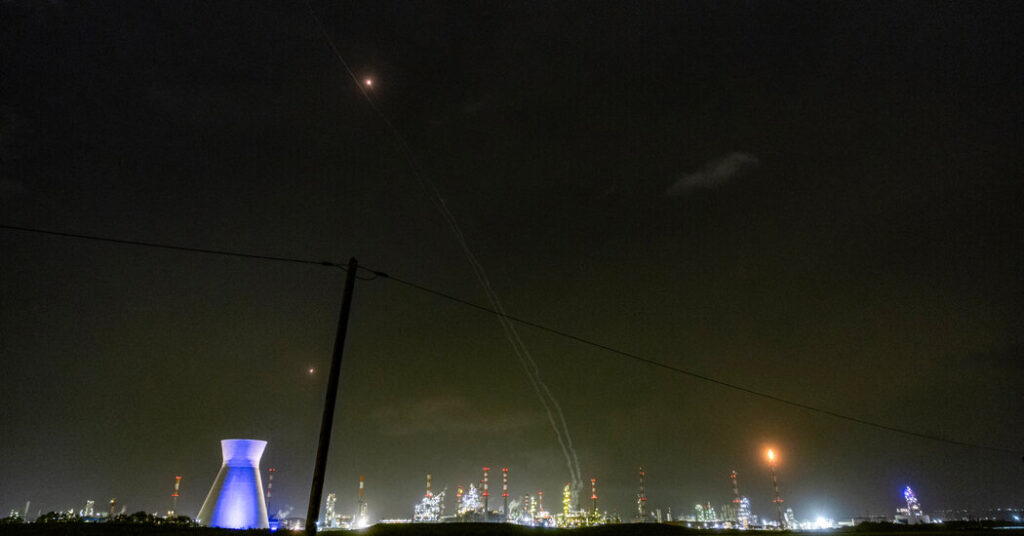
Drone attacks this week also caused fires at two state-owned refineries in Kuwait, and a drone fell at a key energy export terminal in Saudi Arabia. In the United Arab Emirates, officials reported that gas facilities and an oil field were struck by debris from missile interceptions. And in Israel on Thursday, a fire broke out at an oil refinery that was hit by an Iranian missile fragment, officials said.
Saudi Arabia’s foreign minister, Prince Faisal bin Farhan, warned that his government had limited patience with Iran and reserved the right “to take military actions if deemed necessary.”
“We will not shy away from protecting our country and our economic resources,” he said at a news conference on Thursday. When asked what would prompt a military response, the prince declined to elaborate.
“Do they have a day, two, a week?” he asked. “I’m not going to telegraph that.” He added that “what little trust” there was between the kingdom and Iran had “completely been shattered.” The countries re-established diplomatic relations in 2023.
The attack on South Pars gas field infuriated not only Iran, but also Qatar, a U.S. ally which shares ownership of the field and called the strike a “dangerous and irresponsible step” that could threaten global energy security.
Mr. Trump sent conflicting messages about whether the United States knew ahead of time about the attack on South Pars.
In a social media post late Wednesday, he wrote that the United States “knew nothing” about it and that Israel had “violently lashed out.”
Speaking from the Oval Office on Thursday, Mr. Trump said that he had talked about the South Pars strike with Mr. Netanyahu, but he was not clear about when they spoke.
“I told him don’t do that,” Mr. Trump said. Mr. Netanyahu later said that Mr. Trump had asked Israel to hold off further attacks on the South Pars facility and that Israel would respect that.
Three Israeli officials briefed on it said on Thursday that the United States was informed before the attack. They spoke on the condition of anonymity because of the sensitive diplomacy.
Reporting was contributed by Javier C. Hernández, Isabel Kershner, Vivian Nereim, Helene Cooper, Megan Mineiro, Johnatan Reiss, Gregory Schmidt, Alan Rappeport and Eric Schmitt.
Tony Romm is a reporter covering economic policy and the Trump administration for The Times, based in Washington.
The post White House Looks for Ways to Soothe American Jitters Over Surging Prices appeared first on New York Times.