A small team of British military planners has been sent to the United States to help draw up options to reopen the Strait of Hormuz, a British official said on Thursday, as Iranian retaliatory attacks disrupt global shipping and drive up energy prices.
The group has been sent to U.S. Central Command at MacDill Air Force Base, in Tampa, Fla., according to the official, who spoke on condition of anonymity because they were not authorized to discuss the matter publicly.
The British move, reported earlier by The Times of London, appears to be an effort to persuade Mr. Trump that Britain is willing to make a contribution to improving the security of the critical shipping lane, while stopping short of the sort of major military action President Trump has demanded, such as sending warships to the waterway imminently.
The British government has made clear that its priority is finding a negotiated end to the conflict, and that its involvement in securing the shipping lane would come as part of a much broader effort by allies, most likely once the conflict has calmed.
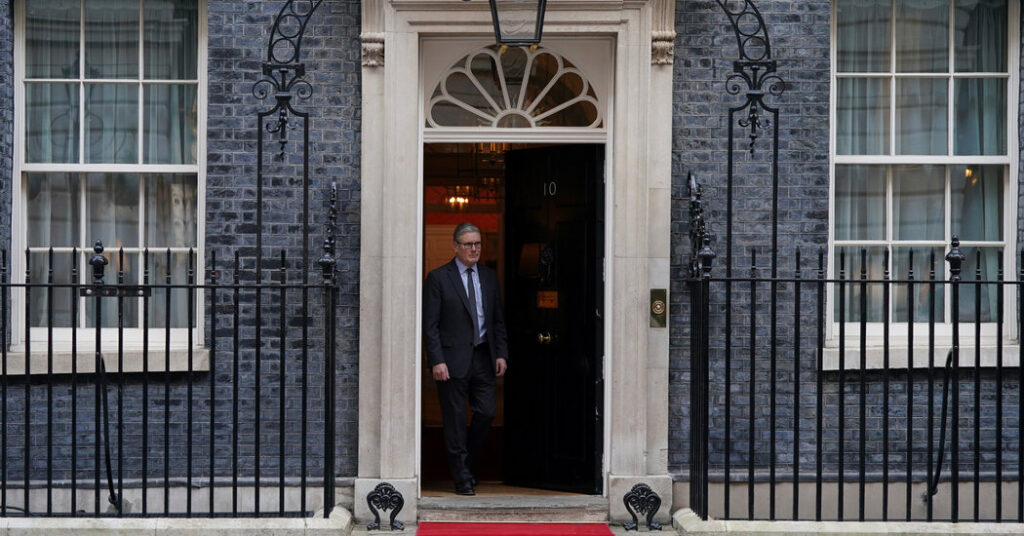
In recent weeks Mr. Trump has sharply criticized Prime Minister Keir Starmer of Britain, who refused to allow British bases to be used for the initial U.S. military strikes on Iran. Mr. Starmer changed his position once the Iranians began retaliating, saying he would allow two British bases to be used for specific “defensive” operations to target Iranian missile sites.
Britain has long had a small number of staff at U.S. Central Command but the additional planners were sent this month.
Mr. Trump said on Monday that he was “not happy” with Britain which, he said “should be involved enthusiastically” in efforts to reopen the Strait of Hormuz.
On Tuesday the president made another personal criticism of Mr. Starmer, who he said “is no Winston Churchill.”
Mr. Starmer, who has avoided responding directly to those comments, said this week that he appreciated the importance of reopening the Strait of Hormuz, adding that this was “not a simple task.” He was, he said, “working with all of our allies, including our European partners, to bring together a viable, collective plan.” The British government has also said it was considering sending mine-sweeping drones.
Speaking to The Times of London about the challenge of securing the Strait of Hormuz, Al Carns, the British armed forces minister, said: “I would say this must be a multinational solution. We’re not anywhere near that at the moment.”
Vessels have come under attack in or near the Strait of Hormuz over the past three weeks as Iran vows not to allow ships to pass through the waterway, normally used by a fifth of global oil shipments. U.S. officials have called on nations to send warships to escort vessels through the strait.
Earlier this week John Healey, Britain’s defense secretary, said that the situation regarding the Strait of Hormuz was complex and that “any plans must be multilateral, with as many nations taking part as possible”
Stephen Castle is a London correspondent of The Times, writing widely about Britain, its politics and the country’s relationship with Europe.
The post U.K. Advisers Sent to U.S. to Help Develop Options to Reopen Strait of Hormuz appeared first on New York Times.