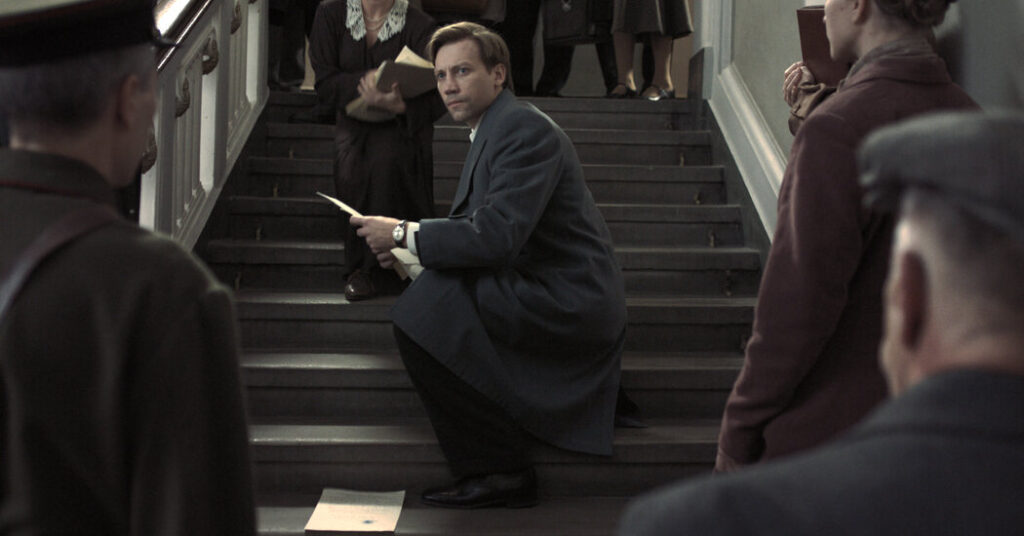
Early in “Two Prosecutors,” Alexander Kornyev, a young attorney, meets with a prison official who can’t believe what he’s hearing. Freshly appointed as a prosecutor, Kornyev wishes to meet with an inmate who sent a desperate petition to his office. The official tries to put Kornyev off with excuses and delays, but the “kid” just won’t quit: He actually wants to right what’s wrong.
That’s a potentially fatal mission to have in 1937 in the Soviet Union, amid Communist purges, but viewers in many countries might feel a twinge of recognition at Kornyev’s quixotic journey. Sergei Loznitsa’s novelistic, confidently imagined investigative drama is an instant classic in the annals of film and literature about the systemic abuses of state power, specifically by a totalitarian government. Adapted from a 1969 novella by Georgy Demidov, a physicist who survived the Soviet gulags, it’s at once faithful to its setting and portrayed with an elemental clarity that lends a fable-like, even dreamlike quality — a nightmare from which he is trying to awake.
Kornyev — played by Aleksandr Kuznetsov, part of a well-cast gallery of faces — persists in meeting the gaunt prisoner in question as well as officials in the bustling capital, Moscow. He puts full faith in a polite, party-line idealism, while everyone else seems to game out the corrupt dynamic that Nikolai Gogol and others have memorably described: Can we arrest you, or are you in a position to arrest us first? His encounters with a state prosecutor or a weirdly friendly stranger are both sweat-inducing and eerily low-key, as Kornyev parses menacing hints, seemingly positive signs and obfuscation.
Loznitsa and his regular cinematographer, Oleg Mutu, envision stark, gray-and-brown fortresses that swallow up justice, whether shooting in an actual Latvian prison dating from 1905 or a government building in Moscow humming with paranoia. There are some unforgettable tableaus and scenes: a prisoner forced to burn other inmates’ letters in a stove, a scaffolding that resembles a calendar with X’s counting off days, and more than one rumbling train compartment packed with comrades telling shifty tales.
Mordantly comedic, “Two Prosecutors” is deliberately paced but makes a tightly conceived addition to Loznitsa’s work, which rides deep into the long, dark nights of Russian history with fiction, observational documentary and immersions in the Soviet archives. Loznitsa, who is Ukrainian, remains morbidly but meaningfully invested in exposing the corrosive bad faith of Russia’s authoritarianism (wherein loyalists are treated like kindling) and relaying the messages of history. (His own actors aren’t isolated from the kind of oppression depicted here: Kuznetsov, Aleksandr Filippenko and Anatoly Beliy all left Russia after its 2022 invasion of Ukraine.)
Loznitsa treads a delicate balance: We respect Kornyev’s naïve persistence, even as we brace ourselves for the consequences. Yet by its twisty end, the film poses the provocative question of the limits to a legalistic approach in the face of tyranny. Violence may be kept largely offscreen in this particular story, but it’s written on the bodies of the broken prisoners. Here, fear lurks behind every other door.
Two Prosecutors Not rated. In Russian and Ukrainian, with subtitles. Running time: 1 hour 58 minutes. In theaters.
The post ‘Two Prosecutors’ Review: Practicing Law in a State of Fear appeared first on New York Times.