The Trump administration holds itself up as a defender of religious freedom. It has created a Religious Liberty Commission, increased funding for faith-based schools and changed vaccine policies to allow more religious exemptions. It ordered a Christmas Day missile attack in Nigeria on what President Trump described as a terrorist group that was killing Christians. The administration has punished universities in the name of preventing antisemitism. “I’ve done more for religion than any other president,” the president claimed at the National Prayer Breakfast this year.
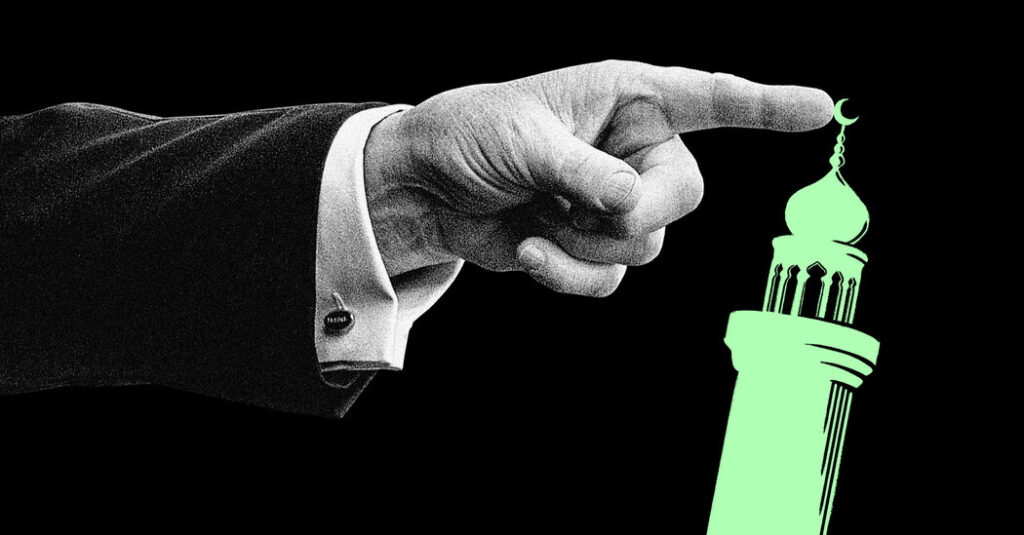
Yet there is an exception to this effort. Mr. Trump and his Republican Party appear uninterested in protecting the religious rights of Muslims. Instead, they are often hostile to Islam.
Their words are odious. As a presidential candidate, Mr. Trump called for a “Muslim ban” on entry to the United States, and a version of it remains in effect. “I think Islam hates us,” he has said. Several other Republican politicians have made similar statements in recent months.
“Islam is not a religion. It’s a cult,” Senator Tommy Tuberville of Alabama posted on social media. Representative Brandon Gill of Texas wrote, “Islam is incompatible with our culture and our governing system.” Representative Randy Fine of Florida called for “radical deportations of all mainstream Muslim legal and illegal immigrants and citizenship revocations wherever possible.” Representative Andy Ogles of Tennessee — who has said that Mayor Zohran Mamdani of New York should be expelled from the country — this month wrote that “Muslims don’t belong in American society.”
Mr. Trump has also made a habit of targeting Muslim communities and politicians for harsh criticism. He does not typically mention their religion when doing so, but the pattern is undeniable. Of the Somali diaspora in the United States, the president said: “They contribute nothing. I don’t want them in our country.” He referred to them as “low-I.Q. people.” He described Representative Ilhan Omar of Minnesota, a Somali American, as “garbage” and said the United States should stop “taking in garbage.” He has directed similar ire at Afghan refugees, and his administration has smeared pro-Palestinian activists as terrorists.
The statements are particularly alarming when viewed in the context of Mr. Trump’s tendency to behave as an aspiring autocrat. Autocrats have a history of targeting vulnerable minority groups to justify their moves.
Recent events in Minnesota show how the scapegoating of a minority group can mushroom into broader violence. The Trump administration chose the state for an immigration crackdown last year, citing a government fraud scandal centered in the large Somali community there. The president unfairly maligned the full community for the scandal. The resulting crackdown led to the brutalization of many residents, both Muslim and not, immigrant and citizen, and to the killing of two protesters, Renee Good and Alex Pretti.
Irrational fear of Shariah — a set of principles, based on the Quran, that guide life for Muslims, much as biblical precepts guide Christians and Jews — is another way in which anti-Muslim hate is translating into policy. Gov. Greg Abbott of Texas recently signed a law that would prevent what he called “Shariah compounds,” supposedly communities that are open only to Muslims and that subject their residents to religious law. In the House, Representative Chip Roy of Texas has introduced a bill called the Preserving a Shariah-Free America Act, while Senator John Cornyn of Texas has cosponsored another, the Defeat Shariah Law in America Act. Mr. Fine, for his part, has introduced a Protecting Puppies from Shariah Act.
These efforts are based on ludicrously false pretenses. Extreme versions of Shariah are a problem in some countries, including Afghanistan and Iran, but they are not a threat in the United States. American Muslims are not attempting to impose Shariah principles on others. As Mustafa Akyol of the Cato Institute has noted, the recent proposals mimic anti-Catholic and anti-Mormon laws enacted in previous centuries. They are based on lies and are intended to scapegoat.
The millions of Americans who practice Islam are just as American as anyone else. They pay taxes, own businesses and serve in the armed forces. Many have been here for generations. Others upended their lives to move here, in some cases because of this country’s constitutional protection of religious freedom.
The surge of anti-Muslim hate has caused many of them to feel threatened in their own country. Some feel anxious about entering a mosque or wearing obvious signs of their faith. In Texas and other places where political leaders have spread hate, the fears can be acute. “We left our roots, our home, our generational stories, to move into a country where we thought these kinds of things would not happen,” Mona Kafeel, who runs Peace in the Home Family Services, a social services organization in Plano, Tex., told us. Now, she said, “That fear is coming back to many of us.”
Mr. Trump’s disparagement of Muslims is part of a broader pattern of bigotry by him. He has targeted Latinos and trans Americans, too. While he criticizes universities for tolerating antisemitism, he and other Republicans have allied themselves with some of the worst peddlers of anti-Jewish hate. Since he entered politics more than a decade ago, with a campaign kickoff speech full of anti-Mexican sentiments, a wide variety of hate crimes have surged, according to F.B.I. data.
In an editorial last year decrying the surge of antisemitism, we emphasized that not all accusations of discrimination are legitimate. Criticism of the current Israeli government for its brutal treatment of Palestinians, for example, is not inherently antisemitic. The same principle applies to other subjects. Radical Islamists continue to carry out violent acts of terrorism, including recent attacks in New York, Texas and Virginia. Denouncing them is important, not bigoted.
A fundamental American principle is that people should be judged by their behavior, not their identity. Mr. Trump and too many other Republicans are instead besmirching an entire faith even as they claim to protect religious freedom.
The worst consequence of the new Islamophobia, by far, is the effect that it has on Muslims. Yet there is damage to America’s national interests, too.
Mr. Trump is prosecuting a war against Iran, which identifies as an Islamic republic and has an overwhelmingly Muslim population. His planning for that war has been reckless, and his explanations of its aims have been contradictory. Combined with the surge of anti-Muslim bigotry from Republicans, the attack on Iran has the potential to look like a war against Islam. Certainly, the bigotry weakens America’s position in the world, especially with heavily Muslim countries, including American partners like Saudi Arabia, Turkey and the United Arab Emirates.
This editorial page had many criticisms of the presidency of George W. Bush, but Mr. Bush took a starkly different approach to that of the current president. Six days after Sept. 11, 2001, he visited a mosque and stood beside Muslim leaders, who he noted were as appalled by the attacks as other Americans. “When we think of Islam,” Mr. Bush said, “we think of a faith that brings comfort to a billion people around the world.”
The attacks against Islam and Muslims from Mr. Trump and other Republicans are shameful. They are filled with lies. They deserve denunciation from all Americans, regardless of politics or religion.
Source photograph by Tasos Katopodis, via Getty Images.
The Times is committed to publishing a diversity of letters to the editor. We’d like to hear what you think about this or any of our articles. Here are some tips. And here’s our email: [email protected].
Follow the New York Times Opinion section on Facebook, Instagram, TikTok, Bluesky, WhatsApp and Threads.
The post Trump’s Hypocrisy on Religious Freedom appeared first on New York Times.