Subscribe here: Apple Podcasts | Spotify | YouTube | Overcast | Pocket Casts
For the past year or so, economists have remained, if not optimistic about the economy, not alarmed either. Then recently came what economists call a series of “revisions” to data reports. These were not the superficial kinds of revisions that leave the central story intact. To name just one, original estimates had 2025 new-job numbers at 584,000, which was just tepidly okay. That was revised to a net number of only 116,000.
Across the past two years, the revisions mean that the American economy has about a million fewer jobs than previously reported. Coupled with the worst economic growth numbers since the early pandemic. Plus the highest inflation in two years. And that is before we’ve factored in the largest supply disruption the oil market has ever seen.
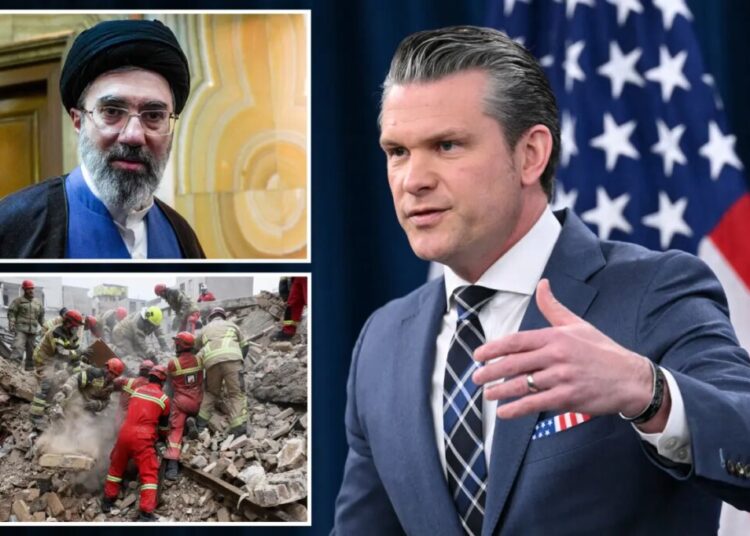
President Trump was elected partly to address voters’ concerns about rising prices and inflation. Now his war in Iran threatens to create many more reasons for voters to be concerned.
When Iran closed off the Strait of Hormuz, it shut out roughly a fifth of the world’s oil supply. Oil infrastructure across the Persian Gulf has faced attacks, threatening the supply at its source. Americans are already watching prices climb at gas stations, but that’s only the beginning. Oil prices affect nearly everything Americans eat, wear, and touch. Our staff writer Rogé Karma lays out how the shock of historically high oil prices could push an already fragile economy into recession.
The following is a transcript of the episode:
[Music]
Hanna Rosin: We are now in week three of the U.S. and Israel’s war with Iran, the purpose of which President Trump has still not clearly explained.
The consequences of the war may have seemed abstract to many Americans at the beginning, but now they’re showing up very concretely on the big pylon signs at the gas station.
Female news anchor 1: The U.S. average for a gallon of regular gas was $3.68.
Male news anchor: Gas prices continued to rise over the weekend, with AAA saying the national average now is sitting at about $3.72 a gallon.
Female news anchor 2: The average price for a gallon of gas: $3.79—that’s up 82 cents now since the start of the war.
Rosin: These climbing prices are because Iran is doing something the White House did not seem to have fully anticipated: shutting down the Strait of Hormuz.
[Music]
Rosin: About a fifth of the world’s oil passes through the strait, and by pledging to attack vessels, Iran has effectively stopped commercial shipping from the Gulf.
Rogé Karma: There are, right now, hundreds of tankers carrying pretty much all of Middle East oil production parked outside of the strait, afraid to go through.
Rosin: That’s Atlantic staff writer Rogé Karma.
Karma: As a result, you have production fields shutting down because they don’t have enough storage. You have the price of a barrel of oil skyrocketing.
Female news anchor 3: For the first time in years, oil prices surpassed $100 per barrel as a war in the Middle East continues to impact oil production and shipping worldwide.
Karma: The International Energy Agency, the IEA, has called this the single largest disruption to the global oil supply in history.
This is the scenario that energy analysts have been worried about for about half a century.
Rosin: Earlier this year, a barrel of crude oil cost about $60. Now the price is hovering around $100. If the conflict isn’t resolved quickly, prices could continue to rise, passing $100, hitting $150 or even $200 per barrel—prices that have literally never been seen before.
The cost of the Iran war may soon become very visible to Americans, in a day-to-day way. So many things you buy routinely are dependent on the price of oil. Raising that price to new heights can easily disrupt our entire economy—an economy that’s already pretty shaky right now.
Rogé, welcome to the show.
Karma: Thanks so much for having me. It’s great to be here.
Rosin: So the Trump administration and its allies have suggested that because the U.S. produces its own oil, we are relatively insulated.
President Trump: We don’t need oil. We have all the oil we need for ourselves. It’s one of the great assets that we have.
Rosin: Respond. Is that true?
Karma: That is partially true. Relatively is doing a lot of work there.
When we say that the U.S. is a net exporter of oil, what we are actually talking about is finished petroleum products. There are two stages to oil production. One is: The raw crude oil, you take out of the ground, and then that crude oil is refined into products like gasoline, like diesel, like plastics, which then are used—gasoline, obviously, is what you fill up your car with at the pump. And the U.S., while it is a net exporter of those finished products, it is a net importer of the crude oil itself.
Also, there are multiple types of crude oil. The shale revolution in the U.S., which started in the early 2000s, which was the discovery of a lot of, basically, oil across the Gulf of the country, basically produces a type of oil that experts call “sweet light crude,” which is this thinner oil and this much lighter oil. But a lot of American refineries that process that oil were created before the shale revolution. They’re primarily set up to process the kind of what is called “heavy sour crude” that comes primarily now from other places.
And so what the U.S. basically does is we import a lot of heavy sour crude from other places, we export a lot of our own sweet light crude to other places, and then we do a lot of that refining here, which goes into finished products. And so, yes, we’re technically a net exporter, but we are inextricably connected to the rest of the global market, such that when the price of a barrel of oil goes up because of a disruption elsewhere, it also goes up here.
Rosin: So why haven’t oil prices made Trump back off from Iran already?
Karma: That’s a great question. (Laughs.) One answer is that oil prices haven’t climbed nearly as high yet as many experts think they could. Right now, we have oil prices at about $100 a barrel. Hopefully, that doesn’t change by the time this episode is released, but as of this taping, oil prices are around $100 a barrel. Experts think that they could go much higher: $150, $200 a barrel.
And the reason why they haven’t is a bit befuddling to me. It really reflects, I think, a view among oil traders that Trump will chicken out, that this crisis is not going to last—for the exact reason you just asked me that question, Wouldn’t higher oil prices cause Trump to back down?
[Music]
Karma: The irony of this situation is that I think a lot of traders in the oil markets are assuming Trump will back down; therefore, the price of oil is not going up as fast, and because of that, Trump is actually less likely to back down. And so you almost have this kind of self-fulfilling loop, I think, happening right now in the markets, where everyone believes that Trump will back down, but because they believe he will back down, the prices actually aren’t going up to the point that might make him back down. It’s a little bit of a mirror of kind of the sort of Trump “TACO trade” theory that had been percolating around why stock markets haven’t fallen more in response to some of Trump’s actions.
But I genuinely have been befuddled by this, and I think if the oil markets were to internalize the severity of this, prices would go up very quickly.
Rosin: So there might be a moment where they lose faith.
Karma: There might be a moment, and again, the big question is when that moment comes; it’s really hard to predict.
Rosin: In a world where oil is more scarce, oil prices are higher. How does that affect the economy overall?
Karma: Gas prices are only the beginning. Oil is an input to so many different materials, so many different sectors and industries throughout the economy.
I would say the big ones—again, prices at the pump. The second big one is airfares; we’ve already seen airfares, especially for transatlantic, for international flights, go way up. And then I think another area it’s going to increasingly show up is food.
So fertilizer is made from different components. Some are things like urea and ammonia. A lot of these come directly out of the Strait of Hormuz. A lot of them are created from natural gas that also comes out of the Strait of Hormuz. So those supply chains. And then all of the tractors and the harvesters, the machinery that’s used to power farms is powered by diesel. Food is transported, obviously, by trucks.
So I think it’s going to start showing up in prices basically everywhere—every time you go to make a purchase of clothes, something that’s wrapped in plastic, every time you go to buy food. And I think there’s another way this was going to show up. It’s not just going to be higher prices.
What do consumers do, often, when they’re faced with higher prices? You end up pulling back, and you end up stopping your spending of other areas in order to pay more for these products, especially gasoline. This is a pattern that happens throughout history every time there’s an energy shock.
When the economy’s doing really well, that’s not as big of a problem. Consumers pull back a little bit; it’s not a huge deal. Right now is not that moment for the U.S. economy. The economy is looking weak in terms of the job numbers. It’s looking weak in terms of economic growth. It is already stagnating in terms of hiring.
In an economy that is not doing very well, a sudden pullback in consumer spending can create a really vicious cycle that a lot of economists I talk to think could end up leading to a recession.
Rosin: Okay, I actually think I would like you to make the case for how fragile the economy is, because I know that’s debated now. It’s debated politically; it’s debated among economists. So why do you think the economy is particularly fragile right now?
Karma: So over the last few weeks, we have gotten a series of economic data reports that I think have been extremely alarming. I had a piece I wrote the other week that was called “The Economy’s Warning Light Is Flashing Yellow,” so not quite red, not quite a recession yet, but looking very bad. And there were a couple reports in particular that were concerning.
The big one is the jobs numbers. So the story for the past year or so has been we’re getting not as many jobs as before, but the labor market is still growing; jobs are still being created. And there was basically a series of revisions that have been made to last year’s job numbers that showed that we originally thought there were close to 600,000 jobs created last year—already not a great year. That was revised down to around 180,000 and then 116,000. That is one-tenth of the jobs that were created in 2024. So in 2025, we got one-tenth of the job creation. That is not the sign of a healthy labor market.
At the exact same time as we’re getting this huge slowdown in the job market, we’re also seeing economic growth slow down. The total output of the U.S. economy was about 4.4 percent in the third quarter of last year. That is a really high number. That’s great. The average is about 2 percent going back, so 4.4 percent is fantastic. It then fell off to, according to the most recent revision, 0.7 percent. That is just a dramatic dropoff. And you also, at the same time, have a pullback in consumer spending already.
And so basically, what you have—I think the way to summarize all this—is even before this oil crisis, you had the worst economic growth numbers since COVID. You also had the highest inflation report in two years. And all of that was even before we start talking about oil.
Rosin: The political questions that follow from what you just said are so obvious. Trump was elected, in large part, because people were discontented over inflation. The administration has been sensitive to price concerns that Americans are feeling. But you’re describing a situation where prices are going up; we may be at the start of the recession.
What’s actually happening in the economy and the political story that prevails of what’s happening in the economy are often disparate from each other, but what do you think about that, like how that plays out?
Karma: It is truly ironic that Donald Trump came into office as the affordability guy.
Trump: We inherited a mess, with high prices and high inflation, and we’ve turned it around, and we’ve made it great.
Karma: He very much, again, like you said, rode this wave of discontent and then immediately got into office and decided, long before this crisis, to institute global tariffs, which are literally going to raise the price of everyday goods, of deporting huge parts of the American workforce, almost as if he was trying to raise prices.
And then, you have this set of crises, which it’s been interesting because throughout all of this, even as inflation has remained pretty sticky throughout Trump’s term, the one price that really did fall, relative to where it was under Joe Biden, was the price of gasoline.
Trump: After gasoline skyrocketed to over $5 a gallon and, in some places, $7, $8, and even $9 a gallon under Biden, our policies have brought gas prices way down.
Karma: That doesn’t have much to do with Donald Trump. That has a lot to do with this sort of aftermath of the Russian invasion and the oil crisis that came out of that and the price shocks normalizing.
The one price that the Trump administration could brag about and very much did brag about was the price of gasoline, and now that is also going up.
In terms of what to make of it, politically, I find it mystifying. I had a piece in the fall right after Trump got elected, the fall of 2024, and it was called “The Two Donald Trumps.” And the whole premise of that piece was that Donald Trump was elected, in a lot of ways, as the president who would return things to the status quo, who would make America affordable again, who would end all of these wars, who would secure the border, but that Trump’s agenda was almost specifically designed to create more chaos and more disruption.
And I think you see that specifically on the case of affordability, where, in a lot of ways, what Donald Trump had to do politically was come in and just watch as inflation was already coming down. It was already close to near the Fed’s target. At that point, interest rates would’ve come down. It would’ve been pretty easy. And instead, what he’s done is basically do the exact opposite.
In terms of what is actually going on, I am not a professional Trump psychological reader, but all I do know is that it does not seem to be making the American people very happy, and this war is only accentuating all of those concerns and taking the one price that the administration did have going for them and sending it in the opposite direction.
Rosin: Since we’re talking in animated tones, I just wanna level here before we move on. What you’re saying is that we are adding oil shocks to an already fragile economy and that might lead to an actual recession. Is that actually what you’re saying?
Karma: My view right now is that the economy’s warning light is flashing yellow. This could be bad; it doesn’t have to be.
On top of an economy that is very fragile, if you add a once-in-50-years-level oil shock that sends prices to $150 or $200 a barrel, the kinds of prices we haven’t seen before, I would be extremely surprised if we did not get a recession. It is really hard to imagine an economy that already has as weak job numbers as we have, that has already seen consumers pull back as much, that has already seen as weak hiring as we have getting a shock that big and not reacting in a pretty severe way, so that is what I’m saying.
And in a lot of ways, it mirrors what happens in the 1970s. In the early 1970s, you had an economy where the economy was reeling—it was already somewhat fragile. It was already sort of weakening in terms of growth, in terms of job numbers from a few years prior. Inflation was coming down but was higher than it had been. And then you had this huge shock that changed everything.
But I think, again, a lot of this comes down to a big if. The difference between now and the 1970s is that we could—in theory, at least—end this whenever we wanted to. The Strait of Hormuz does not need to be closed. This was not a crisis beforehand. If you would’ve asked me before this, Is the economy inevitably headed for a recession? I would’ve said, I have no idea.
Time and time again, the doomers have been wrong. Time and time again, I have been someone who I feel like has pushed back against claims of doomerism. But when you have an economy like this and then you have an oil crisis like this, it’s really hard to come to any other conclusion.
[Music]
Rosin: So that’s the view from inside the U.S. After the break, what an oil emergency in the Middle East might mean for the rest of the world.
[Break]
Rosin: I wanna move beyond the domestic scene because an oil shock is a geopolitical event, not just a domestic event. Who gains from a sustained oil shock? Who loses? How does this play out?
Karma: The big short-term winner in this situation is Russia, and specifically is [Russian President] Vladimir Putin.
[Music]
Russia produces a lot of oil. It has had to sell that oil at discounted rates. Ever since the invasion of Ukraine, there have been lots of sanctions on Russia. And now what you have when the oil is cut off from the Strait of Hormuz is countries are going to get desperate. And that means as the price of a barrel of crude goes up, the price of Russian oil goes up a lot.
What that means, basically because the Kremlin controls a huge portion of the country’s oil supplies, a huge windfall for Vladimir Putin’s government. That is going to mean just a lot of cash flowing into the Kremlin that was not flowing in before. That can be then used for the war effort. It can be used to relieve pressure on sanctions.
And also, at the same time, this is gonna create huge geopolitical leverage for Russia. As other countries need their oil, they’re going to have to probably make concessions. Donald Trump has already lifted some of the sanctions on Russian oil.
And so I think the big, big winner in the short term from this is going to be Russia. And I think one outcome that could result from all of this is more and more pressure to come to a quicker settlement in the Russia-Ukraine war that might be more favorable to Vladimir Putin’s terms.
Rosin: Right, and you’re saying a quicker resolution in Putin’s favor merely because he has more cards to play. He’s just a more powerful actor on the world stage.
Karma: He’s a more powerful actor, and lots of other countries who are desperate, who are oil importers, are going to be even more desperate for the oil that he has to offer.
Rosin: Okay, so that’s a winner. I know there are more, but I actually wanna ask you about some losers first.
I’ve read that some Asian countries are already instituting four-day workweeks. How is that showing up across the world and rippling?
Karma: In terms of the biggest short-term losers from this—and loser is even—it’s a shorthand that hides a lot of pain and doesn’t even have the gravity of this crisis.
Most of the oil that leaves the Strait of Hormuz goes to Asia, and particularly South and Southeast Asia. Countries like Korea and Japan, they’re probably ultimately going to be fine. The rich countries in Europe and Asia are going to be fine because they are going to be able to stomach higher prices. They are going to basically bid up the price of this oil.
The less-rich countries, the Pakistans of the world, the Bangladeshes of the world, these are going to be the big losers, in a lot of these countries where you are already seeing big attempts to tamp down on the amount of electricity. You’re seeing really quick attempts to try—How can we bring as much coal online as possible, maybe to substitute for some of the natural gas that’s being cut off?, because that’s a whole ’nother element of this, is it’s not only a fifth of the world’s oil supply, but a huge amount of liquefied natural gas that factors into a lot of electricity.
So I think in terms of the biggest losers, it is going to be a lot of these less-developed countries in Asia, and it is also going to be a lot of the producers who can’t get their oil out from the Middle East. One concern that I’ve had raised to me by several geopolitical analysts at this point is, What’s going to happen to Iraq?
The Gulf states are going to lose a lot of money from not being able to get their oil out, but they are unfathomably rich already. This is mostly gonna result, for their cases, less high-end construction in Dubai, and some of the big projects that Saudi has been doing is maybe put on halt.
But in a country like Iraq that is just achieving some semblance of political stability—a lot of its wealth is on oil production. Losing that production is going to be a big deal. And I think in all of these regions, what we can expect is an increased likelihood of political instability that comes from this.
And so I think it is the smaller, poor producers in the Middle East and the smaller, poorer energy consumers, or oil consumers, in Asia and East Asia that are going to be the biggest losers of this. But again, the instability that happens in those regions can ripple in ways that we can’t predict.
Rosin: Okay, let’s talk about the other big player that we haven’t discussed yet, and that is China. How do they factor into all of this?
Karma: That is a great question because depending on which reports you’re reading, you can think China is the biggest possible loser from this and the biggest possible winner, and it’s a little bit of both.
[Music]
You might immediately think that, given that China is the single biggest importer of oil in the world—by the way, the No. 2 is the United States, which speaks to our conversation earlier—but given that China is the No. 1 oil importer in the world, they would be a big loser from this, that this would cause prices there to rise, that you could see shortages, and that that would ultimately weaken China’s position.
That is true to some extent, but China has a few things going for it. The first is that it sits on the single largest stockpile, the single largest reserve of oil in the world. It has about 1.2 billion barrels’ worth of oil in reserve. For context, that is about four months’ worth of oil that it can tap into. It’s bigger than any other reserve in the world. So China has been planning for this kind of scenario for a long time and has stockpiles at the ready that could help it weather some of that shock.
The second big thing that China has going for it is that it has moved its economy towards being reliant on much more clean forms of energy. It is now getting something like 30 percent of its electricity generation from clean-energy sources. It has been investing hundreds of billions of dollars into becoming basically the leading country for most clean-energy technologies. And so it is, in that sense, right now currently vulnerable but is swiftly moving in a direction that is making it less vulnerable. And that’s what brings in the possible strategic victory for China in the long term.
To the point of what you were saying earlier, a lot of countries would reasonably look at the situation in Iran and say, Look, in terms of my self-interest, it does not make sense for me to be importing oil. If I’m sitting in Europe or I’m sitting in Asia right now, and I’m a leader, I’m saying, Wow, if, on a whim, Israel and the U.S. can decide to attack a country halfway across the world and then that now fundamentally threatens my ability to provide energy for my citizens, maybe I shouldn’t be relying so much on foreign sources of energy.
So almost every analyst I talk to is saying this could very well supercharge countries’ desire to transition to, basically, green technologies—things like nuclear, solar, wind, things that can be produced at home that wouldn’t be as susceptible to these global shocks. And so I think we’re gonna see a big move in that direction.
Well, here’s the thing: Which country controls almost the entirety of the clean-energy supply chain? It is China, which is responsible for producing more than 80 percent of the world’s solar panels, more than 70 percent of the world’s lithium-ion batteries and electric vehicles.
China owns these supply chains through and through. And historically, that has made other countries, like [in] Europe and in Asia, wary of being so dependent on China for these technologies. But if you’re looking at the global stage right now, China might start looking like, and depending on China might start looking like, the least of all bad options.
Rosin: All right, we’ve strayed pretty far into global-order theoreticals, so let’s just bring it back home.
Here’s where we are: Trump seems to desperately want the strait opened. The European allies do not seem inclined to help. Iran isn’t budging. So in war, that means a stalemate. Does that mean it expands in a different direction? What then happens? How does this move?
Karma: Right now, it is, like you said, a stalemate. But there is a possibility that this escalates.
We recently got news that the Trump administration has been attacking one of the primary pieces of oil infrastructure—it’s called Kharg Island—where a lot of Iranian oil is produced. In response, Iran has retaliated by attacking oil infrastructure in the United Arab Emirates and so the way that this could escalate further is Iran not just keeping the strait closed, but attacking the sources of this oil by attacking the infrastructure that produces this oil at its source.
And that would be an escalation in part because, theoretically—and this is how one source, an energy analyst, described it to me this way. He told me, You could think of the Strait of Hormuz as like a kink in the hose of global oil supply. Technically, that’s bad, but you could unkink it at any point. If you attack it at its source, it’s like attacking the faucet. And if you’ve attacked the faucet, if you cut off this oil at its source, it could be weeks, months, even longer before you can get production back online.
And so that is the primary way this could possibly escalate further, is the actual sources of this production could be destroyed. That is the real nightmare scenario, is you end up with this kind of escalation that results in the destruction of a lot of this infrastructure in a way that can’t be undone for a long time.
Rosin: Well, Rogé, this is normally the moment I would say thank you, but I don’t really know what I’m thanking you for. (Laughs.)
Karma: (Laughs.) I’m sorry to be the bearer of bad news.
[Music]
Rosin: On Wednesday, shortly after recording this conversation, Iran and Qatar accused Israel of attacking an offshore natural gas field that the two countries share, which made energy prices jump again. As of now, the war seems to be expanding.
This episode of Radio Atlantic was produced by Rosie Hughes. It was edited by Kevin Townsend and fact-checked by Genevieve Finn. Rob Smierciak engineered and composed original music. Claudine Ebeid is the executive producer of audio at The Atlantic, and Andrea Valdez is our managing editor.
Listeners, if you enjoy the show, you can support our work and the work of all Atlantic journalists when you subscribe to The Atlantic at TheAtlantic.com/Listener.
I’m Hanna Rosin. Thank you for listening.
The post Trump Is Kicking the Economy While It’s Down appeared first on The Atlantic.